
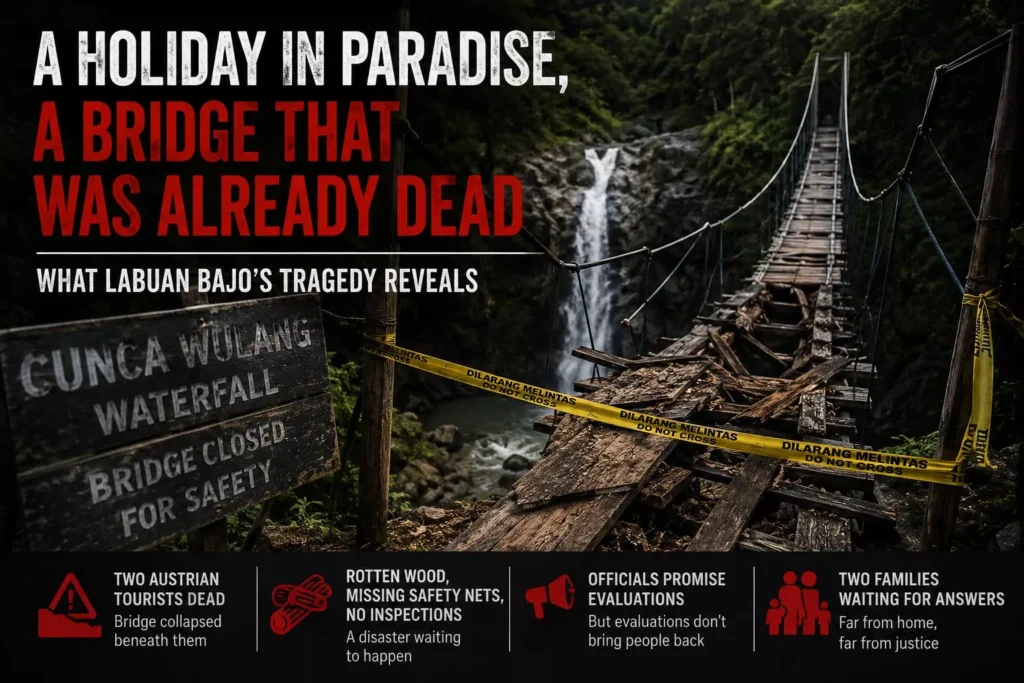
They arrived smiling. They asked their guide to film them crossing the bridge. They wanted to remember the moment.
The bridge collapsed beneath them. And within seconds, a holiday in paradise became a death scene.
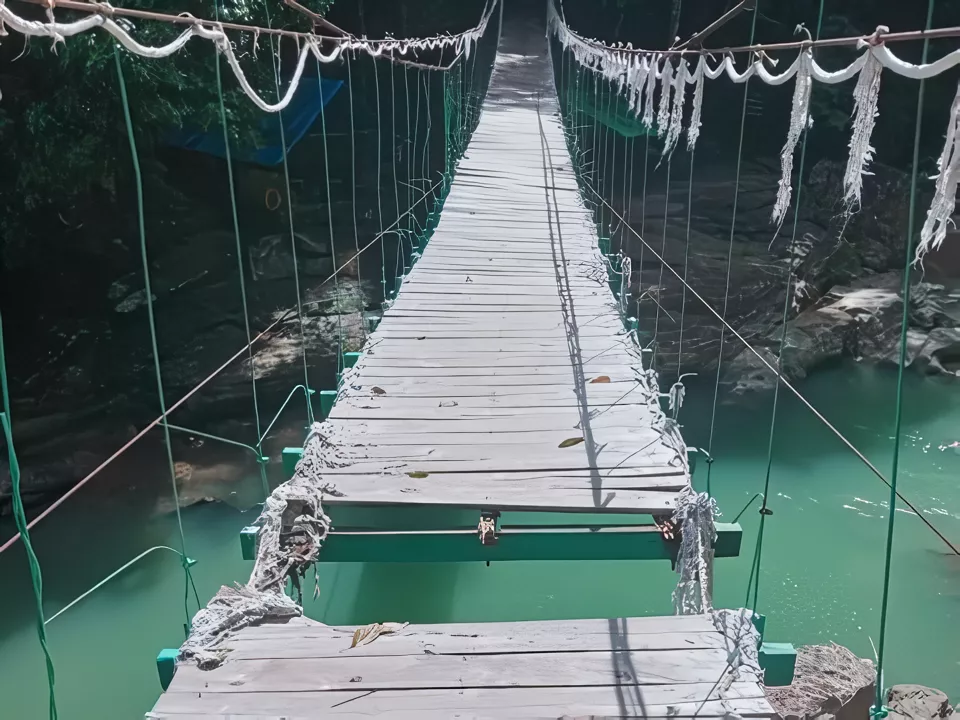
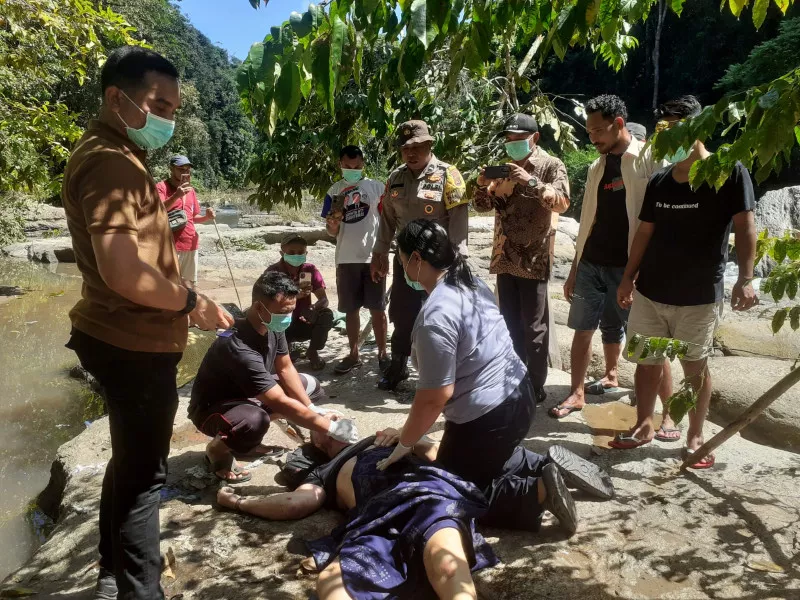
Jurgen Perjul (55) and Astrid Perjul (57), a married couple from Austria, died on Sunday, May 24, 2026, after falling approximately 20 meters onto large rocks at Cunca Wulang waterfall in Labuan Bajo. The wooden suspension bridge — the only access to the popular inland attraction — gave way as they walked across it.
Their tour guide watched them fall. He ran back to the ticket post for help. But there was nothing anyone could do. Both died at the scene.
In the days that followed, police revealed what should have been known long before the couple ever bought their plane tickets.
The bridge’s wooden support beams were rotten. The safety nets on both sides were nearly 90 percent missing. There was no written inspection schedule. No warning signs. No accident insurance for visitors. No standard operating procedure for maintenance.
And two Austrian tourists fell through a hole in the floor.

The Gap Between Marketing and Maintenance
Labuan Bajo is promoted as a “super priority” destination — Indonesia’s answer to the world’s most sought-after travel experiences. Tourists come for Komodo dragons, pink beaches, and luxury liveaboard cruises. The government has poured resources into branding, infrastructure, and international promotion.
But branding does not hold up a bridge.
The Cunca Wulang waterfall is managed by the West Manggarai Tourism, Creative Economy, and Culture Agency, in partnership with a local community tourism group. It is a 1.5-hour drive from Labuan Bajo — far enough from the main tourist strip to escape daily scrutiny, but close enough to be marketed as an authentic eco-tourism experience.
For years, no one apparently asked: when was the last time someone checked the wood?
After the deaths, police found that question had no answer.

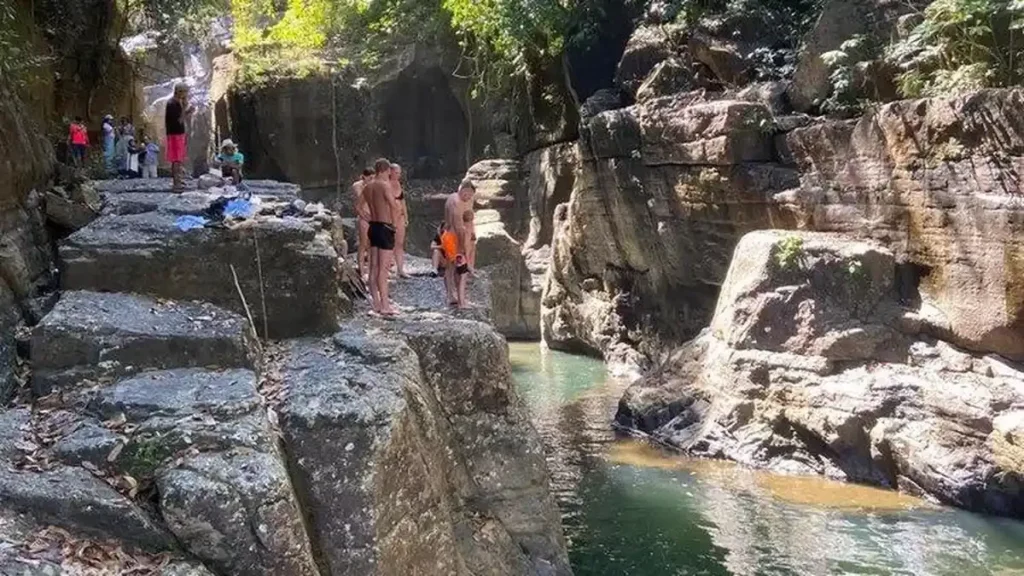
The Witness
Muhamad Muhardin (30), the tour guide, gave a account that haunts.
The couple arrived around 9:20 AM with their private driver. They registered at the ticket post. They trekked toward the waterfall. When they reached the bridge, they handed him their phone.
“They were walking side by side, smiling warmly toward the camera,” he said. “They asked me, ‘Please take a video of us from behind as we cross this bridge.'”
About 10 meters onto the bridge, the planks broke.
“Suddenly, I heard a very loud sound of breaking wood, like a large tree branch falling. Within seconds, the bridge completely collapsed.”
He watched them fall onto the rocks below.
There is no video. The phone was never recovered. The only footage that exists is the one that plays inside Muhardin’s memory.

The Response
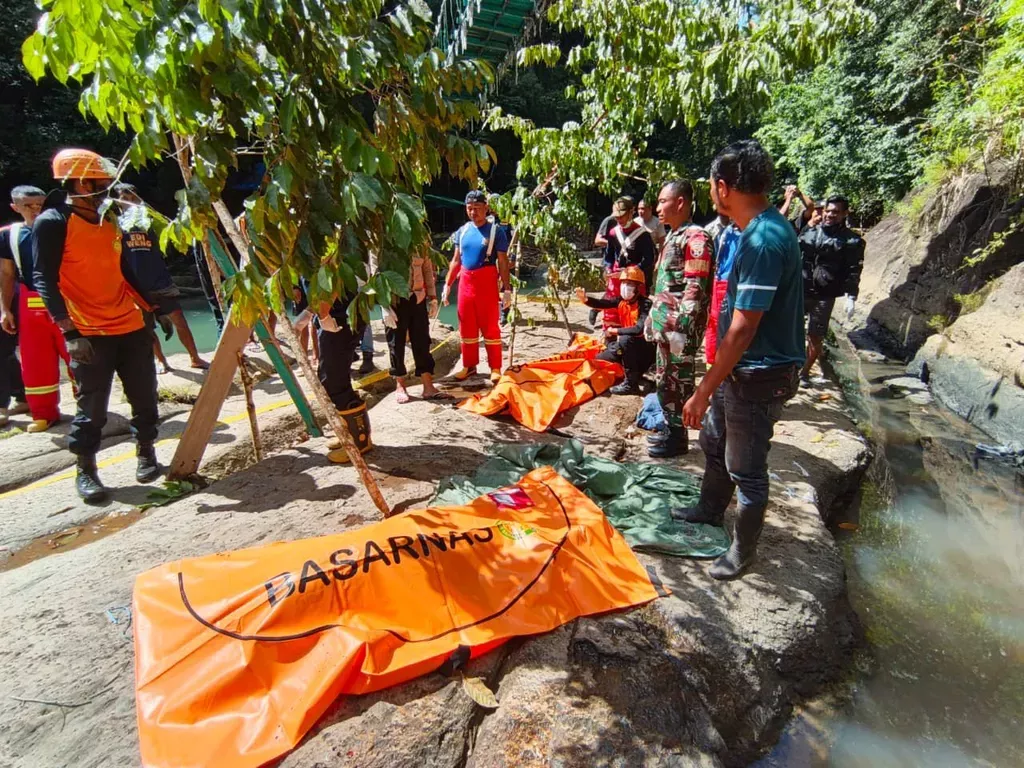
The waterfall has been closed indefinitely. Police are investigating potential criminal negligence against the management. The regional tourism agency has promised a full safety evaluation.
But evaluations do not bring people back from the dead.
The police chief, AKBP Christian Kadang, has also warned the public against sharing graphic photos of the victims’ bodies — a reminder that even in death, the couple has become a spectacle they never chose.
Their bodies are scheduled to be repatriated to Austria. Their families are waiting. And somewhere in the bureaucracy of West Manggarai, someone is probably writing a report about what went wrong.
The report will take weeks. The bridge was rotting for years.
What This Means for Travelers
This is not an isolated incident. Across Indonesia, infrastructure at remote tourist sites is often built with local materials and maintained irregularly, if at all. A bridge that looks rustic can also be unsafe. A trail that feels adventurous can become deadly when rain loosens the soil.
For tourists, the lesson is uncomfortable: you cannot assume that a destination promoted online has been inspected on the ground.
For the tourism industry, the lesson is brutal: one collapsed bridge can undo years of marketing.
For the government, the lesson is unforgiving: a super priority destination cannot afford super priority neglect.
The Silence at Cunca Wulang

The waterfall is closed now. The bridge is cordoned off. The only sounds are the river and the wind.
Two weeks ago, that same bridge carried smiling tourists posing for photographs. Last Sunday, it carried a couple from Austria who asked their guide to film them one last time.
They walked 10 meters onto a bridge that should have been repaired years ago. They fell through a hole in the floor. And they died on rocks at the bottom of a ravine, far from their home, far from their families, and far from any sense that their holiday in paradise would end this way.
Labuan Bajo wants to be a world-class destination. But world-class destinations do not let visitors cross bridges that are already dead.