
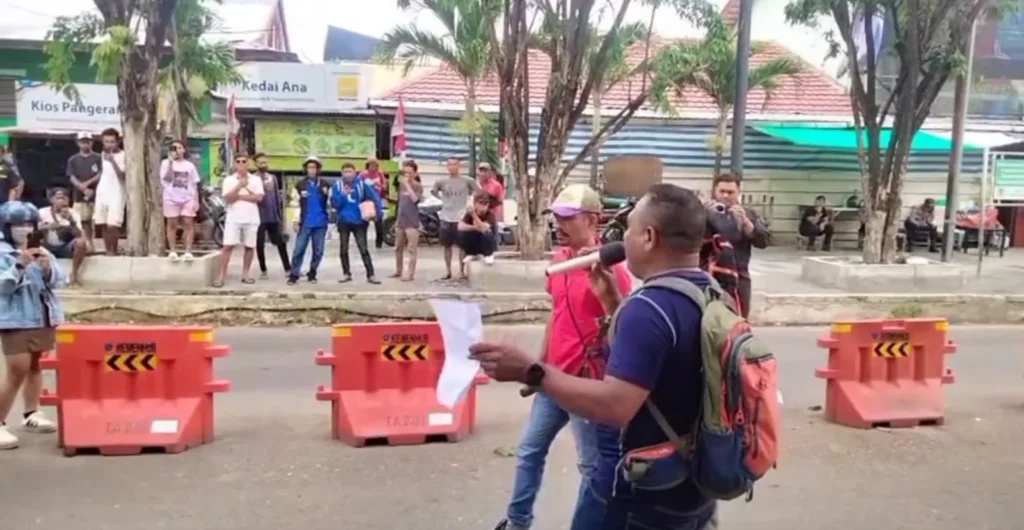
As the search for victims of the KM Putri Sakinah tragedy stalls, local businesses and activists have staged a dramatic protest, alleging systemic corruption within the port authority is paralyzing the gateway to Komodo.
LABUAN BAJO, Indonesia — The scenic Marina Port in Labuan Bajo, the bustling departure point for Komodo National Park, became a stage for public fury on Thursday, January 8, 2026. A protest organized by the Institute for Democratic Society Researchers and Observers laid bare a deep rift between the local tourism community and port authorities, escalating beyond calls for accountability into allegations of an organized “mafia” siphoning millions from boat operators.
Triggered by the sinking of the passenger vessel KM Putri Sakinah, the demonstration has evolved into a broader indictment of KSOP Labuan Bajo, the local Port Authority and Administrative Office. Protesters are now demanding not only legal action but a complete purge of KSOP staff, accusing officials of colluding with an illegal organization to extort boat owners and deliberately engineering a tourism shutdown that has crippled local livelihoods.
From Tragedy to Allegations of Extortion
While initial outrage centered on maritime safety and possible regulatory failures, protesters’ rhetoric has sharpened into specific and damning accusations. One speaker claimed that an “illegal forum,” working in coordination with the head of KSOP, controls all boat operations in Labuan Bajo, charging boat owners IDR 10 million (approximately USD 650) per vessel.
“This KSOP is scum… he is a mafia. He must be removed,” a protester shouted, capturing the mood of the crowd.
Demonstrators demanded that the West Manggarai Police and the East Nusa Tenggara Regional Police immediately name suspects, including the KSOP chief, the ship’s owner, and its crew. According to speakers at the rally, they are responsible for what protesters described as severe damage to the image of tourism in West Manggarai.
A Tourism Shutdown Sparks Fury
Fueling public anger is the continued suspension of tourism activities in Labuan Bajo following the sinking. Maritime tourism operations have remained halted and were most recently extended until January 13, 2026, with authorities citing adverse weather conditions.
Protesters rejected that explanation, framing the closure as a calculated move by actors within the port.
“We demand tourism access remain open, not closed, because this is a scenario created by people at the harbor,” one demonstrator said.
For a town whose economy is overwhelmingly dependent on visitors heading to Komodo National Park, the prolonged shutdown has become an existential threat. Many local workers and small operators say they are bearing the financial cost of decisions made far above them, deepening distrust toward the institutions managing the port.
An Institution Responds, Briefly


Facing mounting pressure, KSOP did not deploy its leadership to address the crowd. Instead, a staff representative offered a short, conciliatory response.
“We are open to all input, criticism, and suggestions for improving the KSOP institution,” the official said. “All institutions have shortcomings. Nothing is perfect.”
The statement did little to ease tensions. Protesters have formally called on the Ministry of Transportation to immediately transfer and dismiss all KSOP personnel they accuse of being part of entrenched corrupt networks within the port system.
At the time of writing, authorities had not publicly responded to the specific allegations of extortion raised during the protest.
A Crisis at the Heart of a Tourism Gateway
The demonstration marks a critical moment for Labuan Bajo, a destination aggressively promoted as Indonesia’s premium marine tourism hub. What began as a maritime tragedy has spiraled into a confrontation over governance, accountability, and trust.
In the narrative voiced by protesters, the community has suffered a double blow: first, the loss of lives at sea, and second, an economic chokehold imposed through what they claim are corrupt practices and opaque operational closures.
The outcome of this standoff will resonate far beyond the marina. It tests whether authorities can restore confidence in a destination where global tourism branding now collides with local allegations of deep-seated malpractice — and whether safety, livelihoods, and transparency can coexist at the heart of one of Indonesia’s most visible tourism gateways.