
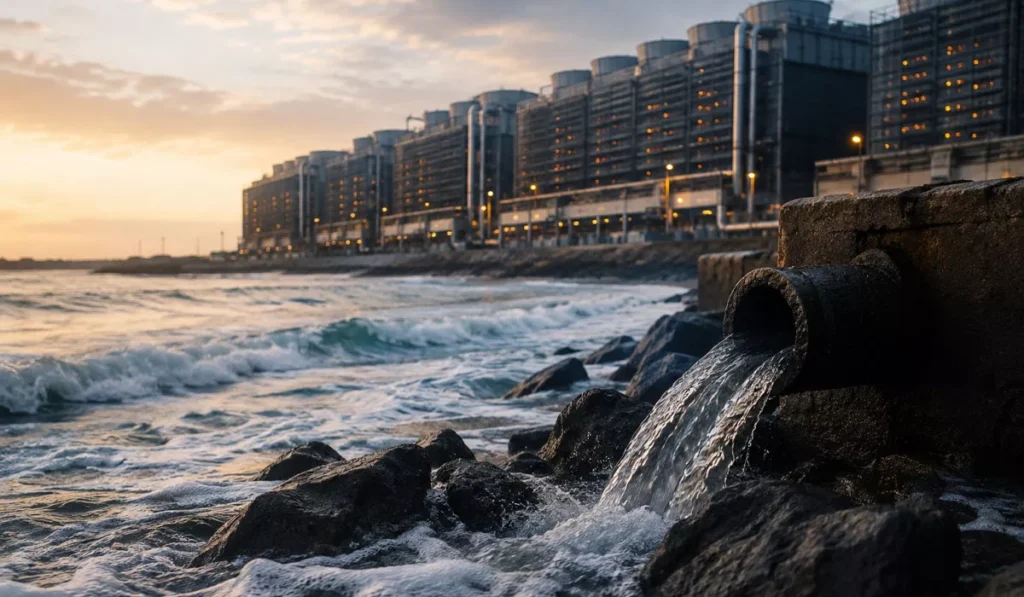
HEYBALI – Most conversations about artificial intelligence’s environmental cost stop at electricity. How much energy does a data center consume? How large is its carbon footprint? Where does the power come from?
But there’s another resource quietly being pulled into the AI race, one that matters far more directly to coastal communities like Bali than most people realize: water.
Behind Every Instant Answer, There’s a Server Running Hot
AI operates digitally, but the infrastructure behind it is entirely physical. Training and running AI models requires data centers packed with thousands, sometimes millions, of computing components running continuously, generating substantial heat that must be removed to keep servers functioning.
One of the most common industry solutions is water-based cooling. But water consumption doesn’t stop inside the server room. There’s direct water use for cooling systems, and there’s an indirect water footprint tied to electricity generation and the manufacturing of hardware components like chips and semiconductors.
So when the question becomes how large AI’s environmental footprint really is, electricity usage alone doesn’t answer it. The more complete question is: how much water does it take to keep the entire system running?
A Number Worth Pausing On
A study published in 2026 estimated that AI’s global water footprint could reach somewhere between 4.2 and 6.6 billion cubic meters annually by 2027. The figure remains a projection with real uncertainty, but the scale alone illustrates a problem that’s becoming harder to dismiss: AI’s growth doesn’t just demand more computers, it demands more physical resources to keep those computers operating.
What’s less obvious is that AI’s water footprint doesn’t always show up where users actually type their prompts. A data center might sit in one location while its associated water consumption stems from power plants and hardware supply chains located somewhere else entirely, meaning the true footprint often extends well beyond the data center’s physical footprint.


When Seawater Starts Looking Like a Solution
That raises a different question entirely: what happens when a data center is built in a coastal area with limited access to fresh water?
One answer the industry has begun exploring is using seawater as part of the cooling process, sometimes combined with desalination technology. On paper, the idea sounds elegant. Seawater is abundant, and desalination can produce fresh water as a byproduct while cooling the facility.
But there’s a word that can’t be skipped over: waste.
Desalination doesn’t just produce fresh water. It also generates brine, a highly concentrated saline byproduct. If its disposal and dispersal aren’t carefully managed, the resulting changes to local water conditions can place serious pressure on marine ecosystems near the discharge point.
In other words, using seawater doesn’t automatically make a data center environmentally friendly. The technology can be part of a solution, but design, location, energy consumption, water intake volume, discharge temperature, and brine management all still have to be accounted for.
A Bali-Based Environmental Advocate Weighs In


Patrick Nasution, an environmental advocate based in Bali, argues this conversation shouldn’t stop at debates over how many megawatts AI consumes. He believes there’s a broader ecological dimension that deserves far more public attention.
“We’ve been so focused on calculating how much electricity AI needs that we’ve forgotten electricity isn’t the only resource being consumed. AI requires water for cooling, land for data centers, materials to build its infrastructure, and when that infrastructure sits in coastal areas, its interaction with the ocean has to be factored in too,” he said.
According to Nasution, the deeper issue emerges when a technology’s benefits are global while its ecological costs are concentrated in specific places. “The real question is who benefits from AI and who bears the ecological cost. Someone elsewhere in the world can get an AI response in seconds, while communities near the data center are the ones directly facing pressure on their water, energy, land, and ecosystems,” he said.
He closed with a pointed reminder about the broader narrative surrounding the technology. “We shouldn’t call AI the technology of the future if building that future means consuming resources that should have been passed on to the next generation. The question isn’t just how intelligent AI is, but how much the earth has to pay to keep it running.”
The Ocean Isn’t an Unlimited Reservoir
This matters most acutely for coastal regions. Picture a large-scale data center built near the shore: the location is strategic, seawater is available, energy infrastructure is in place. From a business standpoint, it might look ideal.
But from an environmental standpoint, that’s precisely where the real list of questions begins. How is the seawater extracted, and in what volume? How is heat from the cooling system released back into the environment? What happens to the high-salinity water produced through desalination? How much additional energy does the entire process require? And most critically, what effect does all of this have on the surrounding marine ecosystem?
These questions carry particular weight for a place like Bali, where daily life and the tourism economy alike depend heavily on the health of coastal and marine ecosystems. The ocean here isn’t simply an alternative water source. It’s habitat, livelihood, and a foundational part of the ecological system that sustains coastal communities across the island.
AI Lives on a Screen, But Its Impact Lives on Earth
When someone types a question and receives an answer within seconds, the entire exchange feels like it happened somewhere abstract, floating in “the cloud.” But there is no cloud in the physical sense.
There’s a building. Servers. Chips. Cables. Electricity. Cooling systems. Water. And in certain cases, a direct link to marine resources and the ecosystems surrounding them.
Measuring AI’s success shouldn’t stop at how fast a model responds or how many people use it. There’s a more important question underneath: how much of the planet’s resources does it take to produce a single answer on our screens? As billions of people begin using AI daily, that question stops being a technology issue and becomes an environmental one, and for Bali, an environmental issue tied directly to the coastline the island depends on for its survival.