
Analysis & Opinion | By Giostanovlatto | December 5, 2025
The Beautiful, Dangerous Paradox of Bali AI
Most tech blogs will tell you that Bali AI is a clean, seamless upgrade to paradise. They imagine algorithms quietly perfecting your holiday—curating your plans, predicting your needs, and shaping an island built on convenience. It’s a story polished for digital nomads and startup founders.
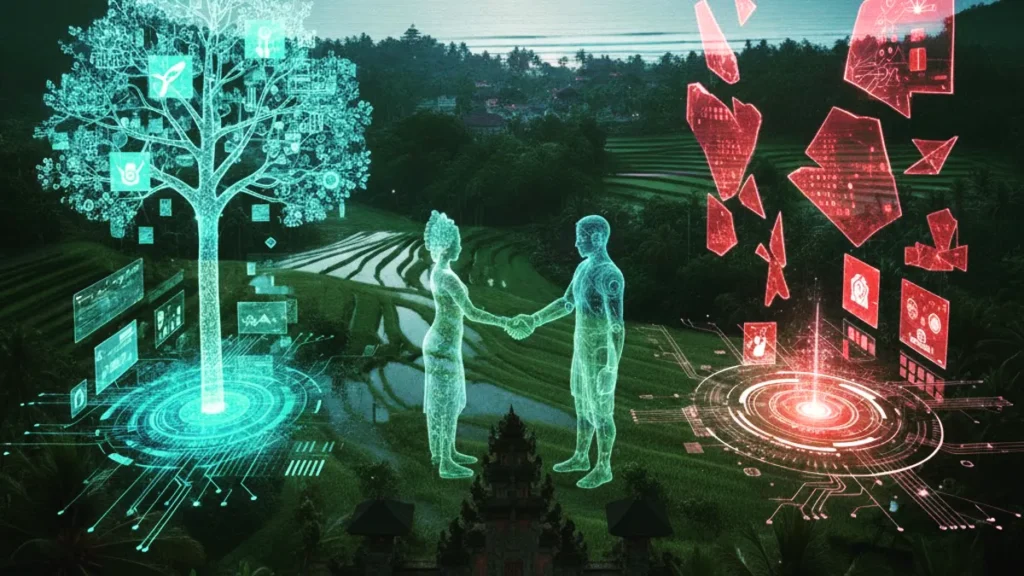
The truth is far less comfortable. Bali has become the world’s most scenic laboratory for a powerful duality. For every moment of brilliance AI creates here, it also builds new opportunities for exploitation. The island isn’t simply adopting artificial intelligence; it’s testing the limits of what humans can control and what they can lose.
Imagine this: an AI concierge in Ubud books your sunrise trek, suggests a hidden warung that fits your dietary needs, and arranges a spa session before you even finish your morning coffee.
Now flip the coin. The same intelligence can conjure a fake cliffside villa, mimic your landlord’s voice, demand a “last-minute security deposit,” and drain your money before you realize something is wrong.
This is not fiction. It’s the daily reality shaping Bali’s digital landscape. The very tool that promises convenience also fuels an ecosystem of highly personalized scams.
Bali is the perfect petri dish. A constant turnover of global visitors, a community of long-term expats, and local businesses rushing toward AI solutions create a dense, high-value digital economy. From luxury resorts to family-run warungs, everyone is adopting AI simply to keep up.
But here’s the gap that rarely gets mentioned: the dark side evolves much faster than the island’s capacity to regulate it. New tools arrive quickly; guardrails almost never do. We welcomed a powerful guest to the island and forgot to define the house rules.
This guide isn’t here to panic anyone about technology. It’s here to map the reality—what works, what breaks, and how you can navigate Bali’s AI era with clarity instead of blind trust. The age of naive digital comfort is finished. Welcome to the dual reality of Bali AI.
How AI Is Quietly Reshaping Bali’s Tourism Machine
Most visitors notice Bali changing through new cafés, fresh hotels, or cleaner roads. But the real transformation is happening silently—inside the algorithms that now shape almost every part of a trip. Bali AI isn’t futuristic or flashy. It works in the background, predicting needs and optimizing decisions long before travelers make them. This quiet shift is already rewriting how tourism operates across the island.
A. Accommodation & Hospitality: The Algorithmic Concierge
Fixed room rates are disappearing. Dynamic pricing systems track global flight demand, weather shifts, public holidays, and even browsing behavior to adjust villa prices by the hour. What looks like a lucky discount is usually a data-driven calculation.
Some properties are testing facial recognition for check-ins, and occupancy models are predicting staffing needs weeks ahead. The upside is efficiency. The downside? A stay that feels more engineered than welcomed.
B. Food, Wellness, and Predictive Service
Restaurants and wellness operators increasingly rely on machine learning. Menu engineering tools analyze sales patterns to decide which dishes stay or go. Demand-forecasting predicts peak dining hours with surprising accuracy, reducing waste and long waits.
Spas and wellness platforms match guests with therapists based on past preferences and review history. It’s smooth and convenient, but it also reduces the thrill of human recommendation and serendipitous discovery.
C. Mobility: Smarter Routes, Higher Stakes
Ride-hailing in Bali is now powered by routing AI that processes real-time traffic, road closures, and accident heatmaps. Some platforms are exploring risk-scoring models that categorize trips by safety levels. The intention is protection; the trade-off is a system that remains opaque and hard to question.
Where Humans Feel the Pressure


While AI boosts efficiency for owners, there’s a quieter shift happening on the ground. A senior concierge in Legian wonders if his decades of local wisdom matter when guests prefer automated suggestions. A tour guide in Ubud questions whether his storytelling can compete with AI-generated narratives.
Bali’s service culture—rooted in intuition, hospitality, and relationship-building—is facing a new era where data often speaks louder than human judgment.
The change is smooth, fast, and largely invisible. It’s making Bali more efficient and profitable, but also redefining the soul of service in ways the average traveler rarely sees.
The AI Fraud Epidemic: When Convenience Turns Into a Weapon
As Bali embraces AI to make travel smoother, a parallel ecosystem is evolving in the shadows. The same tools that help you book a driver or villa are now being used to build scams that feel personal, urgent, and incredibly believable. Fraud in Bali isn’t random anymore—it’s engineered, automated, and scaled by artificial intelligence.
A. Deepfake Villas: Beautiful, Convincing, and Not Real
AI image generators can create flawless villa photos—sunset pools, minimal interiors, rice field views—that never existed. Scammers combine these with AI-written villa descriptions and chatbots that respond instantly, making every part of the listing feel legitimate. By the time you find an empty lot at the “address,” the money is long gone.
B. Voice Cloning: The Most Dangerous Scam on the Island
Scammers now use voice-cloning tools to mimic hosts, hotel staff, or officers. A familiar voice calls, asking for an urgent security deposit or “late check-in fee.” The emotional authenticity bypasses logic, making this one of the most successful forms of AI fraud in Bali.
C. Fake Payment Pages That Look Perfect
LLMs generate professional payment pages that imitate banks, global platforms, or rental services. The logos, layout, and security badges look real. You pay; the confirmation looks valid—and the funds disappear into a criminal network. These pages are mass-deployed during high season.
D. Identity Theft Through Routine Check-ins
Sending a passport photo over WhatsApp or a villa’s web form seems harmless. In reality, bots scrape unsecured data. Stolen documents can be used for financial fraud, synthetic identities, or sold on dark web marketplaces. What starts as a check-in becomes a long-term risk.
E. Chatbots Masquerading as Human Operators
Fraud bots on WhatsApp and Telegram now speak like real staff. They answer questions, send photos, and apply booking pressure—automated end to end. Cheap scooters, last-minute villas, fake visa help—if it sounds too convenient, it probably is.
Why Bali Is a Global Test Bed for AI Fraud

Bali’s digital habits create the perfect storm:
• High-trust, high-frequency payments: Tourists often pay people they’ve never met.
• Constant app-switching: Seamless fraud interfaces blend into the chaos of Gojek, Grab, WhatsApp, Booking.com, and local apps.
• “Vacation Brain” vulnerability: People are relaxed, distracted, and eager to trust.
• Large international flow: Scammers can target every nationality with tailored AI scripts.
The island’s convenience-driven digital lifestyle has become a playground for AI-assisted deception. Bali isn’t just upgrading with AI—it’s confronting the darker version of its own innovation curve.
The Bali AI Paradox: Why We Love the Tool But Fear Its Teeth
There’s a growing contradiction shaping the way people experience Bali AI today. Travelers rely on the island’s digital tools more than ever, yet many also fear the very technology they now depend on. This tension sits at the center of how visitors, expats, and digital nomads interact with AI in Bali, and the data makes the split impossible to ignore.
The Love Affair: AI as the Perfect Island Assistant
Around 80 percent of travelers say they enjoy using Bali AI tools to build itineraries, translate menus, adjust schedules, or predict the best time to visit a temple. These systems turn the overwhelming choices of Bali into something calm, curated, and personal. People happily share their preferences, locations, and browsing habits because the trade-off feels worth it.
In a place known for hospitality, AI becomes an extension of that warmth—a digital concierge that anticipates what you need before you say it.
The Fear: When the Same System Turns Predatory
But beneath that comfort is a growing unease. Many travelers now cite AI-powered scams as their top digital concern in Bali. Over 40 percent have deleted or abandoned local apps due to fear of deepfake fraud, fake payment pages, or voice-cloned “hosts.”
This is the dark side of AI in Bali: the same intelligence that helps you find a hidden warung can also forge a payment request that feels urgent and real. The technology we welcome for convenience becomes the thing we least trust.
Why the Paradox Feels Sharper in Bali
The contradiction isn’t only technical—it’s cultural and psychological.
- The Trust Default
Bali’s social warmth conditions visitors to trust people quickly. That trust spills into digital interactions. A WhatsApp message from a “friendly contact” feels credible here, even when it shouldn’t. - The Sensory Overload Drop
Between traffic, ceremonies, beaches, heat, and jet lag, mental bandwidth shrinks. This creates the perfect opening for AI-generated scams that feel personalized and timely. - The Platform Jungle
Most travelers juggle an exhausting mix of apps: Gojek, Grab, WhatsApp, Traveloka, Booking.com, and dozens of villa sites. In this clutter, a fraudulent link doesn’t stand out. It just looks like one more notification in the Bali digital routine.

The Unspoken Trade-Off
This is the heart of the Bali AI paradox:
We trade caution for convenience. We know the risks, yet we rely on the tools anyway because they make the island feel easier and more inviting.
The next era of AI in Bali isn’t about adding more features. It’s about building trust—ensuring that the same intelligence designed to guide travelers is also built to protect them.
Until that shift happens, everyone on the island is stuck in the same uneasy rhythm: enjoying the benefits of AI while keeping one eye open for its teeth.
Why Bali Became the Perfect Breeding Ground for AI-Powered Fraud
To understand why Bali AI fraud grows faster here than in most destinations, you need to look beyond the technology and examine the island’s unique operating environment. Bali isn’t unsafe. It’s simply structured in a way that gives AI-driven scams plenty of room to operate. Three core conditions make AI in Bali unusually effective for both convenience and exploitation.
1. Warmth and Trust: Bali’s Cultural Strength Becomes a Digital Weakness
Bali’s hospitality creates a default sense of comfort. Travelers trust drivers, villa hosts, and local vendors almost instantly. That same trust often carries into the digital space.
In this mindset, an urgent WhatsApp message from a “host” requesting a deposit feels normal rather than suspicious.
Scammers using Bali AI tools don’t just mimic interfaces—they mimic the tone, friendliness, and cultural cues that visitors already associate with the island. The result is an emotional vulnerability disguised as island openness.
2. A Constant Supply of New, Uninformed Targets
Millions of new arrivals cycle through Bali each year. This creates the perfect environment for AI-driven fraud because:
• Every week brings a fresh wave of people unfamiliar with Bali’s digital norms.
• Travelers are busy handling visas, check-ins, SIM cards, scooters, and money exchanges.
• Vacation mode lowers critical thinking and speeds up decision-making.
By the time a fraud alert spreads, the victims have flown home. The next group arrives with no context. Bali AI scams don’t need to evolve often—each batch of tourists is new to them.
3. A Fragmented Tourism System With No Unified Security Standard
Bali’s tourism economy isn’t centralized. It’s a patchwork of luxury hotels, homestays, tour guides, scooter renters, freelance drivers, and villa owners—each using different platforms, payment systems, and verification processes.
One business uses encrypted check-in systems.
Another sends passport requests over personal WhatsApp.
A third uses a DIY booking site with no security layer.
For AI scammers, this fragmentation is a gift. They can imitate any tier of the ecosystem—from professional to informal—without raising suspicion. Visitors already expect inconsistency. AI in Bali exploits this expectation.


The Combined Impact
These three conditions create a self-reinforcing cycle:
• A trusting culture lowers digital defenses.
• The constant turnover ensures an endless pool of unaware victims.
• Fragmentation creates hundreds of entry points for fraud.
Then AI acts as the accelerant—scalable, fast, hyper-personalized.
This is why Bali AI fraud isn’t just about “scammers getting smarter.” It’s a structural challenge born from the same qualities that make Bali beloved: openness, chaos, charm, and diversity.
Fixing the problem isn’t just about stronger apps or better police reports. It requires a new digital trust framework for a destination built on human trust.
The Regulatory Void: Bali’s Missing AI Rulebook
Bali’s adoption of AI is accelerating, but the rules governing it haven’t caught up. While the island enforces detailed regulations around culture, land use, environmental protection, and animal welfare, AI in Bali operates in a near-total vacuum. The result is a digital landscape where innovation grows fast but oversight barely exists.
What Bali Regulates—And What It Doesn’t
Bali is meticulous when protecting what it values: temple zones, coastal setbacks, environmental waste rules, foreign-owned business structures, and even how sacred monkeys are managed.
But for Bali AI, there are almost no guardrails:
• No standards for AI security or authentication
• No data protection protocol for passport scans or guest IDs
• No mandate for fraud-detection systems
• No clear liability when AI-generated scams deceive travelers
Everything—from how a villa chatbot handles your data to how payment links are shared—is left to individual ethics.


The Accountability Black Hole
This regulatory gap creates unresolved questions:
Who is responsible when Bali AI scams succeed?
Is it the villa owner who used unsecured tools?
The booking platform that failed to detect fake listings?
The payment gateway?
Right now, the answer is simple and troubling: the victim absorbs the loss.
Should Bali develop its own AI standards?
Europe already has the EU AI Act. Tech-forward regions are developing sector-based AI rules. Bali, as a global tourism hub, may need its own hospitality-focused AI guidelines instead of waiting for national regulation that evolves slowly.
Where does AI fit within Balinese values?
Local academics argue AI should be guided by Tri Hita Karana—technology that creates harmony, not harm. But this remains a philosophical aspiration, not enforceable policy.
The Temporary Safety Net
With no Bali AI regulation, protection relies on three fragile pillars:
• Tourist vigilance
• Ethical choices of local businesses
• Platforms reacting only after fraud occurs
This is not a sustainable model for an island that depends heavily on trust and seamless digital interactions.
Why Regulation Matters Now
Regulation isn’t about slowing down AI; it’s about building the guardrails that allow Bali AI to grow safely. Without clear rules on data security, identity verification, platform accountability, and AI ethics, the risks fall disproportionately on travelers—the group least prepared to absorb them.
Until Bali creates standardized protections, every digital interaction carries an invisible risk premium. The island needs a framework that protects visitors, empowers businesses, and aligns with Bali’s values—so AI becomes a tool for harmony instead of a weapon for exploitation.
The Local Innovators: Bali’s Quiet Rebellion in the AI Era
While headlines often focus on scams and regulatory gaps, an equally important story is unfolding beneath the surface: Bali AI is also being built from the ground up by the island’s own innovators. Instead of copying Silicon Valley, these creators are adapting AI to Bali’s particular culture, problems, and rhythm. It’s less about futuristic hardware and more about solving everyday frictions that global platforms overlook.
A. Hospitality Tools Built for “The Bali Context”
Local developers are creating AI tools tailored to the island’s fluid, ceremony-driven routines and fragmented tourism landscape:
• Concierge systems trained on Balinese calendars, warung recommendations, and changing beach conditions
• Cultural-translation tools explaining temple etiquette or bargaining norms—something generic translators miss
• Fraud-screening tools designed for small villa operators who need protection without enterprise budgets
This is AI in Bali that respects nuance instead of flattening it.


B. The Digital Nomad Labs of Canggu & Ubud
Coworking hubs are becoming testbeds for practical AI adoption. Some use automated scheduling to balance deep-work sessions with networking events; others run community platforms that match members based on skills and interests. These systems form an invisible AI layer that gives Bali its reputation as a global remote-work capital.
C. Small-Scale AI for Public Good
Beyond tourism, early-stage pilot projects hint at a more civic future for Bali AI:
• Waste-sorting models for better landfill management
• Traffic prediction systems for Ubud and Seminyak
• Crowd-flow analytics for temples and beaches to preserve capacity
These experiments may be modest, but they’re grounded in urgent, real problems.
Why This Local Innovation Matters
Bali offers a rare “sandbox”: constant global user feedback, agile local businesses, and a culture that adapts quickly. This lets new ideas be tested, refined, and deployed faster than in most cities.
A concrete example is emerging in North Bali. The Buleleng Regency Tourism Office is developing its official “Visit North Bali” app into an AI-powered chatbot. This public-sector initiative aims to move beyond static information, offering tourists dynamic, automated responses about destinations, accommodations, and creative economy MSMEs, with plans for a built-in booking engine. This government-led effort shows AI in Bali being harnessed for public good—to streamline official information and enhance the visitor experience from a trusted source.
These homegrown efforts form an important counterbalance to Bali’s AI fraud problem. They show that artificial intelligence in Bali doesn’t have to be extractive or dangerous. It can also be community-driven—strengthening hospitality, protecting visitors, and supporting local livelihoods.
The challenge now is ensuring that these innovations survive the noise: the scams, the regulatory vacuum, and the unchecked proliferation of unsafe AI tools. If Bali can protect its innovators, it has a chance to shape an AI future that feels uniquely its own.
The Bali AI Survival Guide: Your Essential Digital Self-Defense Checklist
AI in Bali brings convenience and risk in equal measure. Think of this as your practical, no-nonsense protection guide—built for tourists, expats, and digital nomads living inside Bali’s fast-moving AI ecosystem.
Phase 1 — Before Flying to Bali: Secure Your Digital Base
• Update everything. Install system updates, use a VPN, and run a reputable security app.
• Fix your passwords. Use a password manager + 2FA via an authenticator app.
• Protect your identity. Tell your bank you’re traveling; use virtual cards for online bookings.
Phase 2 — Booking in the Era of Bali AI (Spot the Fakes)
• Reverse-search villa photos. AI-generated images often appear on multiple unrelated sites.
• Check the digital footprint. A real villa or operator appears on Maps, social media, guest tags, or recognized platforms.
• Demand a live video tour. This remains the most reliable anti-scam filter.
Phase 3 — Payment: Where Most Bali AI Scams Happen
• Inspect the URL. Must be https:// with correct spelling.
• Favor credit cards. Never send deposits via crypto or direct transfers to unknown accounts.
• Stop when unsure. Fraud signals include sudden redirects, mismatched domains, or pressure messages.
Phase 4 — On the Ground in Bali: Stay Alert
• Beware unsolicited WhatsApp deals. AI bots impersonate hotels, villa hosts, and drivers.
• Watermark your passport scan. Add “For Villa X Only – [Date]” to reduce identity misuse.
• Know who to call:
Tourist Police: +62 361 224 111
Your Embassy: For passport / identity issues.
The New Travel Mindset
This checklist isn’t about fear—it’s about digital awareness. Bali AI can enhance your trip, but only when you pair convenience with deliberate caution. In this environment, your smartest travel skill isn’t picking the right villa—it’s recognizing what (and who) to trust.
Three Futures for Bali AI: Choose the Direction
Bali is at a turning point. AI in Bali can evolve into a force that strengthens its hospitality—or one that erodes it. The outcome depends on how businesses, travelers, and policymakers respond today. These are the three most plausible paths.
Future 1: The Bali AI Ethics Seal
A trust-first model emerges. Bali creates a voluntary but respected AI Ethics Certification for villas, hotels, and operators that meet strict standards in data protection, transparent AI use, and anti-fraud protocols.
Impact:
• Global booking platforms highlight certified listings.
• Travelers choose Bali for verified digital safety.
• Local tech firms attract new investment.
• Bali becomes a global example of responsible tourism AI.
This future turns the current Bali AI risk into a competitive advantage built on trust.
Future 2: The AI Hygiene Rating
If regulators move slowly, the market steps in. Independent groups introduce simple AI Hygiene Ratings for tourism businesses—clear A–F grades that show how well an operator protects your data and payments.
Impact:
• Travelers filter listings by safety score, not just price or photos.
• Serious operators improve their AI hygiene to stay competitive.
• Fraudulent listings disappear under the weight of transparency.
This is a consumer-powered future where Bali AI becomes safer through public accountability.
Future 3: The Bali AI Wild West
The current pattern continues: fast adoption, weak safeguards, and fragmented enforcement.
Impact:
• AI scams in Bali escalate.
• Headlines warn travelers about deepfake villas and identity theft.
• High-value tourists choose safer destinations.
• Local businesses pay the price for a damaged digital reputation.
• Recovery becomes slow, costly, and uncertain.
This is the collapse scenario—Bali’s digital trust erodes faster than it can be rebuilt.


The Key Insight: Bali Still Has a Choice
None of these futures are inevitable. The direction of Bali AI depends on decisions made now—whether the ecosystem values long-term trust over short-term convenience.
AI itself is neutral. Its impact on Bali’s economy, culture, and global reputation will come down to how wisely it’s governed.
The clock is already ticking.
Steering Bali’s AI Destiny
AI in Bali is no longer a future concept. It’s already reshaping how people travel, book, eat, and move across the island. The real question isn’t if Bali AI will change the island, but what kind of change it will bring. The same tools that recommend the perfect sunrise spot can also build a flawless deepfake villa scam. That duality is now the defining tension.
This isn’t a fight against innovation. It’s a call for balance. Bali needs an approach where digital convenience is matched with clear safeguards and cultural grounding. The principles of Tri Hita Karana—harmony between people, nature, and the spiritual—offer a reminder that technology must serve the community, not overwhelm it.
The responsibility is shared.
Travelers need smarter digital habits.
Businesses must invest in transparent, secure systems.
Policymakers have to set guardrails that protect without slowing progress.
The goal is simple: guide AI in Bali so the island’s warmth, trust, and human connection aren’t lost in the process.

As Giostanovlatto, Founder of Hey Bali, puts it:
“Bali’s greatest asset has always been trust. AI now tests that foundation. We can let it fracture what makes this island special, or we can build a new kind of trust—verified, transparent, and resilient.”
The algorithms will keep learning.
What they learn next depends on us.