
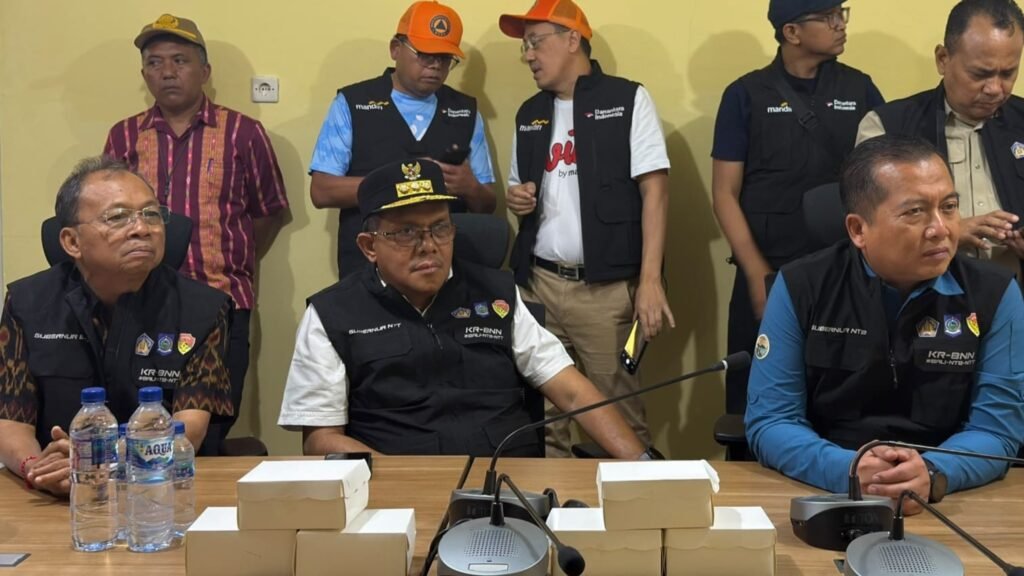
HEYBALI – Some partnerships only prove their worth when tested by crisis. That test arrived this week for Bali, West Nusa Tenggara, and East Nusa Tenggara, when a magnitude 7.7 earthquake struck Flores, and all three provinces’ governors responded not separately, but together.
Bali Governor Wayan Koster and West Nusa Tenggara Governor Lalu Muhamad Iqbal landed directly at Labuan Bajo Airport to assess earthquake damage firsthand. They were received by East Nusa Tenggara Governor Emanuel Melkiades Laka Lena, who has been coordinating recovery efforts on the ground as the disaster’s host province.
Beyond Symbolic Visits
What distinguishes this response from a routine show of political solidarity is what followed the arrival. The Bali and West Nusa Tenggara provincial governments moved quickly in coordination with the Udayana Regional Military Command, deploying medical teams and logistics support while conducting needs assessments for affected residents on the ground.
For travelers and expats who follow Indonesian regional politics loosely, this detail matters: the response translated into concrete field action within days, not just statements of sympathy issued from provincial capitals.
A Cooperation Agreement Signed Months Before the Disaster
Here is the part of the story that adds real depth to what might otherwise look like a routine gubernatorial visit. This rapid, coordinated response was not improvised. Earlier in 2026, the three governors had already signed a cross-sector regional cooperation agreement, part of an initiative known as the “Bali-Nusra Governors Trio.”
The concept is ambitious: positioning Bali, West Nusa Tenggara, and East Nusa Tenggara together as a “Golden Triangle” of growth in eastern Indonesia, built around five complementary development priorities.
Bali, NTB, and NTT as One Tourism Package, Not Competitors
Perhaps the most significant element of this partnership, particularly for anyone planning multi-region travel through Indonesia, is its tourism strategy. For years, Nusa Tenggara Barat and Nusa Tenggara Timur have often been framed as competitors to Bali for the same pool of international visitors. This new framework flips that logic entirely.
Under Indonesia’s national medium-term development plan, the Bali-Nusra region is positioned as a single international tourism and creative economy superhub. Rather than competing for tourists, the strategy actively directs visitors arriving in Bali to continue their journeys onward, toward destinations like the Mandalika Circuit in West Nusa Tenggara or Labuan Bajo in East Nusa Tenggara.
For travelers, this could eventually mean smoother regional itineraries, better cross-provincial transport links, and a coordinated tourism experience spanning all three provinces rather than three disconnected destinations competing for the same visitors.
Four Additional Pillars Behind the Regional Framework
Beyond tourism, the agreement targets interregional transport connectivity, economic clustering and food supply chains, renewable energy transition, and spatial planning designed to protect cultural heritage and environmental capacity across all three provinces.
One of the clearest practical examples involves the supply chain. Agricultural and livestock products from East and West Nusa Tenggara can be channeled directly to support Bali and Labuan Bajo’s hospitality industries, reducing reliance on food imports from outside the region entirely.
A Real-World Stress Test, Passed in Real Time
The Flores earthquake has effectively become the first major field test of this Golden Triangle framework since it was signed. What began as a formal cooperation document has now demonstrated tangible function during one member province’s most significant crisis in years.
For residents of Flores affected by the earthquake, the presence of three governors working in coordination is less about political optics and more about how quickly medical aid, logistics, and psychological recovery support can reach people who need them. So far, this cross-provincial collaboration appears to be functioning exactly as designed on paper, only now under real pressure rather than theoretical planning.