
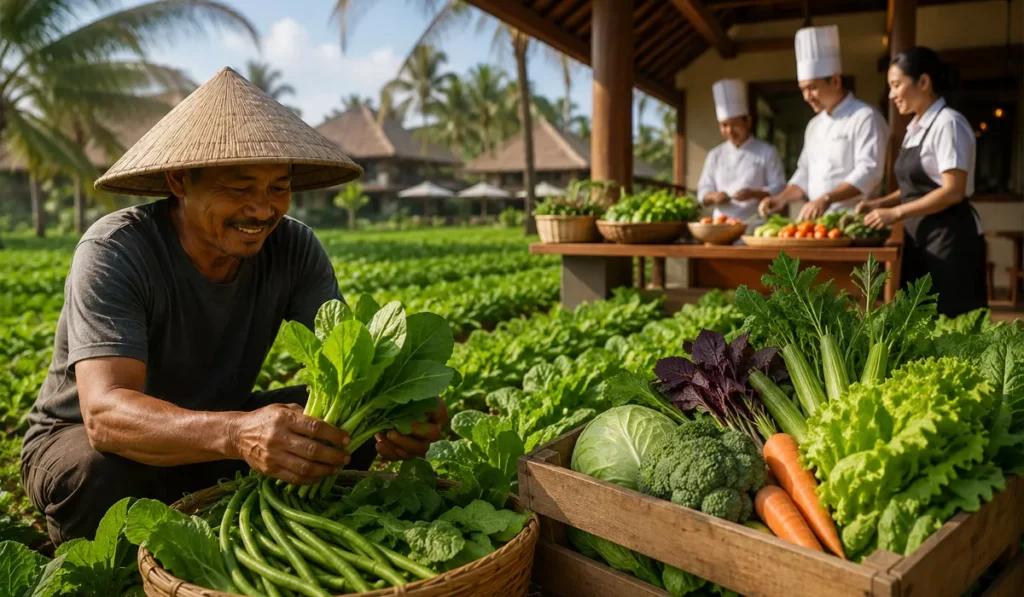
For decades, Bali’s tourism economy and its farming communities have often operated side by side rather than together. Luxury resorts, trendy cafés, and international restaurants serve millions of visitors every year, yet much of the produce on their menus has traditionally come through long supply chains, or even from outside the island.
Now, one of Bali’s busiest tourism regions wants to change that.
The Badung Regency Government, home to tourism hotspots including Kuta, Seminyak, Canggu, Nusa Dua, and Jimbaran, has launched a new initiative aimed at connecting local farmers directly with the island’s hospitality industry, giving hotels, restaurants, and cafés greater access to locally grown food while creating a more stable market for agricultural producers.
Officials believe the strategy could strengthen Bali’s food security, reduce dependence on outside suppliers, and ensure that more tourism spending stays within local communities.
Turning Tourism Into a Reliable Market for Farmers
According to Anak Agung Ngurah Raka Sukadana, Head of Badung’s Agriculture and Food Agency, the tourism industry represents one of the most valuable markets local farmers have yet to fully access.
“Connecting agriculture with tourism is highly relevant because tourism represents a premium market that we have not maximized,” he said on Thursday.
Every day, thousands of hotels, restaurants, cafés, villas, and catering businesses across Badung require a steady supply of fresh vegetables, fruit, herbs, and other agricultural products.
Rather than relying on lengthy distribution chains that can reduce farmers’ earnings, the government wants to build stronger partnerships between agricultural producers and Bali’s hospitality sector, commonly known in Indonesia as HORECA, short for hotels, restaurants, and cafés.
Officials say the closer relationship would create a more predictable demand for locally grown produce while helping tourism businesses source fresher ingredients closer to where they are served.
Solving One of Farming’s Biggest Problems
For many farmers, growing crops has never been the hardest part.
Selling them has.
During harvest season, oversupply often pushes prices sharply downward, leaving farmers struggling to recover production costs despite strong yields.
By creating direct purchasing channels between hospitality businesses and farming communities, officials hope growers will have greater confidence that their harvests already have buyers before crops are even picked.
“Farmers often hesitate because they don’t know whether their products will sell, especially during peak harvest when prices fall,” Raka said. “A stronger partnership with hotels, restaurants, cafés, and supporting businesses can provide greater market certainty.”
Stable demand could also encourage farmers to invest more confidently in quality improvements rather than focusing solely on volume.
Training Farmers for a New Type of Customer
The initiative isn’t limited to connecting buyers and producers.
Badung has also begun training farmers to market their products more effectively in today’s increasingly digital food supply chain.
Thirty participants from farming communities in Petang, Mengwi, and Abiansemal recently joined a government-funded digital marketing program designed to help producers promote local food products and communicate more directly with potential buyers.
Industry practitioners were invited to provide practical guidance on presenting products professionally and using digital tools that appeal to hospitality businesses seeking consistent suppliers.
Officials hope stronger branding, better communication, and improved product presentation will make local produce more competitive, not only within Bali but potentially in national markets as well.
More Than Agriculture
The initiative reflects a broader conversation taking place across Bali about how tourism can generate wider economic benefits beyond hotels and beach clubs.
While the island’s visitor economy continues to grow, policymakers have increasingly argued that sectors such as agriculture, fisheries, and traditional industries should capture a larger share of tourism spending.
For international visitors, the strategy could eventually translate into restaurant menus featuring more locally sourced ingredients, shorter farm-to-table supply chains, and dining experiences that better reflect Bali’s agricultural heritage.
It also aligns with a growing global trend, as travelers increasingly seek destinations that support local producers and sustainable food systems rather than relying heavily on imported products.
Why It Matters
Farm-to-table dining has become a familiar phrase across the world’s leading culinary destinations. Bali already has the farms, the chefs, and one of Asia’s strongest hospitality industries.
The missing piece has often been connecting them efficiently.
If the program succeeds, the island’s tourism economy may begin delivering value far beyond hotels and restaurants, helping ensure that every meal served to visitors also creates new opportunities for the farmers cultivating Bali’s countryside.