
For a few days this week, Indonesia seemed to unite around a single image: a screenshot showing a 23-year-old Indonesian woman turned away from a WhatsApp group because she wasn’t a foreigner. The outrage was swift, understandable, and largely justified. A senator got involved. A national lawmaker weighed in. The Directorate General of Immigration blacklisted two Dutch nationals within 48 hours, an unusually fast response by any government’s standards.
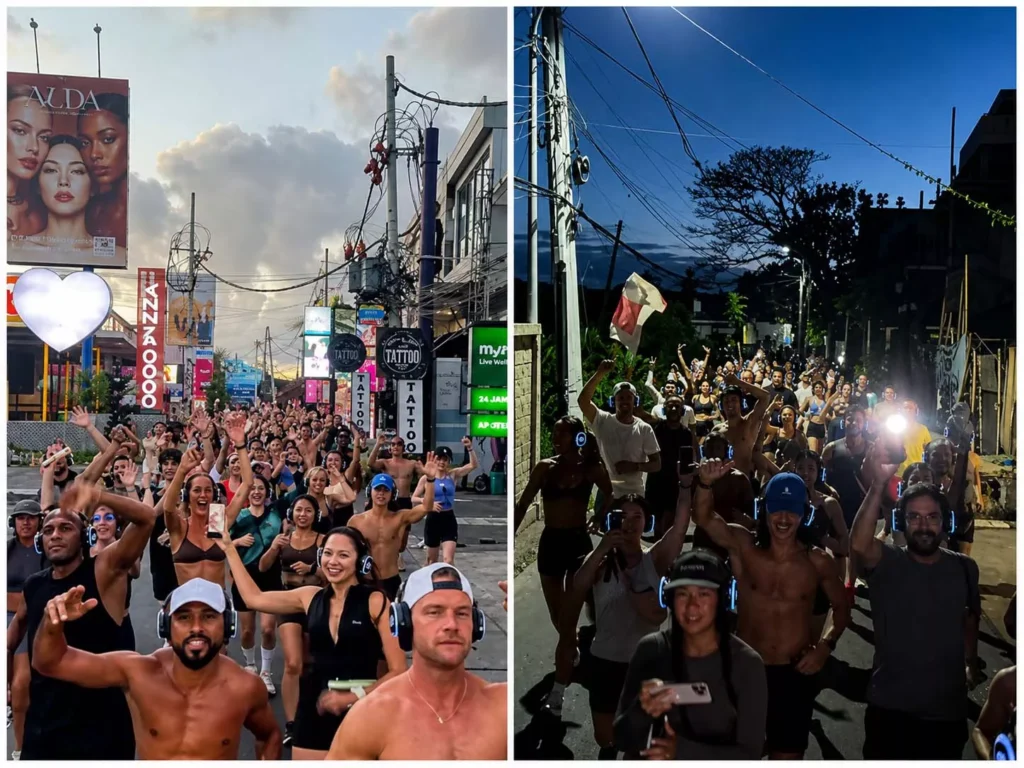
But buried underneath the discrimination story is a far more uncomfortable question that almost nobody in power seems eager to ask out loud: how did up to 150 foreigners run through the streets of Canggu at dawn, week after week, for what appears to have been a considerable stretch of time, without any publicly confirmed permit or coordination with the authorities now saying they were never contacted, until a screenshot finally brought it to the attention of the authorities.
The Quote That Should Worry Bali More Than Any Screenshot
Buried in the coverage is a single line from I Gusti Agung Ketut Suryanegara, head of Badung Regency’s Public Order Agency (Satpol PP), that deserves far more attention than it received. Asked whether his office had been approached by the running club’s organizers, he was unambiguous: “From us, Satpol PP, until now we have never been contacted, let alone given a recommendation.”
Read that again. An event capable of drawing up to 150 people, closing off stretches of public road, with a mobile DJ setup mounted on a vehicle broadcasting music at dawn, ran repeatedly through one of Bali’s busiest expat and tourist corridors, and the agency responsible for public order in that regency says it had no contact with the organizers at all.
This isn’t a story about one WhatsApp group’s registration bias anymore. This is a story about how an activity of that scale and visibility can seemingly not exist, administratively, in the eyes of at least one institution meant to oversee public space, until public outrage forces someone to look.


Discrimination Was the Symptom. The Bigger Question Is What Else Went Unnoticed.
None of this excuses what the screenshots appear to show. Indonesia’s Immigration Director General, Hendarsam Marantoko, was right to call the situation what it looked like: “There should not be a state within a state.” That phrase landed because it captured something real, a foreign-run community operating with its own informal rules on Indonesian soil, seemingly answerable to no one until the internet decided otherwise.
But consider the sequence of events. There is no public indication that road closures tied to the event were formally flagged. There is no evidence that the group’s use of public infrastructure, or the legality of foreign nationals organizing a recurring public event under Indonesia’s immigration rules, was reviewed before this controversy broke. All of that sat visible to anyone passing by, on a public road, at a predictable time, for what participants themselves describe as a recurring weekly fixture, and none of it appears to have triggered an institutional response before this week.
It ultimately took a rejected applicant and a screenshot to do what months, or possibly longer, of plainly visible activity apparently did not.
A Convenient Blind Spot, or a System Genuinely Unequipped to Catch It?
To be fair, Indonesian regulations governing informal community gatherings are not always straightforward, particularly when events begin as small social meetups before gradually attracting hundreds of participants. It remains unclear at what point, legally or administratively, authorities would normally be expected to intervene. That ambiguity, however, only reinforces the need for clearer rules rather than weaker enforcement.
Still, here’s what should genuinely concern anyone who cares about how Bali is governed: this isn’t really about running clubs at all. It’s a pattern. Foreign-organized activities that hum along quietly, visibly, and repeatedly in Bali’s most internationally saturated neighborhoods, Canggu chief among them, until something makes them go viral, at which point enforcement arrives within days, sharp and decisive.
This demonstrates that Indonesian institutions are capable of acting quickly once an issue commands national attention. Immigration identified organizers, traced their permit categories, confirmed their departure through Ngurah Rai Airport, and issued an entry ban within 48 hours. Satpol PP has said it is now “coordinating with the legal department regarding the regulations.” Whether that capacity existed all along and simply wasn’t triggered, or whether genuine regulatory ambiguity delayed any earlier response, is difficult to say with certainty from the outside. What is clear is that meaningful enforcement only became visible after the controversy went viral, not before.

The Next One Won’t Look Like a Running Club
This is the part worth sitting with. If a recurring public gathering of up to 150 foreigners, using public roads, amplified music, and a visible mobile setup, at dawn, week after week, in one of Bali’s most watched neighborhoods, could apparently go unaddressed by at least one permit-related authority until a screenshot forced the issue, what does that suggest about activities that are quieter, smaller, or simply less visible?
The uncomfortable possibility is that whatever comes next, another unlicensed gathering, another foreign-organized activity operating outside its permit category, another informal community quietly establishing its own norms on public land, may follow a similar pattern: existing visibly for some unknown length of time, drawing little formal scrutiny, and only becoming an official priority once it becomes a social media one.
Indonesia’s government reacted well this week: fast, coordinated, cross-agency, from a national immigration chief to a sitting DPR member to provincial police. That is not nothing. But speed of reaction is not the same thing as presence of oversight, and Bali’s institutions have more reason to examine how long this went unaddressed than to take comfort in how quickly it was punished once it became impossible to ignore.
What Actually Needs to Change
The fix here isn’t rhetorical. It’s structural, and unglamorous, exactly the kind of fix that rarely generates a viral moment of its own. Regencies like Badung would benefit from clearer, more consistently communicated rules on recurring public gatherings, and a monitoring approach that doesn’t depend entirely on a village head, a police officer, or a passing local noticing and choosing to report it. Permit requirements for road-based community events need to be publicized clearly enough, and applied consistently enough, that “we were never contacted” stops being, in effect, a routine institutional answer.
Because whatever exactly caused the delay this time, ambiguous rules, overlapping jurisdictions, or simply an absence of proactive monitoring, the pattern itself is the real story. Bali will likely keep discovering problems like this one the same way it discovered this one: after the fact, after it’s already viral, and after the easiest part, holding the people caught on camera accountable, has already been mistaken for solving the thing that let them go unnoticed in the first place.
About the Author
Giostanovlatto Sinantong is the Founder of Hey Bali and a tourism observer who firmly believes Bali is too beautiful to stop asking difficult questions about it.
If this editorial made you smile, thank you. If it made you think, even better. If it made you angry… the comments section has been invented for exactly that.