

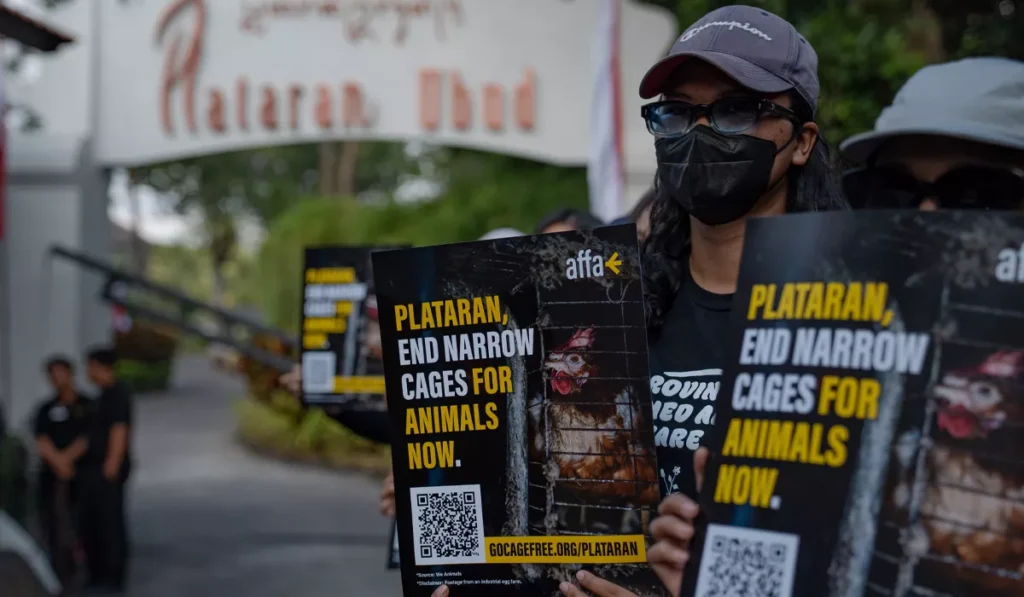
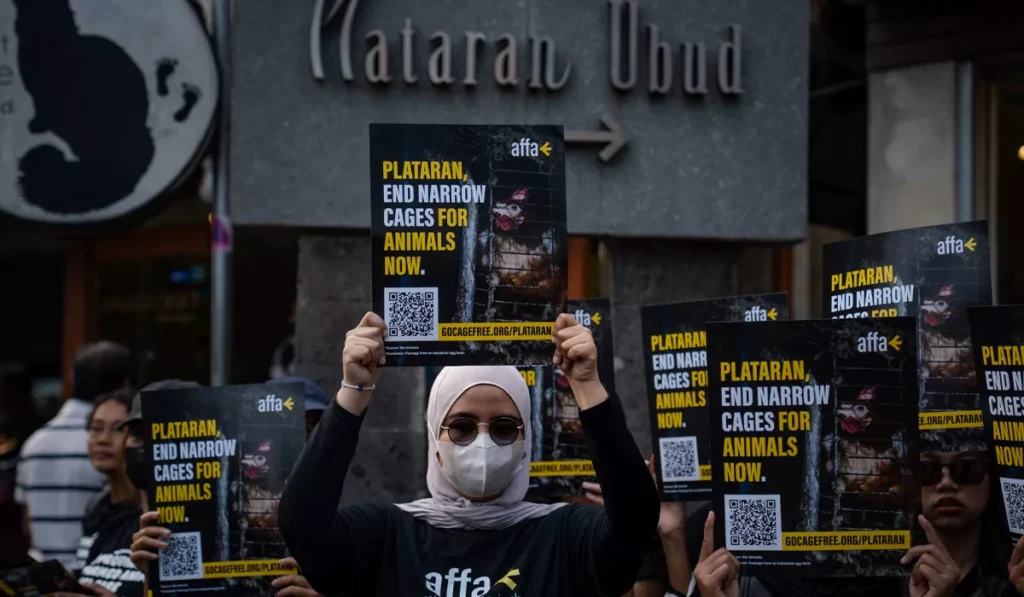
HEYBALI – Outside the manicured entrance of Plataran Ubud on Monday morning, the usual scene of arriving guests and resort staff was interrupted by a different kind of visitor. Around ten activists gathered at the property’s gates, while motorbikes circled the grounds carrying banners with a single, pointed message: stop sourcing eggs from caged hens.
The protest was calm, brief and carefully organized. But it landed on a company that has spent years cultivating an image built on sustainability, conservation and what it calls “Indonesian hospitality with purpose.”
A Month-Long Campaign, One High-Profile Target
Monday’s demonstration was not an isolated event. It formed part of a broader campaign that has seen motorbikes crisscross Bali for the past month, carrying the cage-free message directly to hotels, restaurants and consumers across the island.
Plataran, however, has become a focal point. The group operates a growing network of hotels, resorts, restaurants and event venues across Indonesia and Japan, and has built its brand heavily around nature, heritage and responsible tourism. That is precisely the territory campaigners argue should include how the eggs served to guests are produced.
“We have been reaching out to Plataran since 2024,” said Elfha Shavira, Campaign Lead for Act for Farmed Animals. She said discussions with Plataran stakeholders and lobbying efforts in Jakarta had so far produced no formal cage-free commitment.
What “Cage-Free” Actually Means, and Why It Matters
For visitors unfamiliar with the terminology, the distinction is stark. According to the campaign, Indonesia’s egg industry remains dominated by battery-cage farming, in which laying hens can spend their production cycle in extremely confined spaces, sometimes no larger than an A4 sheet of paper. Campaigners say such confinement prevents hens from performing basic behaviors such as spreading their wings, nesting and dust bathing.
The welfare concerns are not the only issue campaigners point to. They cite a 2019 European Food Safety Authority report on higher Salmonella prevalence in confined cage systems, as well as research from Universitas Gadjah Mada that identified antibiotic-resistant Salmonella in supermarket eggs sourced from small-scale cage-based operations.
A Test Case for “Sustainable Luxury”
This is where the protest becomes bigger than one hotel.
Campaigners are asking what sustainability means once it extends beyond a property’s gardens, energy use and environmental programs and into the supply chain feeding its kitchens.
Shavira cited research from the University of Queensland’s Centre for Animal Welfare and Ethics, which found that the housing system is the second most influential factor after price when consumers choose eggs.
“As a business group operating in Indonesia and Japan that serves the international market, Plataran ought to address this ethical matter,” Shavira said. She also pointed to what she described as a wider shift in Indonesia, saying 110 Indonesian companies had already made cage-free commitments.
The protest ended without a public cage-free commitment from Plataran. AFFA said it would continue pressing hospitality businesses across Bali to address the issue.
For Bali’s steady stream of international travelers, many drawn to the island for its branding around wellness, sustainability and conscious tourism, the question is becoming harder to leave at the hotel lobby door: how sustainable is a luxury experience when the supply chain behind it is still largely invisible?