
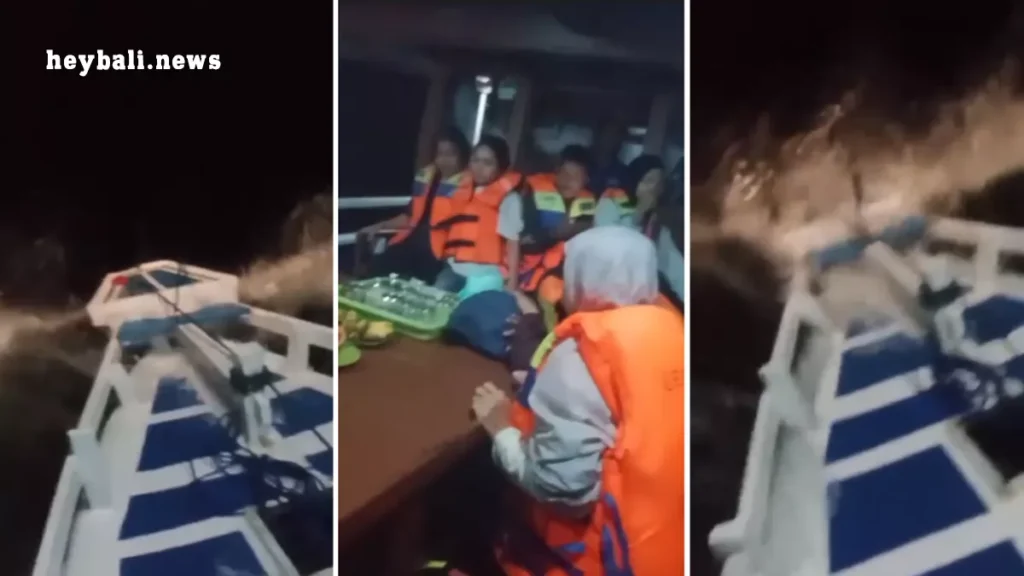
LABUAN BAJO, Indonesia — The traditional wooden pinisi that sank in the waters of Komodo National Park late Friday had passed all required safety checks and departed under what were considered acceptable weather conditions, Indonesian maritime authorities said, pointing to an unexpected surge of powerful swell waves as the likely cause of the accident.
The vessel, Putri Sakinah, went down in the Padar Island Strait on the night of December 26 while carrying Spanish tourists on a routine sightseeing route from Komodo Island to Padar Island. Seven of the 11 people on board were rescued. Four others — all members of the same Spanish family — remain missing.
According to Stephanus Risdiyanto, head of the Labuan Bajo Port Authority, the ship had been officially declared seaworthy and was issued a sailing permit after inspections earlier that day. Weather forecasts at the time of departure showed no immediate hazards that would have prevented the journey.
“Based on the vessel’s seaworthiness and weather conditions that were still considered safe, the sailing clearance was granted,” Mr. Risdiyanto said during a briefing at the Marina Labuan Bajo port command post on Saturday.
He noted that on Friday alone, the port authority approved departures for 189 vessels operating in the Labuan Bajo area. Of those, Putri Sakinah was the only ship to encounter a life-threatening emergency.
“What happened was an exception,” he said. “Out of 189 vessels that sailed, only one experienced a critical incident.”
A Sudden Wall of Water

Investigators now believe the sinking was triggered not by strong winds or heavy rain, but by a sudden swell — large, fast-moving waves generated far from the accident site and traveling long distances across the ocean.
The swell, authorities said, was linked to Tropical Cyclone Seed 96S in the southern Indian Ocean. While the system was still distant from Flores waters, its energy propagated northward, sending powerful waves into narrower island channels like those around Padar.
Wave heights reportedly surged to around 2.5 meters, despite earlier forecasts suggesting seas of less than one meter in the area.
“In Padar Strait, the expected wave height that night should have been around 0.5 to 0.75 meters,” Mr. Risdiyanto explained. “But because of the swell generated by the cyclone system, wave heights could suddenly double or more — though only for short periods. That is what occurred.”
Those brief but violent surges proved enough to overwhelm the vessel.
Weather Warnings, But Limited Predictability
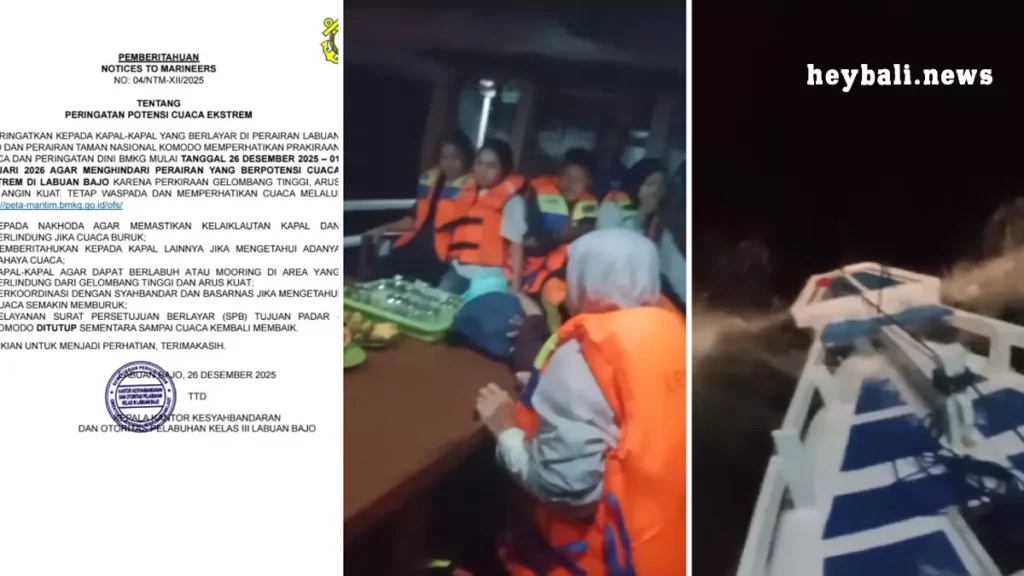
Screenshot of the video of large waves in Komodo and the notification letter from BMKG December 27, 2025
Indonesia’s meteorological agency, BMKG, had previously warned of the potential for higher waves in Komodo waters through December 28. However, officials said the conditions were still assessed as manageable for tourist vessels at the time of departure.
Maria Patricia Christin Seran, head of the Komodo Meteorological Station, emphasized that swell waves are particularly dangerous because they can arrive without local warning signs.
“This was swell — wave energy transmitted from a distant storm system,” she said. “According to reports from Basarnas and port authorities, the wind conditions at the site were not strong. That supports the conclusion that this was not a local weather event.”
She added that when swell waves enter narrow island passages, their height can increase dramatically, raising the risk of marine accidents even under otherwise calm skies.
Rescue Efforts Hampered by the Same Conditions
The unpredictable waves continued into the early hours of Saturday, complicating search and rescue operations. Authorities said swells reaching between two and three meters persisted for short intervals of 30 minutes to an hour, limiting visibility and maneuverability for rescue boats.
The Putri Sakinah sank at approximately 8:30 p.m. local time, about 30 minutes after departing Komodo Island. The ship experienced an engine failure before being struck by the swell, according to preliminary findings.
On board were six Spanish tourists, four crew members, and one Indonesian tour guide. The four missing passengers have been identified as Martín Carreras Fernando, his wife Martines Ortuno Maria Lia, and their two children, Martín Garcia Mateo and Martinez Ortuno Enriquejavier.
Search and rescue teams continue to scour the waters around Padar Island as families, authorities, and the tourism community await answers.
For a region that markets itself as one of the world’s safest and most spectacular marine destinations, the incident is a sobering reminder that nature’s reach extends far beyond visible horizons — and that even certified vessels can find themselves vulnerable when distant storms send their force across the sea.