
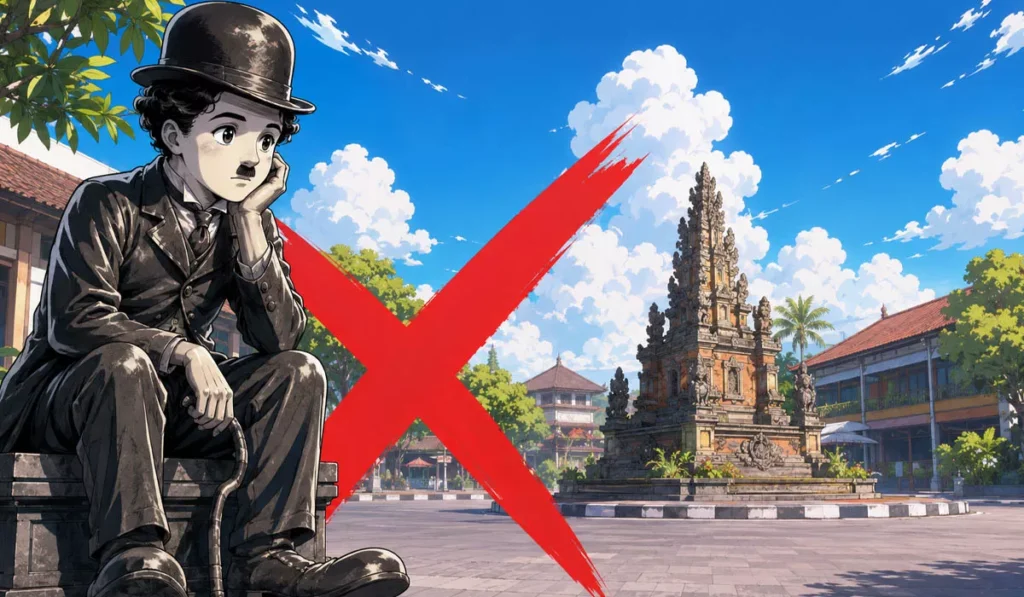
HEYBALI – For a city trying to tell more of its own history, Charlie Chaplin seemed like an unusual but intriguing character to put in the picture.
The legendary British comedian once visited Denpasar, and a plan had emerged to install a statue of him near the city’s historic center, outside the former Inna Bali Heritage Hotel on Jalan Veteran. The proposed location was just north of Catur Muka Statue, widely regarded as the zero point of Denpasar.
Now, the idea has been dropped.
Denpasar’s Public Works and Spatial Planning Agency says the proposed statue will no longer be installed following public discussion and concerns raised about the plan.
“It has been cancelled. We are looking at the developments and opinions expressed in the media,” said I Gede Cipta Sudewa Atmaja, acting head of Denpasar’s PUPR Agency, on Wednesday, August 19.
But there is an important detail behind the decision: the proposed site was not actually public heritage land.
The Site Was Private Hotel Property
According to Cipta Sudewa, the location was private property belonging to the hotel, a place with its own historical connection to Chaplin because the comedian had once visited the property.
That distinction became part of the wider discussion over who should build and manage a monument celebrating that history.
“If there is a desire to build it, it would be better for the hotel itself to do so,” Cipta Sudewa said.
The idea had previously attracted attention from Denpasar City Council members and the city administration, partly because Chaplin’s connection to the hotel gives the location an unusual piece of international history.
Chaplin, whose silent-film character became one of the most recognizable figures of early cinema, was known for turning physical comedy and expressive movement into a global language.
For Denpasar, that history could potentially have become another small connection between the city’s past and international visitors.
Then Came the Question of Royalties
The problem was not whether Chaplin was famous enough to deserve a statue.
It was what could happen after the statue was built.
Denpasar Mayor I Gusti Ngurah Jaya Negara had previously said the city government agreed with lawmakers that the hotel should take responsibility for any monument on its property, partly because of concerns over authority and legal responsibility.
There was another question too: intellectual property.
“Could there be royalties involved?” Jaya Negara said during a discussion at the Denpasar City Council in July. He said the issue needed to be considered carefully because the hotel site has historical value.
Council member I Gede Tommy Sumertha made a similar point. He acknowledged that a Charlie Chaplin statue could become an attraction for visitors to Denpasar, but said its legal status needed to be examined first.
The concern was straightforward: build first, ask questions later, and the city could potentially face a claim or legal dispute.
What Happens to Chaplin’s Bali Story Now?
For the moment, the statue is off the table.
Cipta Sudewa said the hotel could still pursue the idea independently if it wishes to commemorate Chaplin’s connection to the property.
That leaves Denpasar with an interesting question. The city is increasingly looking at its heritage not simply as old buildings and monuments, but as stories that can make the historic center more meaningful to residents and visitors.
Charlie Chaplin happens to be part of one of those stories.
The statue may not be coming. But the history behind the idea has not disappeared.