
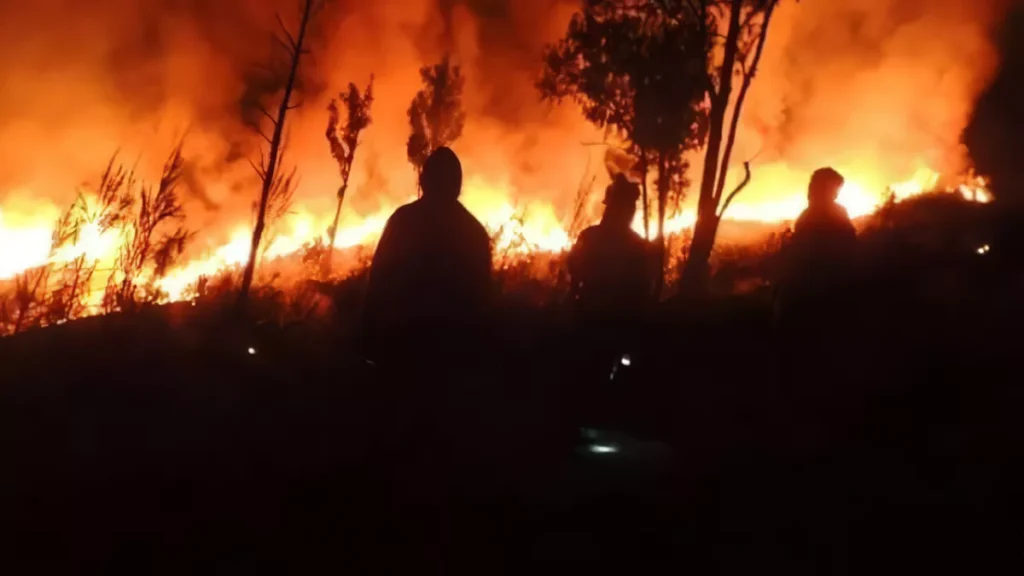
The protected savanna area on Lombok island is burning. With limited personnel and nightfall approaching, officials made a difficult decision: wait until morning.
LOMBOK, Indonesia – A fire is burning across the protected savanna of Mount Rinjani National Park, one of Indonesia’s most iconic trekking destinations, and authorities say they are struggling to contain it.
The blaze broke out Tuesday around 11:00 AM local time in the Savana 2 area of Propok, East Lombok, according to Ma’ruf Hadi, head of the Rinjani National Park Management Section for Region II. By midday, the flames had spread to Savana 1.
“The fire then expanded into the Propok Savana area, which is dominated by dry savanna vegetation,” Hadi told local media.
The affected area is within the non-climbing zone of the park, but officials remain deeply concerned. The dry season has arrived, and the vegetation is tinder-dry.
A Struggle Against the Elements
Ground crews from the national park and local savanna management have been working to extinguish the hotspots. But their efforts are hampered by a familiar constraint in disaster response across the archipelago: limited resources.
Personnel are stretched thin. Logistics are constrained. Firefighting equipment is basic.
By 7:00 PM, the fire was still active in several areas.
Then came a decision that no fire commander wants to make.
“Given that conditions have entered the night with very limited lighting, and considering the safety factors of the personnel on duty, extinguishing activities have been temporarily suspended,” Hadi said.
Operations will resume Wednesday morning.
The Dry Season Threat
Indonesia is entering its annual dry season, a period when forests and savannas across the archipelago become increasingly vulnerable. What is typically a time of clear skies and peak tourism becomes, for park managers, a season of anxiety.
On Rinjani, the vegetation is predominantly dry grass and scrubland — highly flammable and capable of spreading fire rapidly when wind picks up.
The national park is one of Lombok’s primary attractions, drawing trekkers from around the world who come to summit the 3,726-meter volcano and camp along its crater rim. The savanna areas, particularly Propok, are known for their sweeping landscapes and wild deer populations.
For now, the fire remains within the non-climbing zone. But officials are not taking chances.
An Appeal for Caution
Hadi issued an appeal to visitors and local residents alike.
“We hope the public will refrain from activities that could potentially trigger fires,” he said. These include land clearing, burning vegetation remnants, and discarding cigarette butts carelessly.
It is a plea that echoes across fire-prone regions worldwide, from California to Australia to the Mediterranean. But in remote areas with limited firefighting infrastructure, prevention is often the only realistic strategy.
What This Means for Travelers
For international visitors planning treks on Mount Rinjani, the fire is not yet an immediate threat to the main climbing routes. The blaze is contained to the Propok savanna, which is outside the designated trekking corridors.
However, conditions can change quickly.
Wind shifts. Fire spreads. Access roads may be closed. Air quality in the region could deteriorate if the blaze continues to burn.
Travelers with upcoming Rinjani treks should:
- Monitor updates from the national park authority
- Check with local guides and tour operators before departing
- Be prepared for possible cancellations or route changes
- Avoid any activities that could spark new fires — including discarding cigarette butts
A Larger Pattern
This is not the first fire on Rinjani, and it will not be the last.
In 2018 and 2019, significant fires burned portions of the national park, closing trekking routes for weeks and damaging sensitive ecosystems. Each time, the pattern was the same: dry conditions, strong winds, limited equipment, and a suspension of night operations due to safety concerns.
The underlying vulnerability has not changed.
As the dry season intensifies, park managers across Indonesia — from Rinjani to Bromo to Komodo — will be watching, waiting, and hoping.
And when night falls, as it did Tuesday on Rinjani, they will sometimes have no choice but to let the fire burn until morning.