

Opinion and analysis by Giostanovlatto, founder of Hey Bali and a tourism practitioner in Bali.
That headline isn’t an exaggeration. It’s the natural conclusion after watching how the Bonnie Blue saga unfolded in real time. What began as an “international scandal” dripping with moral outrage, talk of a 15-year sentence, and cross-agency investigations somehow shrank into a minor traffic violation faster than anyone expected. By the time the dust settled, the story had deflated so abruptly the public barely had time to process it.
And as Bonnie walked out smiling, the irony was impossible to ignore.
During questioning, she reportedly quipped, “You’ll have to subscribe to find out.” Not a confession, not even a defense—just the unmistakable instinct of a creator who understands that every crisis can be converted into clicks. Which makes it fair to wonder whether, somewhere in the back of her mind, she was thinking:
If Bali wanted to boost my engagement, they succeeded perfectly.
It was fast, chaotic, and honestly a little absurd. This entire saga moved at the speed of the internet, not the rhythm of law. And that’s exactly what makes the Bonnie Blue episode so strangely satirical.
1. Act One: “The Arrival of Bonnie Blue — and the Start of Viral Chaos in Bali”
Bonnie Blue, a British content creator known for courting public attention, landed in Bali on November 6, 2025. It didn’t take long for her to become the center of the spotlight. Along with her crew, she began producing a series of videos that spread rapidly, sparking curiosity, irritation, and debate almost simultaneously.
2. Act Two: December 4–5 — The Silent Arrest, The Noisy Narrative
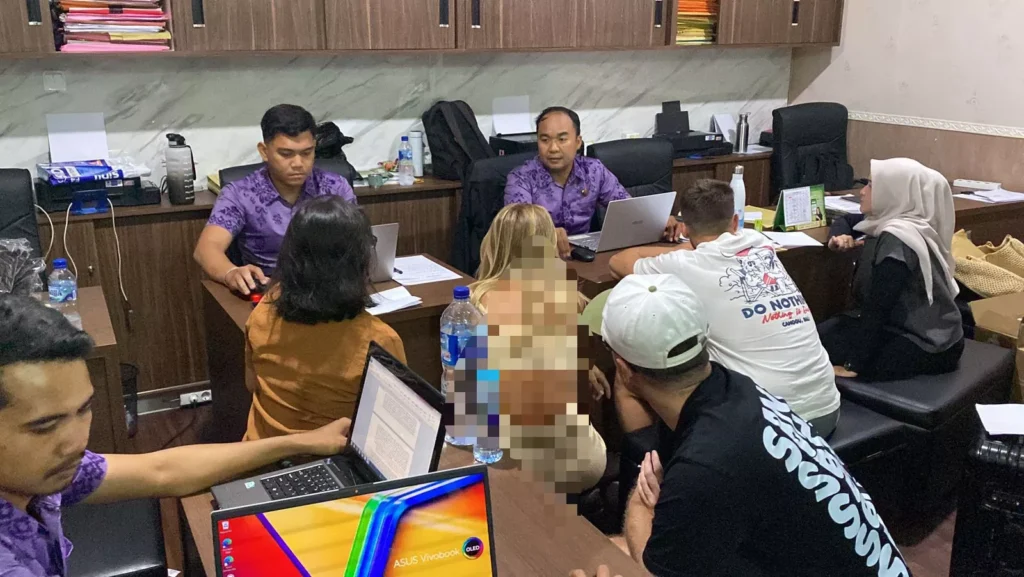
December 4, 2025, didn’t begin with sirens or public commotion. Bonnie Blue’s arrest was far quieter than the internet imagined. The Badung Police secured Bonnie at a studio in the Pererenan area, along with 17 others present at the location. No media scrum, no crowds, no spotlight. Just a tightly sealed operation.
December 5 — The Official Statement That Fueled Speculation
The next day, December 5, the Badung Police gave their first official statement. Police Chief AKBP M. Arif Batubara told the press:
“The location is suspected to have been used by the alleged perpetrator to produce lewd videos.” (as quoted by Detik).
This statement triggered a wave of news and speculation. Within hours, the issue ballooned into a major narrative: alleged moral violations, possible visa misuse, and criminal threats exaggerated by click-hungry channels. It all moved faster than the actual process of evidence examination and analysis, which was still underway.
The result?
A silent arrest transformed into a global opinion fest in less than a day. An act that demonstrated how quickly a mere allegation could morph into an international drama, even before evidence was fully unpacked and conclusions were drawn.
3. Act Three: Saturday, December 7 — The Day the Drama Suddenly Changed Genre
Then came Saturday, and the entire plotline seemed to have a “skip” button pressed.
Without grand announcements or official releases explaining anything, international media began reporting that Bonnie Blue and her team had been released. Just like that.
No handcuffs.
No intense, pressured stares.
No aura of a major criminal.
Following the earlier narrative, the public might have imagined Bonnie leaving the detention cell with heavy steps and a face full of remorse. The reality was the opposite. She appeared with a relaxed expression—more like someone who just finished brunch in Canggu than someone recently accused of serious violations under a global spotlight.
This sudden tonal shift left the public bewildered. How could a case filled with heavy words like “pornography,” “immigration violations,” and “threat of 15 years in prison” change as swiftly as tropical weather?
If this drama were a movie, this would be the moment the audience starts asking:
Did we just watch a trailer for a movie that was never actually made?
4. Act Four: December 11 — The Police & Immigration Press Conference: All Criminal Allegations Collapse

December 11 became the most striking turning point in this saga. The Badung Police and Ngurah Rai Immigration finally appeared together before the public, and what they said made the entire prior drama sound like a trailer for the wrong genre.
The conclusion was simple yet staggering:
There was no element of pornography in Bonnie’s content.
There was no evidence of any criminal act.
All the criminal narratives that had exploded online—collapsed instantly.
And the climax: Bonnie Blue was officially declared free.
Even the issue of the contraceptives, which had fueled sensational international headlines—an element discussed at length by the public—was ultimately not categorized as evidence of any criminal act. In short: it was a sensation, yes. A crime, no.
Even the previously serious-sounding suspicion of immigration violations was narrowed down to a “possible” administrative visa breach—and even that was not certain. In other words, the global moral storm that raged for a week turned out to be little more than a small squall on social media timelines.
What was initially understood as a major case involving public morality, heavy legal consequences, and international scrutiny ultimately became something far simpler—and, frankly, far more absurd.
Bonnie walked out a free person.
The public could only wonder:
How could a drama this big end up being that small?
5. Act Five: December 12 — The Big Court Hearing That Turned Out to Be About… Traffic Violations?

And here lies the peak absurdity of the entire Bonnie Blue saga.
After the world discussed pornography, visa violations, morality, and even a 15-year prison threat, the public finally learned that the actual court hearing on December 12 had nothing to do with any of it.
No discussion about adult content production.
Nothing about immigration.
No grand scandal.
The hearing, it turned out, only concerned matters more fitting for a comedy sketch than the climax of an “international scandal.”
One of Bonnie’s crew was found to have purchased a used pickup truck with unclear paperwork—the vehicle registration (STNK) was not in order, and the document of origin was dubious. The same crew member was also driving without an international driver’s license, something foreigners are required to have when operating a vehicle in Indonesia. This case was ultimately categorized as a minor traffic violation and resolved through a quick, simple hearing.
After a full week of drama, cross-agency investigations, and boiling global scrutiny, the “major case” once touted had shrunk to a matter of vehicle registration and a driver’s license. An ending so anticlimactic it’s hard not to laugh.
An irony so complete, it’s difficult to decide:
Should we laugh, or just facepalm?
Amidst all the international-scale criminal narratives, the end of this story was merely an administrative vehicle issue—the kind of problem that usually just requires a fine, not press conferences and international news alerts.
If this isn’t comedy, then what is?
From Global Storm to Local Drizzle
This is the journey of the Bonnie Blue case: starting with global panic, endless moral commentary, analyses sounding more dramatic than reality, only to end with a swift release that felt utterly anticlimactic.
Bonnie came to Bali as a content creator.
In a matter of days, Bali—aided by the international media—turned her into a new global celebrity.
And now, she leaves with engagement through the roof, a more recognized name, and a reputation arguably stronger than before this drama erupted. The irony is simple: a case labeled a scandal ultimately crumbled into triviality. All that grew was Bonnie’s popularity and the public’s weariness of excessive sensation.
And perhaps, amidst all the noise, one lesson remains:
In the internet age, big storms don’t always end with a bang. Sometimes, as with this case, they fade into a light drizzle, leaving one character smiling the widest—Bonnie Blue.