

BALI, INDONESIA – As debate continues online about payment disputes at accommodation and restaurants in Bali, one question keeps resurfacing among tourists and expatriates: can businesses legally charge extra just because you pay by credit card?
Under Indonesian regulations, the answer is clear. They cannot.
This article explains what the rules actually say, why the practice still appears in some places, and what travelers can do if they are asked to pay a credit card surcharge.
What Indonesian Regulations Say
Indonesia’s central bank, Bank Indonesia, strictly regulates how card payments are handled. Under current rules, merchants are not allowed to pass on credit card transaction fees to customers as an added charge.
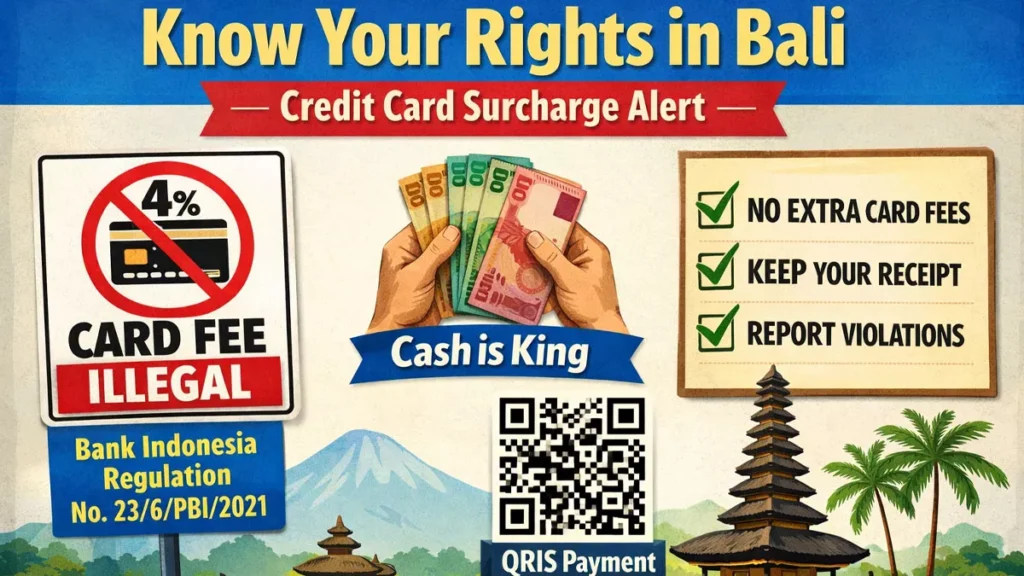
The legal basis is Bank Indonesia Regulation (PBI) No. 23/6/PBI/2021 on Payment Service Providers, specifically Article 52. In simple terms, the regulation states that any fees charged by banks to merchants must remain the merchant’s responsibility, not the customer’s.
Those fees, commonly known as the Merchant Discount Rate (MDR), are paid by hotels, restaurants, and shops to the bank or card network. They are part of the cost of doing business, not an optional add-on for guests.
How Much Should You Be Charged?
For customers, the expected surcharge for paying by credit card is straightforward:
- Credit card surcharge: 0%
- What you pay: Only the listed price of the room, meal, or service
Behind the scenes, banks typically charge merchants an MDR of around 1.5% to 2.5%, depending on the card type and issuing bank. That cost is contractually agreed between the bank and the merchant.
When a business asks for an additional 4% fee, the number is not only unusually high, it also raises red flags. Even in cases where merchants improperly pass on costs, the figure usually mirrors the MDR. A 4% charge suggests the fee goes beyond bank costs and may include extra margin, something explicitly prohibited under payment regulations.
A Common Point of Confusion: Tax and Service Charges
Not every extra percentage on a bill is illegal, and this is where misunderstandings often arise.
In hotels and restaurants across Bali, it is standard to see:
- Service charge: around 10%
- Government tax: around 11%
These charges are lawful and are often presented together as “plus-plus” or a combined 21%. They apply regardless of whether payment is made by cash or card.
The problem arises when, after tax and service charges are added, a cashier says something like: “If you pay by credit card, there is an additional 4%.”
That extra card-related fee is not permitted under Indonesian rules.

Why the Practice Still Exists
Despite clear regulations, credit card surcharges still appear in parts of Indonesia, particularly among small or independent businesses. Several factors contribute:
- Thin profit margins
- Limited understanding of payment regulations
- A belief that card fees should be borne by the customer
While these pressures are real, they do not change the legal position. From a regulatory standpoint, passing MDR costs to consumers remains a violation of payment system and consumer protection rules.

What Travelers and Expats Can Do
If you are asked to pay a credit card surcharge in Bali, there are practical and measured steps you can take:
- Ask for clarification
Politely confirm whether the extra charge is a card surcharge or part of tax and service. - Decline the surcharge
You may explain calmly that Indonesian regulations do not allow credit card surcharges to be passed to customers. - Use another payment method
If the business insists, consider paying by cash or QRIS transfer to avoid the disputed fee. - Keep your receipt
If you end up paying, a receipt showing “card fee” or “bank charge” is strong evidence of a violation. - Report if necessary
Complaints can be made to your card-issuing bank or through channels connected to Bank Indonesia. In serious cases, banks can impose sanctions on merchants, including withdrawing card payment facilities.
Possible Consequences for Businesses
Merchants found to be violating payment rules may face:
- Written warnings
- Financial penalties
- Termination of cooperation with banks, including removal of card machines
For hotels and restaurants that rely on international guests, losing card payment facilities can have long-term consequences.
Alternative Payment Options: Why Cash Still Matters in Bali


While credit cards are widely accepted across Bali, cash remains one of the safest and least problematic payment methods, particularly at small hotels, homestays, cafes, and locally run businesses.
Paying in cash eliminates the risk of unexpected card surcharges altogether and avoids confusion over payment regulations. For many smaller merchants, cash is still the most familiar and straightforward form of transaction, especially outside major tourist hubs.
Another increasingly common option is QRIS bank transfer, Indonesia’s national QR payment system, which allows payments directly from local bank apps without additional fees. For tourists who have access to local banking apps or digital wallets, this can be a practical middle ground between cash and cards.
For travelers, a balanced approach often works best:
- Use cash for small accommodations, local eateries, and day-to-day expenses
- Reserve credit cards for larger hotels, established restaurants, and international chains
- Ask about total pricing upfront, including tax and service, before choosing a payment method
Choosing the payment method that fits the setting not only reduces friction but also helps maintain smooth interactions, particularly in environments where card payment rules may not be consistently understood.
A Matter of Rights and Expectations
For travelers and expatriates, understanding these rules is not about confrontation, but clarity. Indonesia welcomes millions of international visitors each year, and transparent payment practices are part of maintaining trust in its tourism economy.
At the same time, how disputes are handled matters. Calm, respectful communication often resolves issues more effectively than escalation, particularly in a cultural context where saving face remains important.
Knowing your rights helps avoid misunderstandings on both sides of the counter. In Bali’s increasingly global hospitality landscape, clear rules and professional conduct protect guests and businesses alike.
#heybalinews