
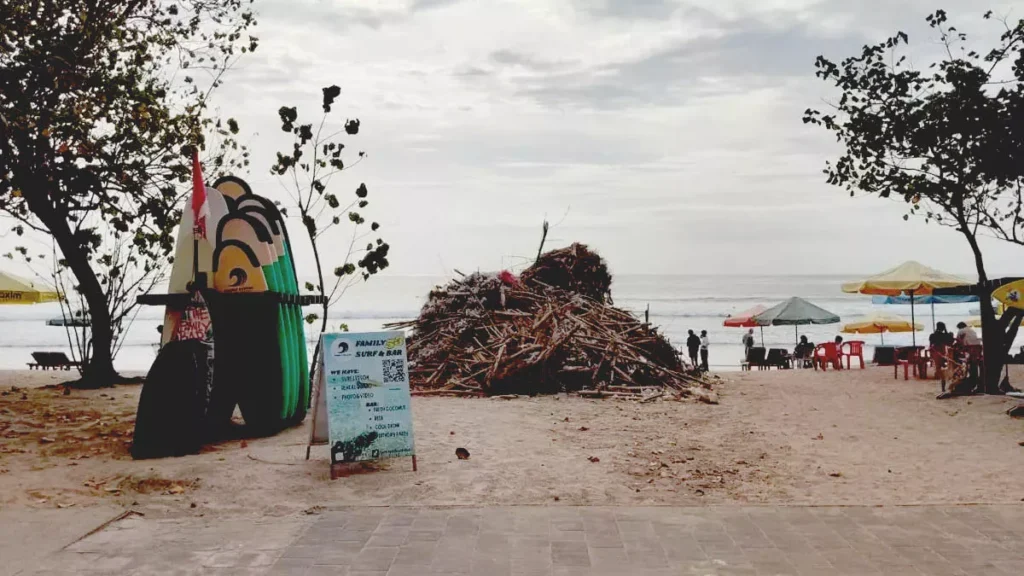
Despite a daily deployment of sanitation crews, military, and police, Bali’s most famous shoreline is losing a logistical battle against a seasonal tide of marine debris.
KUTA, Bali — Each dawn, before the first surfers paddle out and sun-loungers are arranged, a dedicated force of 200 workers mobilizes across Kuta Beach. Their mission: to reclaim the sand from a nightly invasion of plastic bottles, styrofoam, and organic waste. Comprising local staff, regency sanitation officials, and personnel from the military and police, this clean-up brigade is a testament to the urgency of the task. Yet, as visitors this week witnessed, their Sisyphean efforts are being thwarted not on the frontline, but in the supply chain—by a critical and persistent shortage of trucks needed to haul the waste away.
I Putu Gilang Bayu Sadra Putra, assistant manager of the Kuta Beach tourist site, outlines the logistical breakdown. While the cleaning crews are sufficient, the system is overwhelmed by the sheer volume of ocean-borne debris, a phenomenon that peaks during the west monsoon. “The personnel are adequate,” Gilang stated, “but we have a constraint with transportation. We can’t load and haul it away immediately because the volume is substantial.”
The Bottleneck: A Missing Fleet of Trucks
The operational flaw is stark. Collected waste is temporarily stockpiled in a holding area in Setra, on land provided by the local traditional village. However, transporting it to a final disposal site requires a convoy that doesn’t materialize.
Gilang estimates that clearing the backlog just once demands around 30 dump trucks, each with a 5-cubic-meter capacity—a fleet rarely available. This forces a staggered removal process, where new waves of trash arrive before the old piles are fully cleared, leaving unsightly mounds that can fester for a week or more.
This chronic shortage points to a deeper, recurring systemic failure in municipal resource planning, where the seasonal surge in “marine sending”—debris carried from rivers and neighboring coastlines by currents—predictably outstrips the capacity of local logistics.
A Cycle of Blame and a Call for Upstream Solutions
Facing inevitable complaints from tourists who see the piles and assume negligence, Gilang is emphatic: cleaning is a relentless, daily ritual. “We clean this trash, and tomorrow more comes… Those who don’t understand think we are not taking any action,” he says. His frustration underscores a fundamental truth: the clean-up, however heroic, only addresses the symptom.
He redirects responsibility upstream, calling for public education to curb littering in rivers—the vectors that feed this cycle of “marine sending.” The problem, therefore, is not solely Balinese; it is regional, carried by tides that respect no administrative boundaries.
For Bali’s international community and tourism industry, the recurring sight of trash on Kuta Beach is more than an eyesore; it is a direct assault on the island’s core brand promise of natural beauty. While officials may note that the worst trash flows coincide with the tourism low season, the reputational damage is cumulative.
It highlights a sobering disconnect between the island’s world-class hospitality offerings and the often-overwhelmed back-end municipal systems that support them. The army of cleaners can win the daily battle on the sand, but the war will be lost without a strategic reinforcement of logistics and a fundamental shift in waste management across the entire island—and the wider archipelago.