
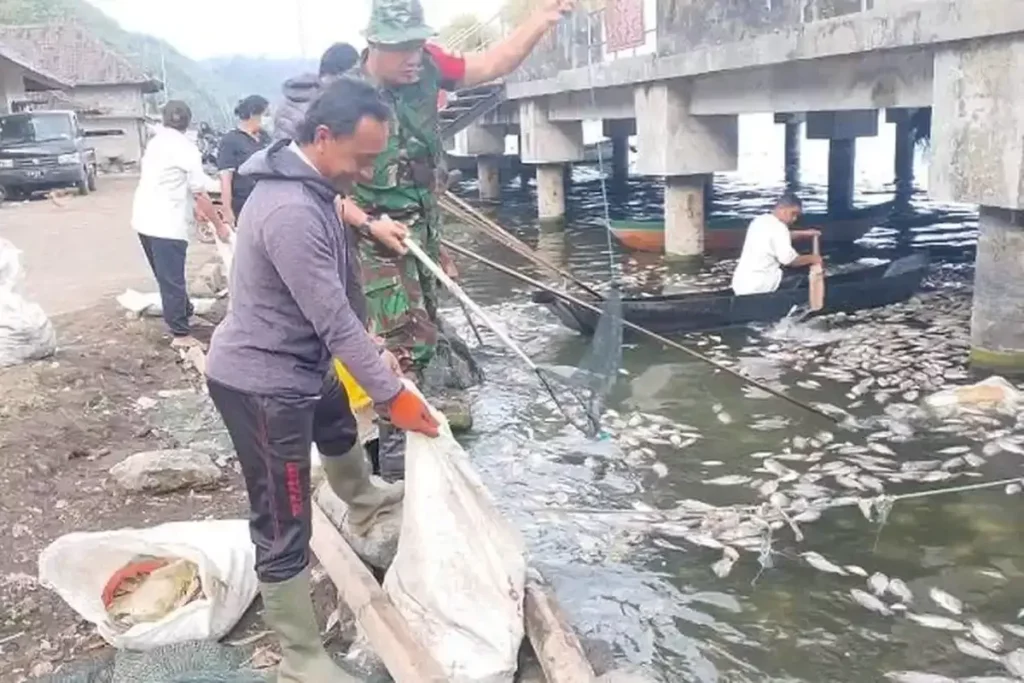
Water conditions at Lake Batur in Bangli Regency, Bali, are gradually returning to normal following a sulfur eruption that triggered a mass fish die-off, though the pungent smell of decomposing fish remains noticeable at several points around the lake, even as cleanup crews work to remove the last of the carcasses.
Water Quality Improving, But the Smell Persists
The Bangli Agriculture, Food Security, and Fisheries Department (Dinas PKP) said scattered fish carcasses remain the primary source of the lingering odor, despite improving water quality overall.
“Water conditions in the affected area have started to return to normal. It’s just that the smell of the dead fish is still quite strong,” said I Wayan Agus Wirawan, Head of the Fisheries Division at Bangli’s Dinas PKP, on Sunday, July 27, 2026, as reported by TribunBali.
According to Agus, his department has been working alongside multiple agencies to clear fish carcasses along Lake Batur’s shoreline since the die-off began. However, carcasses still scattered across parts of the lake continue generating a strong smell, and cleanup efforts are ongoing to prevent the odor from becoming a public health nuisance.
In a practical turn, the collected fish carcasses aren’t going to waste. “We’re sending the fish carcasses to farming groups in the Pengotan area to be processed into fertilizer,” Agus said.
37.1 Tons of Dead Fish, Over Rp 1 Billion in Losses
Bangli’s Dinas PKP recorded that as of July 25, 2026, total fish deaths caused by the sulfur eruption at Lake Batur reached 37.1 tons. Fish farmers in the area are estimated to have suffered losses exceeding Rp 1 billion (approximately $65,000) as a result.
According to preliminary data, Abang Dukuh was the hardest-hit area, with fish deaths reaching approximately 25 tons. Buahan Village recorded 10.4 tons of dead fish, while Kedisan Village recorded around 1.7 tons.
Monitoring Continues
Despite the improving water conditions, Bangli’s Dinas PKP says it continues monitoring Lake Batur’s water quality to anticipate any further impact. “We are still monitoring the water conditions at Lake Batur. Thankfully, the impact of the sulfur eruption has not spread beyond these three villages,” Agus said.
Background: A Volcanic Lake’s Toxic Turn
The sulfur eruption at Lake Batur triggered mass fish deaths across Abang Batudinding, Buahan, and Kedisan villages. Cleanup of the fish carcasses has been carried out by Bangli’s Dinas PKP with support from Indonesian military (TNI) and police (Polri) personnel, university students, and local residents.
Why This Matters for Visitors to Lake Batur
For travelers planning a visit to Lake Batur, a popular stop alongside the Mount Batur sunrise trek and known for its volcanic crater lake setting, the lingering smell is worth factoring into trip planning in the near term, even as authorities confirm the underlying water quality is recovering. The incident also underscores a natural risk specific to this volcanic region: Lake Batur sits within an active caldera, and sulfur-related disturbances, while not common, can occur with limited warning, occasionally causing significant, sudden impact to the lake’s aquatic ecosystem and the local fish farming communities that depend on it.
For now, authorities say the damage has remained contained to the three affected villages, but continued monitoring suggests officials are not yet ready to declare the situation fully resolved.