
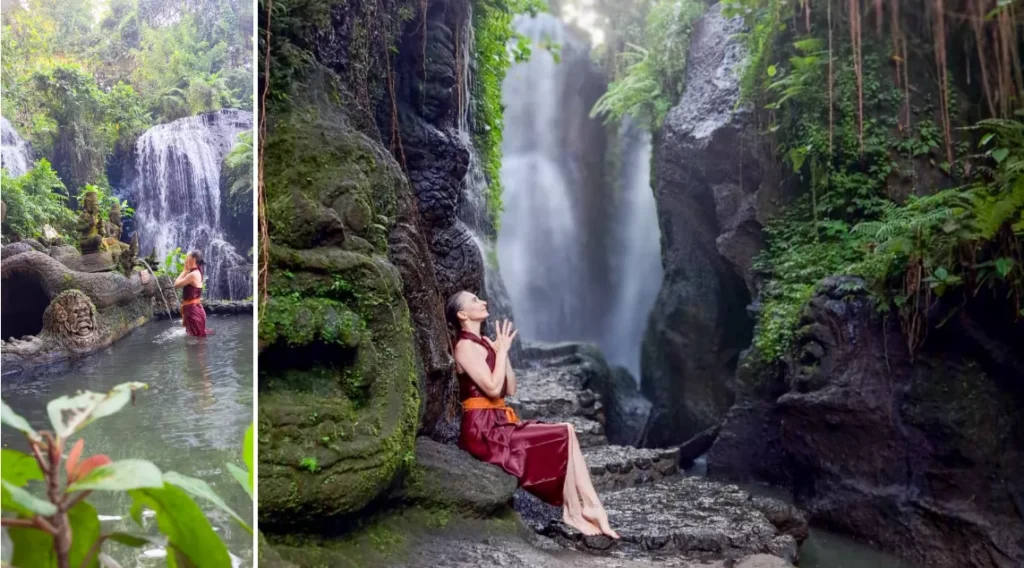
Located in the verdant hills of Abiansemal, this sacred Balinese site offers visitors more than a scenic plunge—it promises purification, palm readings, and a growing menu of high-end spiritual therapies. Here is what you need to know before you go.
ABIANSEMAL, Bali — There is a place in the hills of Badung where the water does more than fall. It cleanses.
Taman Beji Griya Waterfall, tucked into the narrow roads of Desa Punggul, has emerged as one of Bali’s most sought-after destinations for melukat—the traditional Balinese Hindu ritual of spiritual purification. Unlike the island’s more commercialized waterfall attractions, where swimwear and selfie sticks dominate, Beji Griya operates on a different currency: intention.
Visitors arrive not merely to cool off, but to be restored. The ritual, conducted in sacred spring water believed to carry purifying energy, is increasingly drawing international travelers seeking something beyond Bali’s beach clubs and sunset bars.
But as demand rises, so too does the complexity of the visitor experience. Here is a practical guide to navigating Beji Griya with the respect it requires.
Location and Access
Taman Beji Griya Waterfall is located on Jalan Mawar, Desa Punggul, Abiansemal District, Badung Regency—approximately 35 kilometers from I Gusti Ngurah Rai International Airport, a journey of roughly 90 minutes by car. From central Denpasar, the distance is about 21 kilometers, or 50 minutes.
The final approach requires patience. Access roads narrow considerably as they wind through village terrain, and the path to the waterfall itself involves uneven, moderately steep terrain. Comfortable, secure footwear is not optional.
Admission and Pricing
The site operates daily from 9:00 AM to 6:00 PM local time.
General admission is structured by residency: Rp 20,000 for domestic visitors, Rp 50,000 for international tourists. This grants access to the waterfall grounds and viewing areas.
Participation in spiritual activities carries separate fees:
- Melukat purification ritual: Rp 300,000
- Palm reading: Rp 1,000,000
- Healing therapy: Rp 1,500,000
- Life therapy: Rp 1,500,000
- Chakra aura opening: Rp 1,500,000
The pricing reflects both the specialized nature of these services and the growing positioning of Beji Griya within Bali’s premium spiritual tourism segment.


Understanding Melukat
To approach melukat as merely a “tourist activity” is to misunderstand it entirely.
In Balinese Hindu tradition, melukat is a solemn rite of purification—lukat meaning “to cleanse” or “to liberate.” The ritual involves immersion in or sprinkling from sacred water sources (tirta), accompanied by prayers led by a pemangku (priest) or designated ritual keeper. It is believed to wash away negative energies, mental impurities, and spiritual blockages.
At Beji Griya, the ritual is conducted in a designated pool fed by natural springs. Participants are guided through offerings, prayers, and water immersion in a sequence that has been maintained for generations—now shared with a global audience.
Essential Etiquette and Practical Tips
Because Beji Griya remains an active spiritual site rather than a secular attraction, visitor conduct is closely tied to the preservation of its sanctity. Local custodians and frequent visitors offer the following guidance:
1. Approach with a clear mind. The ritual is not a performance. Visitors are encouraged to arrive in a state of calm, with genuine intention. Those experiencing menstruation are traditionally prohibited from entering, in accordance with Balinese Hindu custom.
2. Dress appropriately. Swimwear is not permitted. All visitors must wear a sarong and sash, which are typically available for rental or included in activity packages. Footwear should be practical for uneven stone surfaces.
3. Time your visit strategically. Peak hours between 11:00 AM and 2:00 PM see the highest congregation of visitors. Early morning or late afternoon offers a more contemplative atmosphere and softer light for photography—where permitted.
4. Book ahead for therapies. Palm reading, chakra work, and the various healing therapies require dedicated practitioners and dedicated time. Walk-in availability is limited; advance reservation is strongly advised.
5. Observe silence and restraint. This is not a location for loud conversation, disruptive behavior, or intrusive photography. The site’s custodians reserve the right to refuse entry or ask visitors to leave if conduct is deemed inappropriate.
A Destination in Transition
Taman Beji Griya Waterfall occupies an increasingly complex space in Bali’s tourism ecosystem. It is at once a place of genuine religious observance, a community-managed ecotourism asset, and a commercial enterprise offering services priced at a significant premium to local income levels.
For international visitors, this convergence requires heightened awareness. The same waterfall that offers spiritual renewal also tests one’s capacity for cultural sensitivity. The same ritual that welcomes outsiders also demands compliance with customs that may feel unfamiliar or restrictive.
This is not, in other words, a disinterested attraction. It is a living site of faith that has chosen to open its doors.
The question for each visitor is whether they arrive as a tourist—or as a participant.
For readers planning a visit: Reservations for melukat and therapeutic services can be arranged through Taman Beji Griya’s official channels. Visitors are encouraged to confirm current pricing and availability in advance, as rates and schedules are subject to change.