
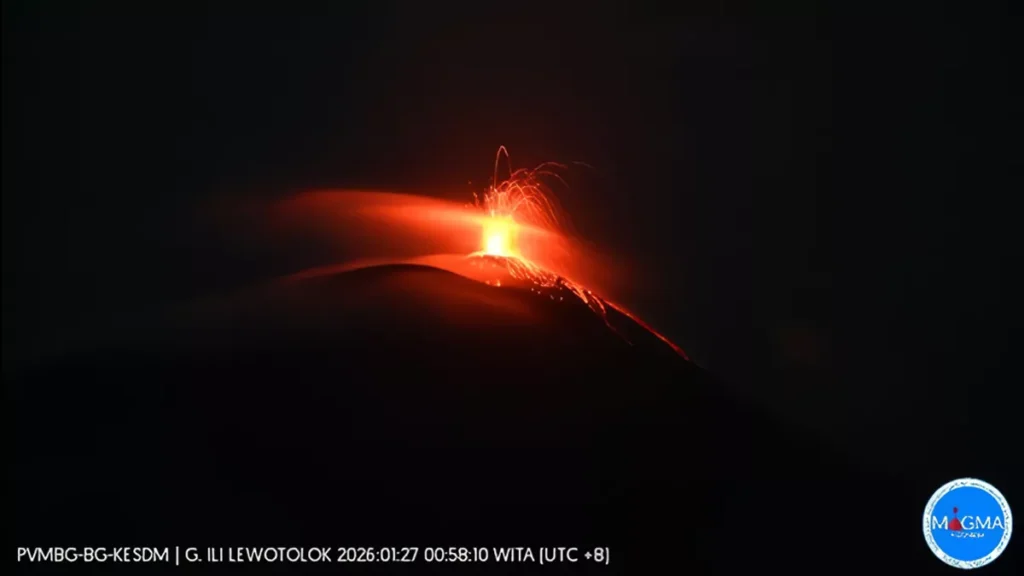
HEYBALI – Somewhere in eastern Indonesia right now, a mountain is glowing red at night. Mount Ile Lewotolok, on the island of Lembata in East Nusa Tenggara, sent lava flowing 1.2 kilometers down its southern slope this week, and it did not stop at one eruption.
158 Eruptions Before the Sun Rose Twice
Officials at the Ile Lewotolok observation post recorded 158 separate eruptions in a single 24 hour window on Tuesday, August 17. Each eruption sent ash and rock 100 to 500 meters into the air, according to Yeremias Kristianto Pugel, the officer on duty at the monitoring post.
“It erupted 158 times, with an amplitude of 11.1 to 40 millimeters and each event lasting 39 to 119 seconds,” Pugel said in a statement released Wednesday. He said the eruptions came with glowing rock fragments and rumbling sounds ranging from faint to moderate, along with lava visibly flowing 1,200 meters from the crater’s edge toward the south.
The mountain also produced 13 gas emissions, 36 non-harmonic tremors, two hybrid earthquakes, and three shallow volcanic quakes in the same period, on top of continuous background tremor. That is an unusually busy day even for a volcano that has been active on and off for years.
A Mountain That Rarely Sits Still
Ile Lewotolok stands 1,413 meters above sea level and sits within Indonesia’s Ring of Fire, the arc of volcanoes and fault lines that runs through the country and makes it one of the most seismically active places on earth. Eruptions here are not rare, but a stretch of 158 in 24 hours signals the mountain is currently in an intense active phase rather than a quiet one.
Pugel is urging residents, hikers, and any visitors near the mountain to stay at least 2 kilometers away from the crater. He also flagged a specific danger zone to the south, southeast, and northeast, where hot lava could collapse and send debris and superheated gas cascading down the slope.
Local authorities are additionally telling residents to wear masks to protect against volcanic ash, cover eyes and skin, and seal off clean water storage so ash does not contaminate drinking supplies.
What It Means for Flights Heading East
Lembata sits several hundred kilometers east of Bali, so this eruption has no direct impact on life or travel on the island itself. The connection that matters is in the sky, not on the ground.
Volcanic ash is one of the few things that can ground a flight outright, since it can damage jet engines in ways ordinary weather cannot. Bali’s Ngurah Rai Airport is the main gateway for travelers connecting onward to East Nusa Tenggara, including Labuan Bajo and Komodo National Park, so an active eruption anywhere along that flight path is worth watching.
As of this report, no flights out of Bali have been disrupted and the ash and lava activity remain contained within Ile Lewotolok’s 2 kilometer exclusion zone. Anyone with a flight booked toward Flores, Lembata, or other parts of East Nusa Tenggara in the coming days should keep an eye on airline advisories, since ash-related delays in this region tend to appear with little warning.