
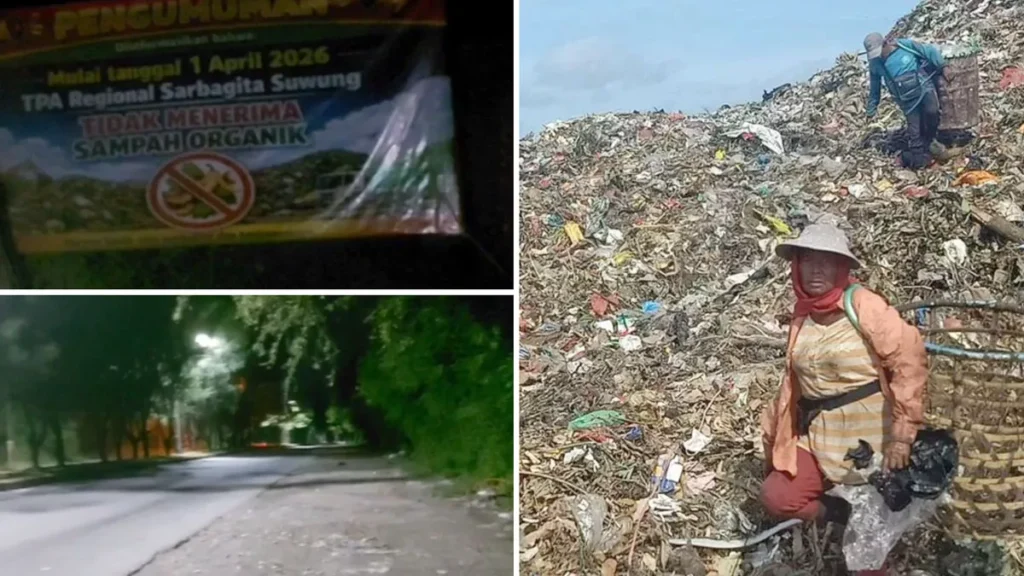
DENPASAR, Bali — At exactly midnight on April 1, 2026, Bali’s largest landfill, Suwung, appeared to shut down as scheduled.
A field check conducted by Hey Bali journalist Ferry Fadly at 00:00 WITA found no visible activity at the main entrance of the landfill. There were no garbage trucks entering or exiting, and the area—typically busy with continuous waste transport—was completely empty.
The observation provides the first on-the-ground indication that the long-discussed closure of Suwung has been implemented, at least operationally, from the start of April.
A Key Node in Bali’s Waste System Goes Quiet
For years, Suwung has served as the central disposal site for much of Bali’s waste, handling significant volumes generated daily from households, businesses, and the tourism sector.
Its closure marks a major shift in how the island manages its waste flow.
While the decision aligns with broader efforts to address environmental concerns and reduce landfill dependency, it also removes a critical component of Bali’s existing waste infrastructure.
Immediate Uncertainty on Waste Flow
The absence of truck activity at Suwung raises immediate operational questions.
If waste is no longer being directed to the landfill, where is it being diverted? And are alternative systems ready to handle the volume?
Bali produces thousands of tons of waste each day. Without a fully functioning replacement system, disruptions could emerge quickly—particularly in densely populated and high-tourism areas.
At the time of observation, there was no visible indication at the site of rerouting or temporary holding operations.

Transition Without Margin for Error
The closure of a primary landfill requires coordinated transitions across collection, transport, and processing systems.
Any gap between policy and execution risks creating bottlenecks.
In Bali’s case, the challenge is amplified by the island’s economic dependence on tourism. Cleanliness is not only an environmental issue, but also a core part of the visitor experience.
Even short-term disruptions in waste handling could have visible consequences.
A Critical Phase Begins
The shutdown of Suwung does not resolve Bali’s waste problem—it shifts it.
Responsibility now moves to whatever systems are in place to replace or redistribute the landfill’s role. Whether those systems can absorb the demand remains unclear.
Authorities have previously indicated plans for improved waste management approaches, including reduction at source and expanded processing capacity. However, the effectiveness of these measures will now be tested in real time.
What Comes Next
As of the early hours of April 1, the situation on the ground is defined by one fact: Suwung is no longer operating as it did before.
What follows will determine whether the closure represents a turning point—or a disruption.
For residents, businesses, and visitors alike, the coming days will provide a clearer picture of how Bali manages one of its most persistent challenges.
#heybalinews / Ferry Fadly