
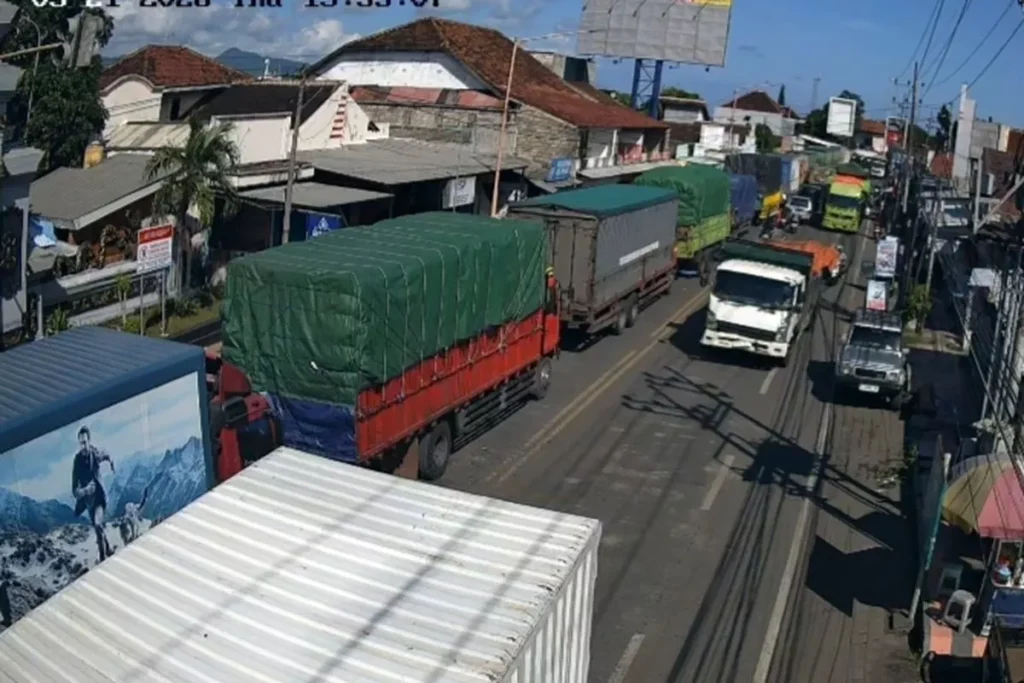
As first reported by Kompas, rough weather across the Bali Strait triggered major ferry delays this week, creating traffic queues stretching up to six kilometers near Bali’s Gilimanuk crossing.
Strong winds and difficult sea conditions disrupted ferry docking operations at both Ketapang Port in East Java and Gilimanuk Port in Bali, one of Indonesia’s busiest inter-island transport routes.
By Thursday morning, trucks, buses, private vehicles, and logistics carriers were backed up along the coastal road toward Watu Dodol as ferries struggled to recover from delays that began Wednesday night.
“The bad weather yesterday created a domino effect,” Rahut, a navigation safety officer at the BPTD Ketapang Port Service Unit, told reporters on Thursday, May 21, 2026. “The impact is still being felt now.”
According to Yudhi Nugraha Septiadi from BMKG’s Ketapang-Gilimanuk Meteorological Service Office, wind speeds reached around 13 knots, while waves climbed to approximately 0.7 meters.
Although relatively moderate, the conditions were enough to complicate docking maneuvers for ferries crossing the narrow Bali Strait, particularly when strong crosswinds pushed vessels sideways during approach.
Several ferries reportedly struggled to align properly with docking ramps.
The disruption worsened Thursday morning when low tide conditions temporarily affected loading and unloading operations at LCM docks on both sides of the strait. Ferries remained stationary while vehicle queues continued growing along access roads.
By midday, 28 ferries remained in operation — roughly the normal number for daily crossings — but operators were unable to immediately clear the backlog created overnight.
Vehicles scheduled to cross Wednesday evening were still waiting Thursday morning, while some Thursday departures slipped into the afternoon as traffic moved slowly toward the ports.
The Bali Strait crossing serves as Bali’s primary land-sea gateway for logistics, tourism traffic, fuel transport, and daily commuters moving between Java and Bali.
While ferry operations continued throughout the disruption, authorities warned that clearing accumulated traffic would take time even after weather conditions improved.
BMKG forecasts show lighter weather conditions through the weekend, though afternoon rain and waves approaching one meter remain possible in the strait.
“We will continue to provide updated weather forecasts,” Yudhi said.
For travelers planning overland movement between Java and Bali in the coming days, authorities are advising additional buffer time before heading toward the ports.
Because even relatively minor weather shifts across the Bali Strait can quickly turn one of Indonesia’s busiest ferry crossings into hours of waiting.