
Written by Giostanovlatto, Founder of Hey Bali and Observer of Tourism & Sustainability
DENPASAR — On the spreadsheets of Indonesia’s Central Statistics Agency (BPS), Bali is a dazzling success story. From January to October 2025, the island welcomed nearly 5.9 million international tourist arrivals, a stunning 10.99% increase from the previous year. With this momentum, the magic number of 7 million visits by year’s end is no longer a projection but an inevitability. Bali has not just recovered; it has surged far beyond its pre-pandemic zenith.
Yet, these very same figures, when scrutinized, are not a monument to triumph. They are a sounding alarm ringing through the heart of the celebration. A celebration marked by a healthy 67.75% occupancy rate for starred hotels, yet now tinged with a critical question: why did this rate dip by 1.03 percentage points compared to July 2024, amidst a sea of rising arrivals? Is this not the first clue that Bali’s revival is a groggy awakening—a recovery in quantity that is beginning to strain its very quality and economic structure?
Act I: A Celebration of Numbers on a Fracturing Stage
Let us first acknowledge the figures. A 10.99% surge is the dream of every destination marketer. The market shift from reliance on China to the dominance of Australia (23% share) and the remarkable rise of India (second place cumulatively from Jan-May) is a diversification worthy of applause. Bali has proven itself resilient, beloved, and in high demand.
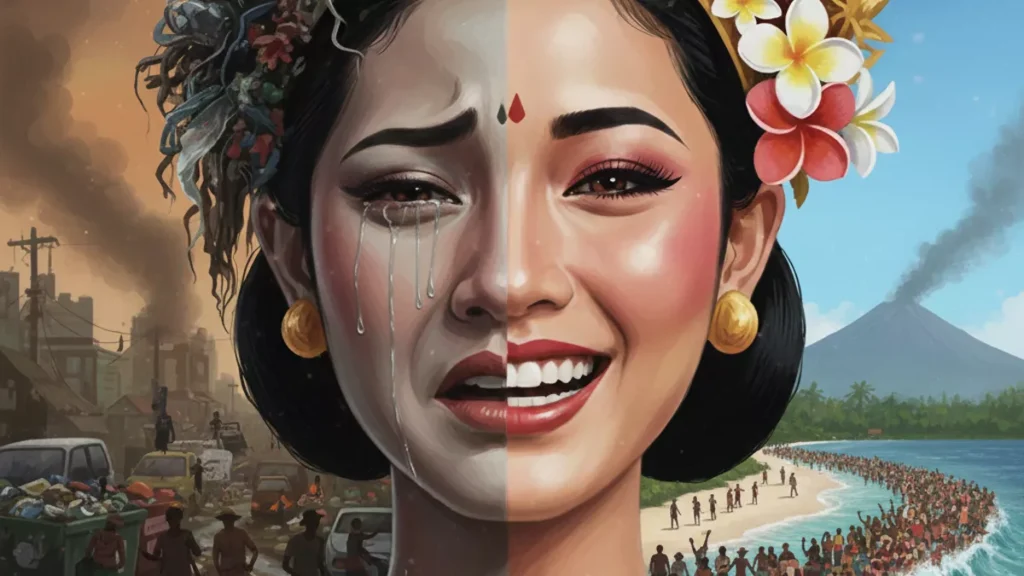
However, the stage upon which this celebration is held is showing structural cracks. The prestigious travel guide Fodor’s has unequivocally placed Bali on its “No List” of destinations to reconsider in 2025. The reason is not political instability or safety concerns, but environmental and governance failure: an acute waste crisis, brutal pressure on sanitation and water systems, and cultural fatigue from overtourism. This is not a critique from local activists; it is a warning stamp from the international community that the image of the “Island of the Gods” is being eclipsed by the shadow of an “Island of Traffic and Trash.”
Act II: Narrow Mathematics Amid Ecological Distress

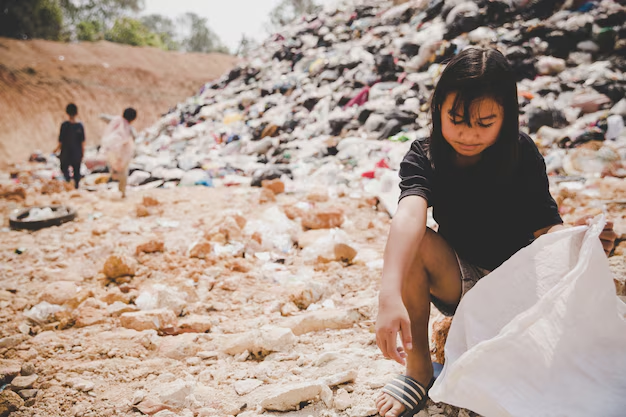
Herein lies the paradox, playing out with cruel precision. 7 million tourists is an equation for 7 million points of unmanaged ecological pressure. Each arrival represents a water footprint, plastic waste, carbon emissions, and road expansions that consume rice fields.
The cheerful BPS data on arrivals stands in diametric opposition to daily field reports: the collapse of the Suwung landfill, rivers transformed into open sewers, and the streets of Canggu, Ubud, and Kuta turning into endless parking lots under the midday sun. The surge from India and Australia is not just about foreign exchange; it is also about different consumption patterns, facility expectations, and waste volumes. We have succeeded in diversifying our markets, yet we have utterly failed to diversify the impact.
The critical question is this: do our policies match this explosion? The IDR 150,000 tourism levy levied on each foreign visitor is a fiscally smart response on paper. Yet, where is the transparency for the flow of these funds? Are they rescuing the rivers of Gianyar, or evaporating into bureaucratic ether? Ethics regulations and deportation threats for cultural offenders are symbolic, yet fail to address the root cause: how do we create a system that prevents the arrival of “problem tourists” at the very gate of entry?
Act III: From “Recovery” to “Redirection”—A Call to Pivot

Reaching 7 million arrivals is not an end goal; it is a critical inflection point. The narrative must now pivot from recovery to redirection. This is not about reducing numbers, but about transforming their value.
First, a moratorium on new development in South Bali. Instead of adding capacity in zones already gasping for breath, the government must boldly redirect investment and promotion to East, North, and West Bali. The 49% occupancy rate for non-starred accommodations signals vast potential for dispersed lodging. Sustainability begins with spatial redistribution.
Second, from a “Tourist Tax” to a “Tourist Trust Fund.” The tourism levy must be managed by a transparent, publicly audited special body, with explicit allocations: 40% for integrated waste management, 30% for ecological restoration (mangroves, coral reefs, watersheds), 20% for cultural revitalization, and 10% for oversight and law enforcement. Every tourist has the right to know their contribution is saving Bali.
Third, quality quotas over quantity quotas. Instead of chasing headcounts, establish minimum standards for tour operators and accommodations regarding waste management, water efficiency, and contribution to the local circular economy. Provide tax incentives for green performers, and impose strict sanctions on environmental violators.
Finale: 7 Million as a Turning Point, Not a Peak


The 7 million mark we are set to achieve is not a mountain peak to be summited with euphoria. It is a precipice at a crossroads. One path descends, following the inertia of quantity, leading us toward a Bali that is exhausted, saturated, and soul-depleted—a destination visited because of advertising and abandoned because of reality.
The other path, an ascent, requires the courage to pivot: from an extractive to a regenerative economy, from mass tourism to accountable travel, from pride in visitor volume to pride in the quality of encounter.
That choice is in our hands now. For the figure of 5.9 million is not merely a statistic; it is 5.9 million mirrors reflecting who we truly are. Are we wise stewards, or negligent caretakers? The time to write a new chapter is upon us, before the old one inscribes a tragic finale for the Island of the Gods.