
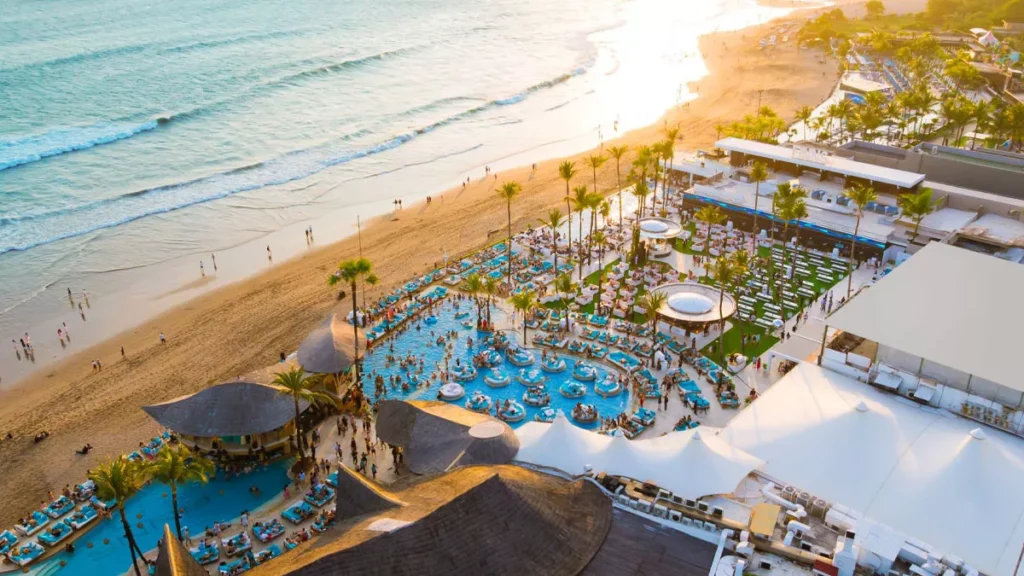
DENPASAR, Bali — In the beachfront district of Berawa, a proposal to expand Finns Beach Club—one of Bali’s most prominent beachfront entertainment venues—has ignited a conflict that cuts to the very heart of the island’s future. This is not merely a dispute over a construction permit; it is shaping up to be a definitive litmus test for Bali’s often-professed commitment to sustainable tourism, pitting lucrative development against the harsh realities of ecological limits.
The flashpoint is a formal rejection by WALHI Bali, the region’s foremost environmental advocacy group, of the project’s mandatory Environmental Impact Assessment (Amdal). Submitted on December 18, 2025, the critique presents a stark indictment: the plan to build new restaurants and facilities is based on a dangerous and unsustainable reliance on the island’s most precious and dwindling resource—water.
A Plan Anchored in a Drying Well
The Amdal document reveals that the expanded Finns Beach Club would depend entirely on deep-well groundwater, drawing an estimated 659 cubic meters per day at full operation—an amount comparable to the daily water needs of a small village. For environmentalists, this is not a detail but a fatal flaw.
“This shows a sole dependence on groundwater in an area already experiencing a structural water deficit,” stated Made Krisna “Bokis” Dinata, Director of WALHI Bali. “It is extremely dangerous.” The southern Badung region, a dense tapestry of hotels, villas, and local communities, has been categorized by officials as under “high water stress.”
Beyond Water: Building on Shaky Ground
The environmental objections extend into the realm of physical risk. Critics, including the legal advocacy group KEKAL Bali, note the Berawa site is officially designated as prone to flooding, coastal abrasion, and tsunamis.


“The Amdal fails to properly link this massive construction to increased flood runoff or coastal changes,” argued I Made Juli Untung Pratama of KEKAL Bali. “It makes disaster mitigation reactive, not preventive.” The concern is that the project’s impermeable surfaces will exacerbate flooding in surrounding areas—a risk not just for the club, but for the entire neighborhood.
The Stakes for Bali’s Global Community
For Bali’s international residents and the travelers who cherish the island, this bureaucratic battle carries profound implications. It interrogates the authenticity of the “sustainable Bali” brand marketed worldwide.

“This is the inevitable confrontation,” observes a long-time sustainable development consultant based in Ubud. “For years, ‘green’ and ‘eco’ have been marketing terms. Now, a concrete project is forcing a binary choice: will approval be given based on economic potential alone, or will scientifically documented environmental limits finally dictate the scale of development?”
The outcome will send an unambiguous signal and set a direct precedent for dozens of other projects queued along Bali’s fragile coasts. The Bali Forestry and Environment Agency (DKLH) now holds that decision. Its verdict on the Finns Beach Club expansion will answer a question resonating far beyond Berawa: Are Bali’s sustainable tourism promises a guiding philosophy, or merely a convenient slogan?
Hey Bali News provides in-depth analysis on the environmental and policy decisions that shape the future of life and business in Bali.