
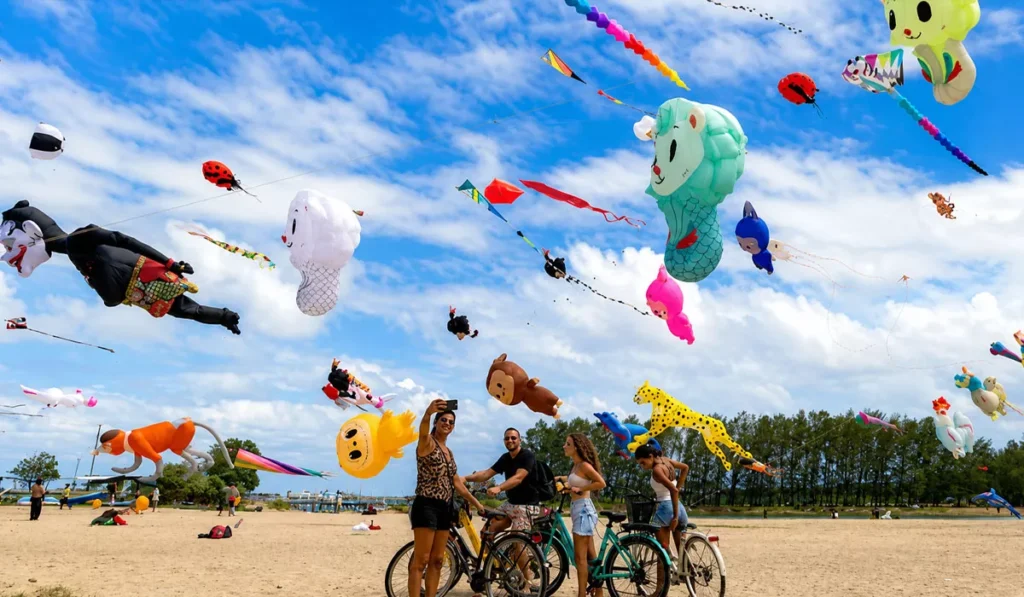
For four days this week, the sky above Sanur’s Mertasari Beach has belonged to something other than airplanes and paragliders: thousands of kites, from towering traditional Balinese giants to intricately shaped international creations, filling the air as part of the annual Rare Angon Kite Festival, running from July 23 to 26, 2026.
Day One: A Giant Takes to the Sky
The festival opened with kite flying running from 10am to 5pm local time. This year’s opening day centerpiece was a genuine spectacle: a giant kite measuring 25 meters long and roughly 20 meters wide, one of the standout attractions kicking off this year’s event.
Day Two: Kites Light Up After Dark
On the second day, daytime kite flying continued from 10am to 5pm, followed by a night flying session beginning at 7pm, accompanied by live music. During the evening session, kites fitted with LED lights glowed spectacularly against the dark sky, offering a nighttime spectacle that rivaled the daytime displays in visual impact.
Days Three and Four: Traditional Competition Takes Center Stage
The festival’s third and fourth days shift focus to a traditional Balinese kite competition, while international kite flying relocates to Muntig Siokan for the remainder of the event.
A Truly International Lineup
This year’s festival drew participants from 23 countries, including Austria, Australia, Thailand, the Philippines, India, and Germany. In total, 105 international kites took to the air in a wide range of creative designs, from strawberries and frogs to wayang shadow puppet figures and depictions of the Hindu god Ganesha. The traditional Balinese category proved even larger in scale, with more than 1,000 kites entered into competition.
The Three Sacred Shapes of Balinese Kite Tradition
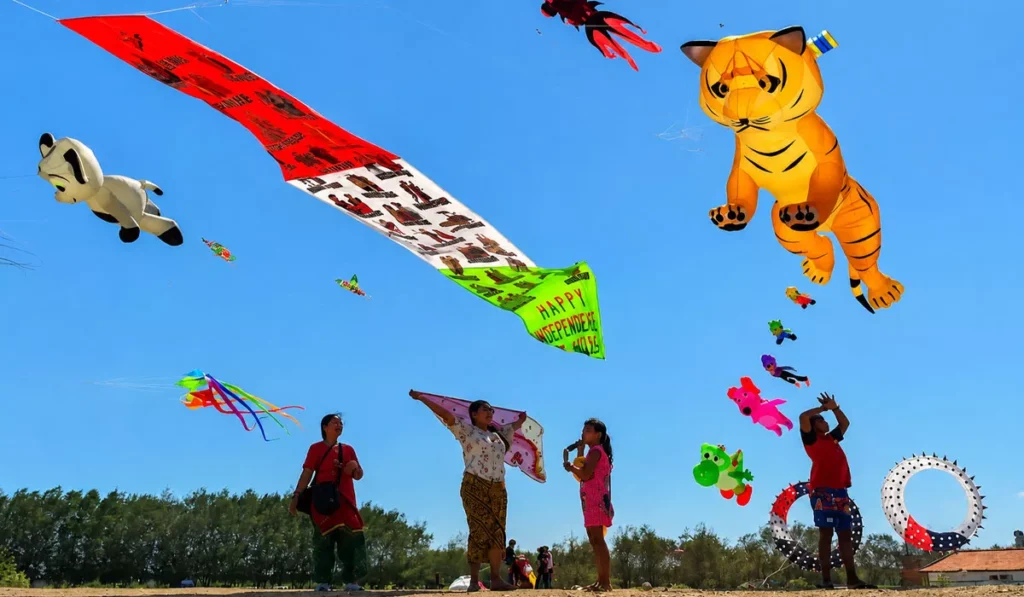
The festival showcases three distinct types of traditional Balinese kites: the bebean, shaped like a fish; the pecukan, an elongated oval design; and the janggan, widely considered the most majestic of the three.
Janggan kites are carved to resemble Basuki, the cosmic dragon of Balinese mythology, and feature a tail stretching over one hundred meters long in black, red, and white. Because they are regarded as sacred objects, janggan kites are typically blessed through a specific ceremony before being flown for the first time.
The Mythology Behind the Festival’s Name
The festival takes its name from Sang Hyang Rare Angon, one of the manifestations of the Hindu god Shiva within Balinese belief, depicted as a divine shepherd who summons the wind through a magical flute, allowing kites to take flight.
Traditionally, Balinese farmers have also believed kites help ward off pests during harvest season. Rare Angon is honored on Tumpek Kandang, a holy day dedicated to animals within the Balinese Hindu calendar.
Why This Festival Is Worth Seeing in Person
For travelers and expats in Bali this week, the Rare Angon Festival offers something increasingly rare on an island often associated with beach clubs and temple tours: a genuinely spiritual, community-rooted event that’s also spectacular on a purely visual level. Unlike many festivals designed primarily for tourists, this one is layered with meaning specific to Balinese cosmology and agricultural tradition, while remaining entirely accessible, and free to watch, from the sand at Mertasari Beach.
For anyone visiting Sanur this week, the best vantage point is the beach itself during daylight hours, though the Wednesday and Thursday night flying sessions, with LED-lit kites glowing against the dark sky, are arguably the festival’s most photogenic moments.