
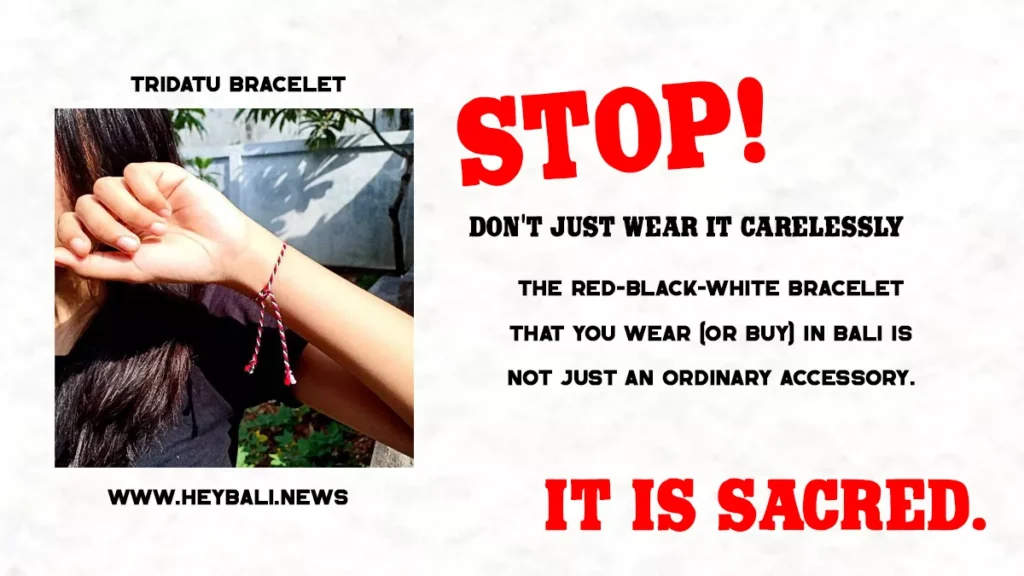
The Tridatu Bracelet has become one of Bali’s most recognizable cultural symbols, worn by locals, expats, and travelers alike. Beyond its red, black, and white threads, the Tridatu Bracelet carries deep spiritual meaning rooted in Balinese Hindu philosophy, reflecting balance, cosmic cycles, and sacred ritual traditions. As the bracelet moves from temple ceremonies to global popularity, its story raises questions about cultural preservation, identity, and respect in a rapidly changing Bali.
A Symbol That Outgrew Its Own Simplicity
In Bali, it is almost impossible to walk through a market, a temple courtyard, or even a quiet village lane without noticing a woven thread of red, black, and white wrapped around someone’s wrist. For many visitors, the Tridatu Bracelet looks like a charming souvenir—light, colorful, affordable, and undeniably photogenic. Yet behind this simple braid lies one of the island’s deepest philosophical symbols, a cultural artifact that carries layers of spiritual meaning rooted in Balinese Hinduism.
Over time, the Tridatu Bracelet has shifted from a sacred object reserved for ceremonies into an item worn by millions, from temple devotees to digital nomads exploring Bali’s beaches and rice terraces. Understanding its meaning offers a window into how tradition and modern identity interact on this island where spirituality infuses everyday life.
The Philosophy Behind the Colors
At the heart of the Tridatu Bracelet is the tri-color symbolism that represents the fundamental structure of the universe. Each thread reflects a cosmic principle, intertwined to remind the wearer of balance, responsibility, and humility.

Tri Murti: The Three Divine Manifestations
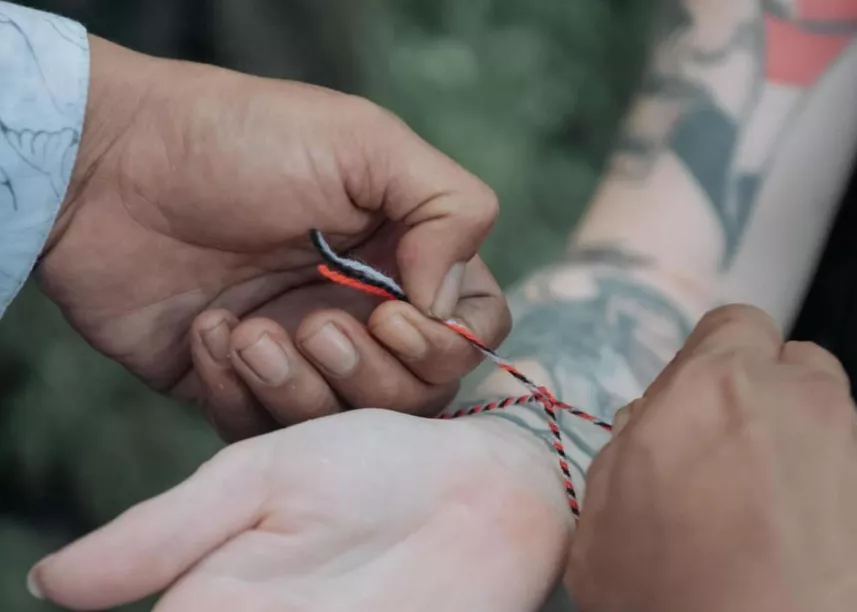
In Balinese Hindu belief, creation, preservation, and dissolution are the three essential movements of existence. These movements are embodied by the Tri Murti—Brahma, Vishnu, and Shiva—each represented by one color of the Tridatu Bracelet.
- Red symbolizes Brahma, the creator, whose energy flows with passion and vitality.
- Black represents Vishnu, the preserver, the source of stability and endurance.
- White signifies Shiva, the purifier, the essence of clarity, goodness, and liberation.
The Tridatu Bracelet becomes a wearable reminder that life is always in motion. Everything is created, maintained, and eventually returned to the origin. Nothing remains fixed. This simple braided thread is a lesson in impermanence disguised as an accessory.

Tri Kona: The Journey of Human Life
Beyond the gods, the Tridatu Bracelet also mirrors the human experience: birth, life, and death—known as Tri Kona. It encourages the wearer to act with awareness during the “life” phase, the moment in the middle where choices matter.
In Bali, life is not seen as a straight line but as a circle in which each action influences the next turn. Wearing the Tridatu Bracelet is a conscious acknowledgment of that cycle.
Traditional Rules and Sacred Etiquette
Although the bracelet is now widely available, traditional Balinese families still treat it with reverence. The Tridatu Bracelet carries ritual weight, and its use follows etiquette that reflects its spiritual origin.
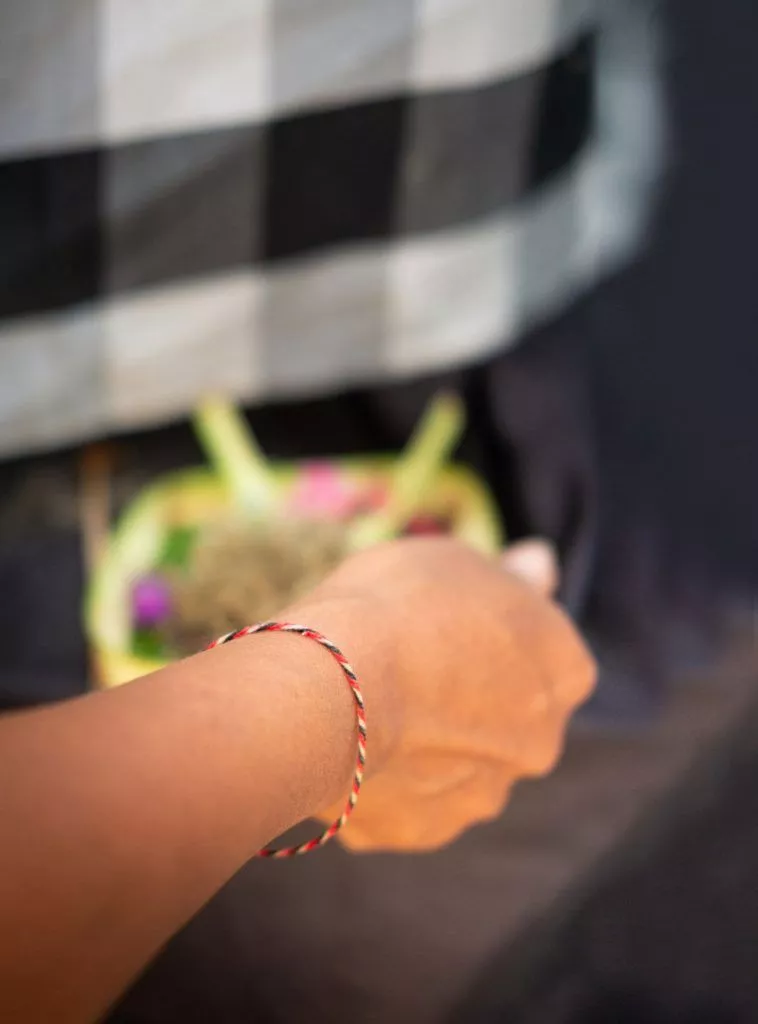
It is traditionally worn on the right wrist, where sacred threads—such as benang tridatu or benang putih—are tied after ceremonies. The right hand represents purity, good deeds, and the channeling of positive energy.
Most importantly, the bracelet must never be cut. Allowing the Tridatu Bracelet to break on its own is believed to symbolize that its protective function has been completed. Cutting it would be akin to abruptly ending a blessing.
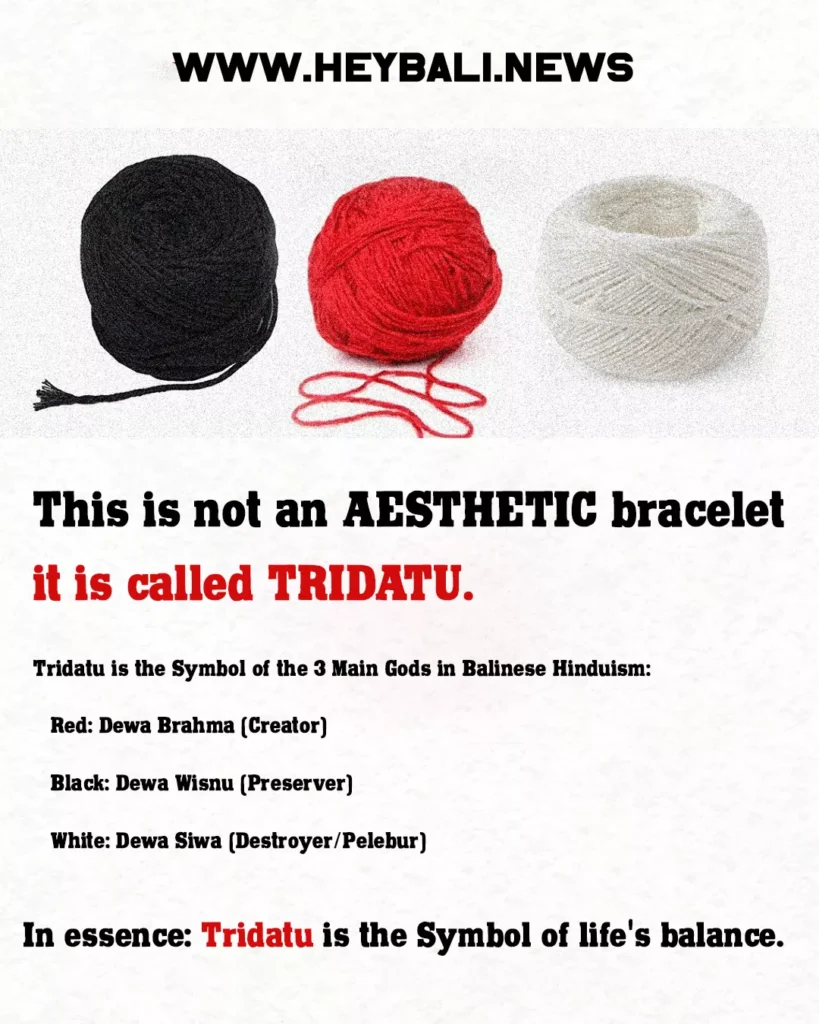
Historically, the bracelet was not bought. It was given by a sulinggih (high priest) after a cleansing ritual or prayer ceremony. Receiving a Tridatu Bracelet directly from a spiritual leader remains a deeply respected tradition in many Balinese communities.
From Temple Symbol to Global Identity Marker
As tourism grew and Bali became a crossroads of cultures, the Tridatu Bracelet experienced a transformation. What once circulated only within religious rituals now appears on beaches, markets, spiritual retreats, and festival grounds. This evolution has fueled both appreciation and concern.

A Widening Circle of Wearers
Today, anyone can wear a Tridatu Bracelet—locals, expats, long-term residents, and short-term travelers. Many visitors wear it as a token of good energy or a reminder of Bali’s calming spirit. For Balinese people, its wider popularity reflects pride: their cultural symbols are acknowledged far beyond the island.
Others view the Tridatu Bracelet as a symbol of connection. For many digital nomads and foreign residents, it becomes a quiet way of signaling respect toward the traditions that shape everyday life in Bali. When worn with understanding, it becomes an emblem of learning rather than appropriation.
The Challenge of Commercialization
But this widespread appeal also presents a dilemma. The bracelet’s sacred roots risk being overshadowed by its market presence. Many who purchase a Tridatu Bracelet may not realize it is tied to rituals, philosophy, and centuries-old tradition. The challenge lies in ensuring that accessibility does not erase meaning.
Despite this, cultural scholars argue that the spread of the Tridatu Bracelet is not inherently negative. Balinese culture has always been adaptive, dynamic, and open to exchange. What matters is intention—whether the bracelet is worn with awareness or simply as a commodity.
The Tridatu Bracelet in Contemporary Bali
Beyond temples and ceremonies, the Tridatu Bracelet carries new significance in modern Bali. It has become a symbol of local identity in a rapidly globalizing environment. In a place where spirituality, commerce, and tourism intersect daily, the bracelet serves as a bridge—connecting personal belief with public expression.
In conversations with cultural observers in Ubud, many note that the Tridatu Bracelet today represents resilience. Bali has undergone dramatic changes over decades—development pressures, global tourism booms, and environmental challenges. Through all of this, the bracelet remains a quiet thread of continuity, a small object carrying a larger story.
Even local artisans who sell the Tridatu Bracelet in markets often explain its meaning to tourists. Their role is not just commercial but educational. By sharing stories behind the colors, they help preserve the cultural integrity of the item they sell.
Respecting Sacred Culture in a Modern World
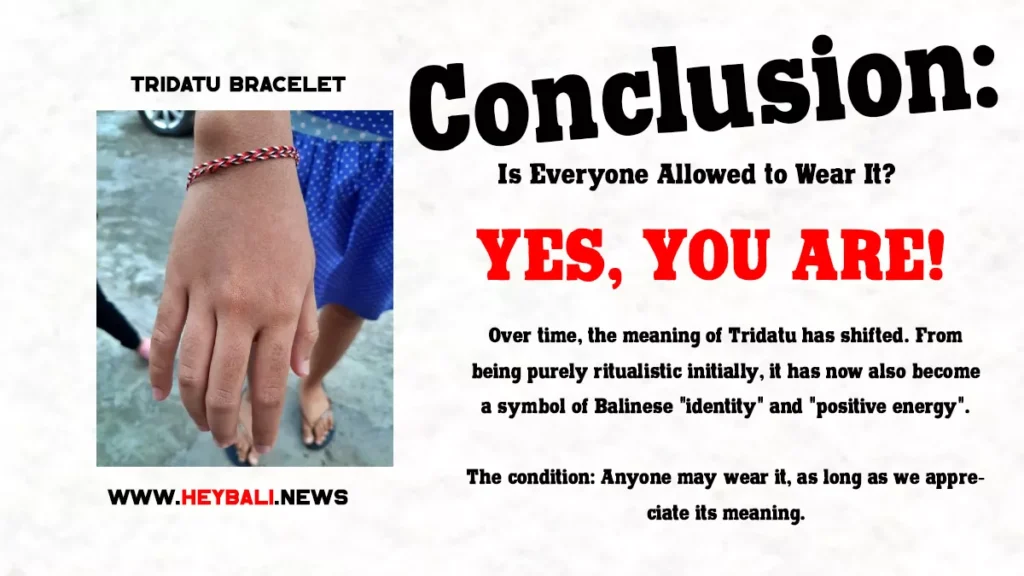
Wearing the Tridatu Bracelet does not require conversion, ritual initiation, or local ancestry. But it does call for respect. In Bali, symbols are not merely decorative. They reflect layers of philosophy embedded in everyday life—seen in offerings placed at dawn, prayers whispered at temples, and ceremonies held throughout the year.
For travelers, expats, and residents, the Tridatu Bracelet is an invitation to engage more thoughtfully with the island. It encourages a slower pace, a deeper look, and a recognition that Bali’s beauty is not only physical but spiritual.
Between the Sacred and the Contemporary
Today, the Tridatu Bracelet inhabits multiple worlds. It remains sacred in ritual settings, meaningful within local communities, and simultaneously embraced by a global audience. Its significance has expanded, not diminished.
As the island continues to navigate cultural preservation amid rapid growth, the Tridatu Bracelet stands as a reminder—woven in three colors—of balance. Creation, preservation, transformation. Past, present, future. Tradition, adaptation, identity.
Whether worn after a ceremony or bought as a keepsake, the Tridatu Bracelet carries a story that deserves to be acknowledged. It is more than an aesthetic accessory. It is a piece of Bali’s spiritual architecture, a thread that binds memory, meaning, and mindfulness into a single loop.