
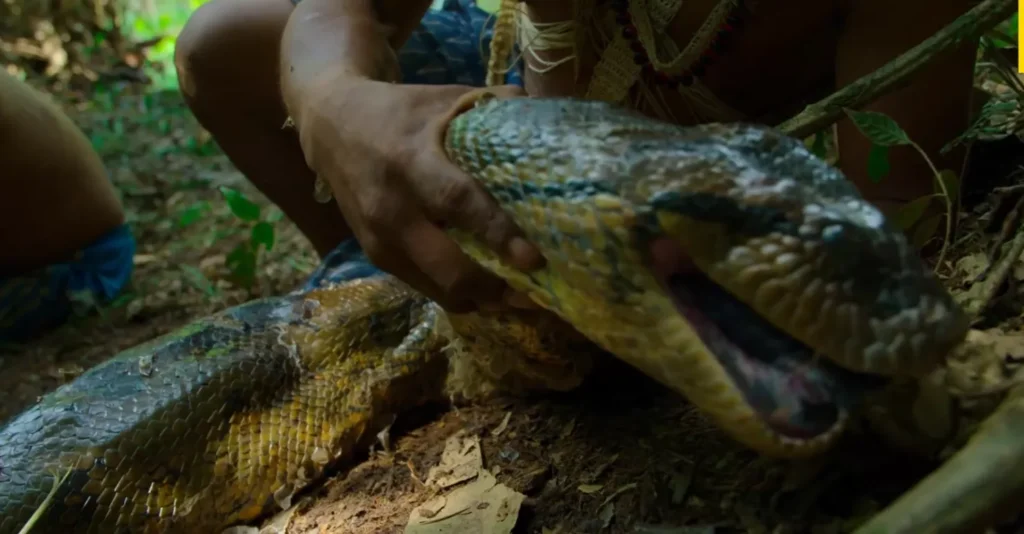
Newly released footage from a 2022 journey captures the moment researchers, guided by indigenous experts, encountered a massive snake now recognized as a genetically distinct northern green anaconda.
A newly released documentary clip has revealed the tense, muddy moment scientists and actor Will Smith came face-to-face with a giant anaconda in the depths of the Ecuadorian Amazon—an encounter that has contributed to the formal recognition of a new species of the world’s heaviest snake.
The footage, part of the National Geographic series “Pole to Pole with Will Smith,” follows an expedition into the Baihuaeri Waorani Territory in 2022 to collect genetic samples. Led by Professor Bryan Fry, a toxicologist from The University of Queensland, and guided by Waorani community members, the group navigated remote waterways by canoe before spotting a massive female anaconda resting on a riverbank.
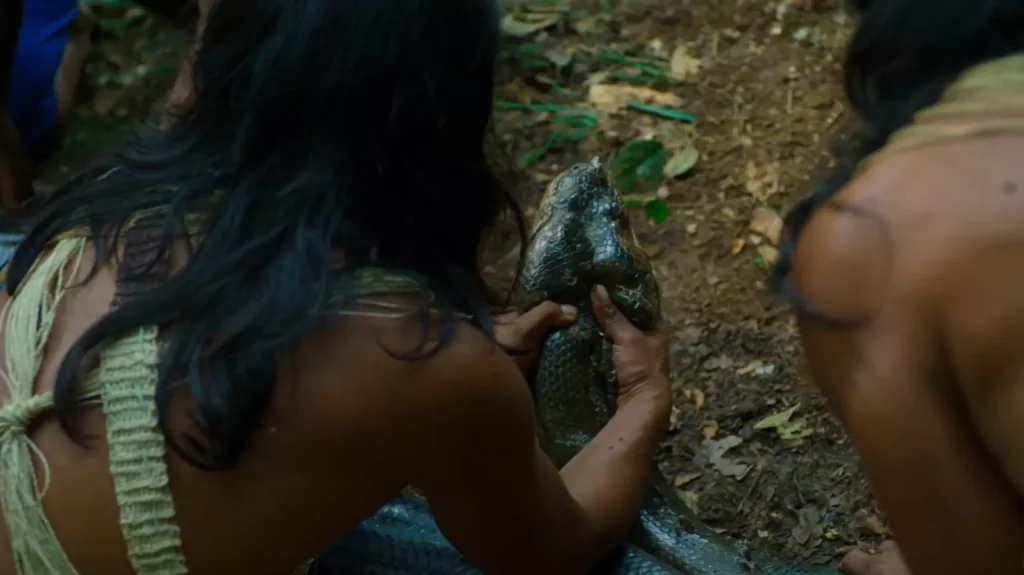
In a swift maneuver, a Waorani guide pinned the snake’s head, allowing the team to safely collect blood and scale samples from the estimated 5-meter-long constrictor. “There is a bite danger,” a guide notes in the video, highlighting the inherent risks of handling an animal capable of killing large prey by constriction.
A Discovery in the DNA
The real revelation came later in the laboratory. Analysis of the collected samples, as reported by Live Science, led to a significant taxonomic revision. The green anaconda, long considered a single species (Eunectes murinus), is now understood to comprise two genetically distinct species.
The newly identified northern population has been named Eunectes akayima (the northern green anaconda), while the southern population retains the original Eunectes murinus classification. The genetic divergence between the two is substantial at 5.5%, suggesting their evolutionary paths separated around 10 million years ago.

Ecology, Contamination, and a Warning
The discovery carries implications beyond taxonomy. Professor Fry’s research highlights a stark dietary difference driven by sexual dimorphism: enormous females hunt large herbivores like deer, while smaller males primarily consume fish and caimans. This dietary preference has placed the males on the front line of environmental pollution.
Because they prey on fish higher in the food chain, male anacondas accumulate far greater concentrations of heavy metals like cadmium and lead from contaminated Amazonian waters. “That is not a small difference. It is a warning signal,” Fry told Live Science. The findings prompted Fry to develop dietary health guidelines for the Waorani, advising pregnant women and children to avoid consuming top predator fish due to contamination risks.
The full encounter, a blend of adventure television and frontline science, premieres as part of “Pole to Pole with Will Smith” on National Geographic on January 13, with streaming on Disney+ and Hulu from January 14. The episode underscores how indigenous knowledge, celebrity-led expeditions, and genetic science can intersect to reshape our understanding of one of the planet’s last great wildernesses.
Source: Nat Geo
