
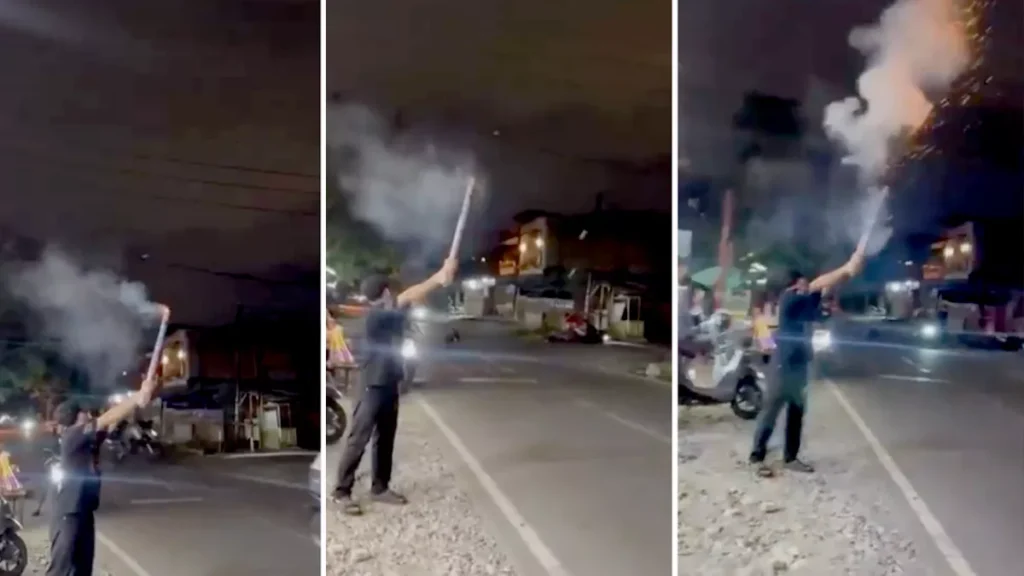
HEYBALI – A short amateur video recorded on a major trans-Sumatran highway has gone viral, not for what it celebrates, but for what it quietly ignores.
The footage opens on a familiar scene. A man stands by the roadside, firing oversized fireworks into the night sky. Explosions bloom overhead, bright and thunderous, drawing cheers and attention. It looks like a moment of festivity, the kind shared endlessly on social media at the turn of the year.
Then, just meters away, a motorcycle crashes at an intersection.
The impact is visible. A rider falls hard onto the asphalt. The sound of the collision is faint but present, partially swallowed by the relentless crackle of fireworks. Yet the camera does not flinch. The phone remains tilted upward, faithfully tracking the arc of light across the sky. No one rushes into frame. No voice calls out. The celebration continues.
What has unsettled viewers is not only the dangerous use of fireworks near a busy road, but the emotional detachment of the person behind the camera. As the accident unfolds in the background, the recording shows no hesitation, no shift of focus, no instinct to intervene. The glowing screen appears to create a psychological buffer, insulating spectacle from suffering.
The irony is difficult to ignore. Fireworks, symbols of joy and renewal, drown out the sound of harm. In the video, celebration is loud and commanding, while a human accident is reduced to background noise. The crack of each explosion seems to muffle not only the crash, but the urgency of compassion itself.
Online reactions were swift and divided. Many criticized the reckless setting of fireworks on a public highway. Others focused on the filmer’s response, or lack thereof. “This is what frightens me,” one commenter wrote. “People are more afraid of missing a beautiful shot than missing the chance to help someone.”
A fireworks display lights up a Sumatra highway. Just meters away, a motorcycle crashes. The camera never turns. A troubling portrait of emotional detachment in the age of viral content. VIDEO ⬇️#Fireworks #RoadSafety #Humanity #BystanderEffect #DigitalDetachment #ViralCulture pic.twitter.com/fDT2v1Zisy
— Hey Bali (@Heybaliinfo) January 1, 2026
The clip has reignited debate about what some describe as a growing “content society,” where the act of recording takes precedence over the responsibility to respond. In this mindset, cameras no longer merely document reality; they mediate it, sometimes dulling the instinct to act. Emergencies become interruptions. Victims become inconvenient details.
Psychologists have long warned about bystander apathy in crowds. But videos like this suggest a more modern layer: when a lens is involved, detachment can deepen. Once the recording begins, empathy risks being postponed, or worse, edited out.
There is no indication of the victim’s condition in the video, nor whether help arrived moments later. What remains, however, is the uncomfortable image of a society increasingly trained to look through screens, even when real life demands immediate attention.
As the fireworks fade and the clip loops endlessly online, it leaves a question hanging in the air, unresolved and unsettling: when celebration becomes content, and tragedy becomes background, what happens to our sense of shared humanity?
#HeyBaliNews