
HEYBALI – A video that surfaced this week out of Indonesia’s remote highlands is difficult to shake off, not because of what it shows, but because of how easily it could be misread.
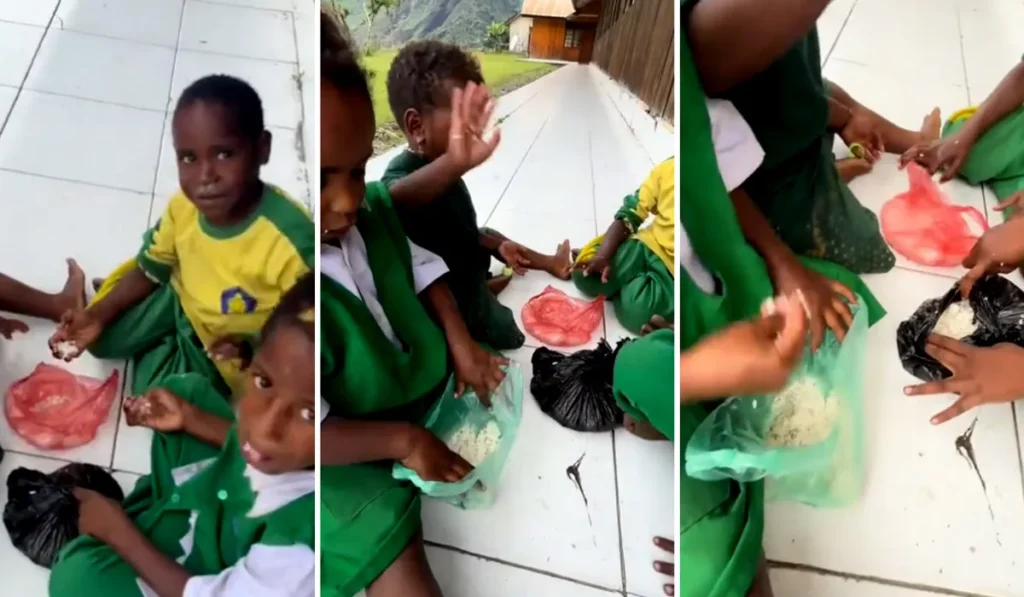
Four schoolchildren sit in a corridor in Puncak Jaya, a mountainous regency in Indonesia’s Papua region, during their lunch break. Two boys, two girls, still in their school uniforms. Their meal is plain white rice, no side dishes, eaten straight from a plastic grocery bag. Two of the children share a single bag between them.
What made the video spread wasn’t the meal itself. It was their faces.
A Smile That Shouldn’t Be Read as Reassurance
The footage was recorded by an Indonesian soldier stationed in Puncak Jaya, known on social media for documenting his interactions with local children near his military post, occasionally sharing snacks or pocket money, sometimes trading goods with kids who visit. This particular clip was different. Rather than a moment of giving, it captured something closer to daily reality: four children eating what they had, exactly as they had it.
What drew attention was that all four kept smiling throughout, even waving at the camera as if greeting whoever would eventually watch.
“Don’t forget to be grateful,” the soldier wrote in the caption.
Where the Story Actually Gets Complicated
The video collected close to 30,000 likes and 1,500 comments within days, most expressing sympathy, prayers, and calls for viewers to appreciate what they have.
But stopping at “be grateful” skips over a more uncomfortable question: why, in a country actively promoting national food security programs and free nutritious meal initiatives, are schoolchildren still eating plain rice from a plastic bag in 2026?
Puncak Jaya is not new to conversations about Indonesia’s development gaps. This central highland region of Papua remains one of the country’s most logistically isolated areas, with limited road access forcing supplies to move by air or on foot through mountainous terrain. Basic goods there routinely cost several times what they do in Java, a direct consequence of how difficult and expensive distribution becomes once you leave Indonesia’s more connected regions.
In other words, what the video frames as simplicity is not a lifestyle choice. It’s the visible result of infrastructure and supply chains that still haven’t reached every part of the country equally.
Why the Children’s Smiles Aren’t Proof That Everything Is Fine
This is the part that tends to get lost in videos like this one. Children smiling doesn’t mean their circumstances are acceptable. Often, it means they’re simply too young to fully understand that their circumstances should look different.
That smile isn’t evidence of resilience worth celebrating without reservation. If anything, it’s a reminder of how easily adults watching from a phone screen can mistake a child’s innocence for contentment, when what’s actually happening is the early normalization of scarcity.
While children in Indonesia’s larger cities grow up choosing what to have for lunch, these children grow up learning to share a single bag of rice between two people. The difference isn’t about character or gratitude. It’s about access.
What’s Actually Worth Reflecting On
Most of the thousands of comments on the video carried prayers and hopes that these children would grow up successful, that they’d one day make their families and their country proud. The sentiment is well-intentioned. But prayers alone don’t change food distribution routes into Puncak Jaya, don’t expand nutrition program budgets for schools in remote regions, and don’t build the infrastructure needed to bring basic staple prices in line with the rest of the country.
For anyone living in or visiting Bali, an island whose brand is built almost entirely on abundance, wellness retreats, infinity pools, curated brunches, the contrast is worth sitting with. Indonesia is a single country, but the distance between Bali’s tourism economy and daily life in Papua’s highlands can feel like an entirely different world.
This video shouldn’t function as a brief moment of sympathy that dissolves the next time the algorithm moves on. It’s a reminder that equitable development across Indonesia, and Papua in particular, remains an unfinished project, one that schoolchildren are absorbing the consequences of long before they’re old enough to understand why their starting point looks so different from that of children elsewhere in the same country.