
A Legacy That Refuses to Fade
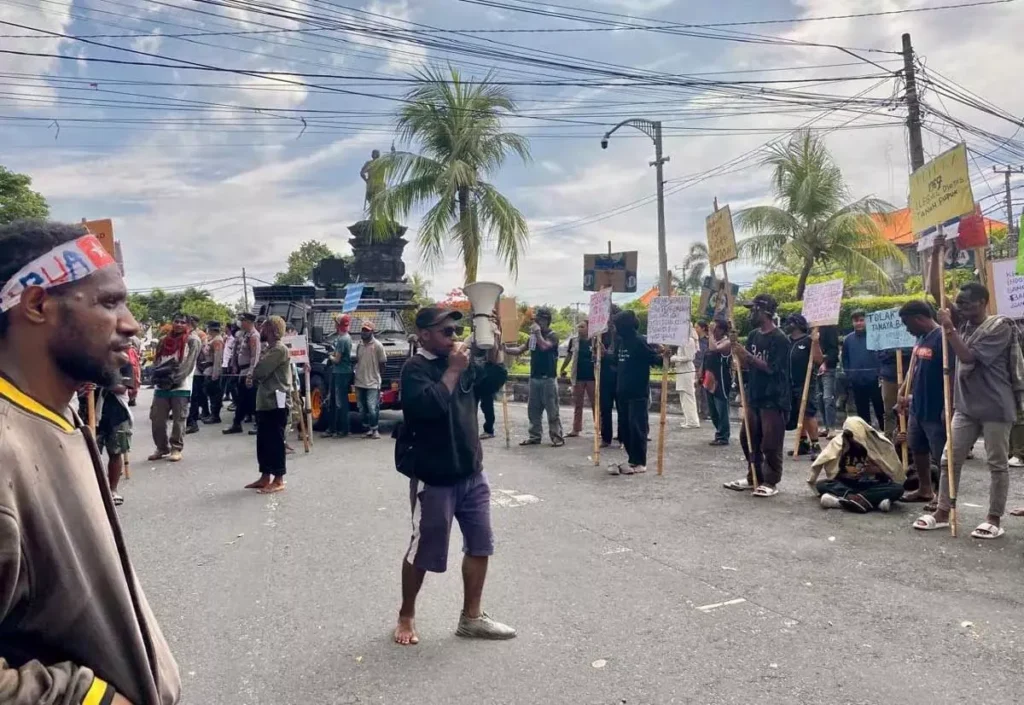
Every 1 December, the West Papua independence movement resurfaces in cities across Indonesia and beyond. In Bali this year, the momentum carried a different weight. At Renon, Denpasar, a circle of demonstrators sang “Aku Papua,” a cultural anthem that has become both a reminder of identity and a quiet form of resistance.
For the students, activists, and community members who gathered, the date marks 64 years since the 1961 declaration of a West Papuan statehood — a moment that briefly gained international recognition before being overtaken by Cold War negotiations, shifting alliances, and the geopolitical interests of far stronger nations.
A Past Negotiated Without Papuans
At the center of the protest was a recurring grievance: the claim that Papua’s political fate was decided without Papuan participation.
Activists pointed to the 1962 New York Agreement, brokered between the United States, the Netherlands, and Indonesia. For many Papuans, the deal became the root of a decades-long conflict. It secured geopolitical stability for Washington, resolved a colonial exit for the Dutch, and delivered territorial consolidation for Jakarta. The missing voice, they argued, was the Papuan people themselves.
This is why the West Papua independence movement directed its message toward the US Consulate in Denpasar. Demonstrators wanted their demands heard by the same country they believe helped shape Papua’s current political reality. When police blocked access to the consulate, the crowd shifted to Renon — but not their message.
Natural Resources and the Political Equation
The tensions surrounding Papua are not only political but also economic. Activists at the Bali gathering criticized what they see as an imbalanced exploitation of natural resources. Mining, especially large-scale copper and gold concessions, has long been a flashpoint.
For demonstrators, these projects represent a deeper problem: decisions made far from the land they impact. The critique is not new, but it remains unresolved — and continues fueling the West Papua independence movement.
A Call to End Military Violence
Another pillar of the protest focused on security and human rights. Demonstrators highlighted a long history of military operations in the region. Their message was clear: an end to violence, and space for Papuans to determine their own future without fear.
These concerns are echoed in international human rights reports, diaspora communities abroad, and solidarity networks in Europe and the Pacific. While each group holds different political views, they share a belief that Papua’s grievances deserve more global attention than they receive.
Why This Matters Beyond Indonesia
Bali’s role in this year’s commemoration underlines a bigger point: the West Papua independence movement is no longer a local or national issue. It has become a transnational conversation involving questions of decolonization, resource sovereignty, minority rights, and the role of major powers in shaping regional outcomes.
For the global audience of Hey Bali News, this is a reminder that Bali — often seen only as a peaceful tourism hub — also serves as a stage where broader regional issues surface. The December demonstrations placed Bali at a crossroads between local expression and international diplomacy.
A Movement That Endures
After 64 years, the West Papuan question remains unresolved.
Papua’s future continues to sit at the intersection of history, geopolitics, and identity. Whether or not one agrees with the demands expressed at Renon, the fact that the movement persists — and continues to draw international attention — signals an issue that cannot be ignored.
For many who gathered in Bali, this is not merely a political cause. It is a generational memory, a cultural inheritance, and a belief that justice, however delayed, remains worth pursuing.
Reported by Ferry Fadly
Written by Hey Bali Newsroom
Source Data: Antara