

Why Does Your Phone Overheat When Charging – You finish a day exploring Bali, plug your phone in at the hotel, and twenty minutes later it feels almost too hot to touch. Before blaming the charger, there’s a good chance your phone is behaving exactly as science predicts.
The Science: Why Charging Always Generates Some Heat
At the most basic level, phone overheating during charging comes down to internal resistance. According to Bluetti Power’s technical breakdown, a phone’s lithium-ion battery generates heat during charging because of internal resistance, and the faster current is pushed through the battery, as with fast charging, the more heat builds up.
The charging circuitry itself adds to this. Inside every phone, a power management IC (integrated circuit) constantly regulates voltage and current levels during charging. Add any background activity, like GPS running for navigation or apps syncing in the background, and you have what Bluetti describes as “a perfect storm of heat sources.”
According to Anker’s official guidance, fast charging is one of the most common culprits precisely because it works by quickly drawing more power from the charger, and higher power delivery naturally produces more heat as a byproduct.
Apple’s own support documentation puts a hard number on this: iPhones are designed to perform ideally between 16°C and 22°C, and the company explicitly warns against using or charging a device in ambient temperatures above 35°C, conditions that can permanently reduce battery lifespan.
Why Using Your Phone While Charging Makes the Heat Worse
Here’s the detail most people don’t realize: charging and using your phone simultaneously doesn’t just add two separate sources of heat together, it compounds them. According to Volta Charger’s technical explainer, running intensive tasks like gaming or video streaming while charging creates what’s called a “parasitic load,” forcing the battery to charge and discharge at the same time. This generates roughly double the thermal stress and accelerates battery degradation far faster than either activity alone.
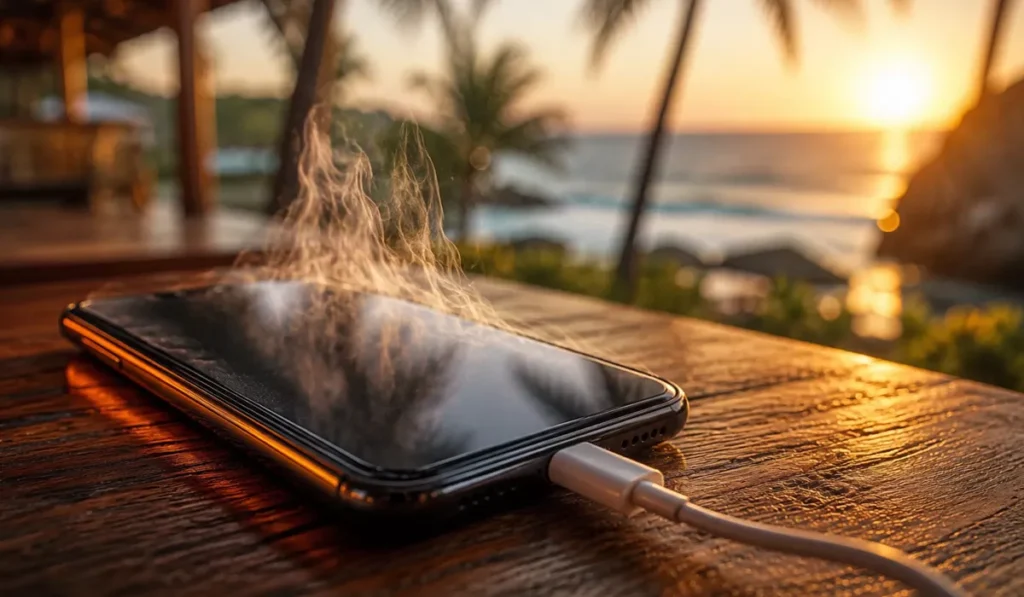
This is precisely the trap most travelers fall into in Bali: phone plugged in at a warung table, GPS still running to confirm the next stop, Instagram open, WhatsApp notifications syncing, all while the device sits directly in tropical sun on a plastic café table.
Why Bali’s Climate Makes This Worse Than Almost Anywhere Else
According to multiple charging technology sources, including Scosche and INIU, high ambient temperature is one of the most significant external factors affecting how hot a phone gets during charging, because the battery cannot dissipate heat effectively when the surrounding air is already warm.
Bali doesn’t just meet that threshold, it consistently exceeds it. Average air temperatures on the island run between 27°C and 32°C year-round, comfortably within range of Apple’s 35°C warning line on a normal day, and dangerously close to it during peak afternoon heat. Humidity typically sits between 75% and 85%, among the more consistently humid climates in the world, and combined with a UV Index regularly reaching 10 to 14, even leaving a phone charging in what feels like “shade” on a beachfront table can mean the device is absorbing considerably more ambient heat than it would in a temperate climate.
According to AVG’s overheating guide, charging a phone on a soft surface like a bed, couch, or even a beach towel compounds the problem further, since the device loses its ability to vent heat effectively, exactly the setup many travelers unknowingly create while charging poolside or on a villa bed.
Why Phones Overheat Faster While Charging in Bali
| Cause | Why It Happens | Bali-Specific Risk |
| Fast charging | Higher current delivers more power quickly, generating more heat as a byproduct | Common with hotel/villa USB-C fast chargers |
| Using the phone while charging | Creates a “parasitic load,” charging and discharging simultaneously | Navigation apps, ride-hailing, and social media running constantly while exploring |
| High ambient temperature | Battery can’t dissipate heat effectively in hot surroundings | Bali’s consistent 27-32°C heat, near Apple’s 35°C safety threshold |
| Poor ventilation while charging | Heat gets trapped with no airflow | Charging on a bed, sofa, or beach towel |
| Cheap or uncertified chargers | Lack proper voltage regulation (“handshaking”) with the phone | Common with budget travel chargers or knockoff cables |
| Aging battery | Increased internal resistance generates more heat over time | Especially relevant for phones already a few years old before a long trip |
| Direct sunlight exposure | Amplifies heat beyond what charging alone produces | Charging on an outdoor café table or sunbed |
Why Heavy Data Use Makes This Even More Relevant for Travelers
One overlooked factor specific to travel is data-heavy app usage. Travelers often spend hours using navigation, messaging apps, ride-hailing services, and cloud photo backups over mobile data. That constant processor activity adds to the phone’s overall heat while charging, on top of everything the battery itself is already generating.
Whether you’re connected through hotel Wi-Fi or a local eSIM, the issue isn’t the connection itself but the sustained workload placed on the processor by constant app activity throughout the day.
How to Actually Keep Your Phone Cool While Charging in Bali
Based on consistent guidance across charging technology sources, a few adjustments make a real difference in tropical conditions:
- Charge on a hard, flat surface, a wooden table or tiled counter, never a bed, sofa, or beach towel, so heat can dissipate rather than get trapped.
- Avoid direct sunlight while charging, keep your phone in shade or indoors, not on a sunbed or café table in direct sun.
- Remove thick phone cases while charging, according to EcoFlow’s guidance, rubberized or heavy-duty cases trap heat between the battery and the case itself.
- Avoid heavy use while plugged in, pause gaming, video streaming, or long navigation sessions until charging is complete, or at least reduce screen brightness and background activity.
- Use a certified charger and cable, cheap or counterfeit chargers lack the voltage regulation needed to charge safely and efficiently, particularly relevant when buying a replacement charger locally while traveling.
- Check battery health periodically, an aging battery generates more heat during charging due to increased internal resistance, worth noting if your phone is a few years old before a long Bali trip involving heavy daily use.

Frequently Asked Questions
Is it normal for a phone to get warm while charging?
Yes. Some warmth during charging is completely normal and expected, it’s a natural byproduct of the battery’s internal chemistry. Concern is warranted only if the phone becomes uncomfortably hot to touch, shuts down unexpectedly, or the battery appears to swell.
Does fast charging cause more overheating than regular charging?
Yes. Fast charging delivers higher current and voltage to recharge the battery more quickly, and that increased power delivery naturally generates more heat than standard charging speeds.
Why does my phone get hotter charging in Bali than it did back home?
Bali’s consistently high ambient temperature and humidity reduce your phone’s ability to dissipate heat effectively during charging, compounding the heat already generated internally by the battery and charging circuitry, and pushing the device closer to manufacturer-recommended temperature limits.
Does using an eSIM in Bali make my phone overheat?
Not directly. The connection type itself, whether Wi-Fi, a physical SIM, or an eSIM, doesn’t generate heat. What matters is how much data-heavy activity, navigation, ride-hailing, streaming, is running continuously in the background, which adds to overall processor load and device heat, especially if that usage continues while the phone is charging.
Should I stop charging my phone if it feels hot?
If it’s mildly warm, that’s normal. If it becomes too hot to comfortably hold, unplug it, remove any case, move it to a cooler, shaded, well-ventilated surface, and avoid using it until it cools down.
What This Means for Your Phone in Bali’s Heat
A phone getting warm while charging isn’t a malfunction, it’s physics and chemistry doing exactly what they’re supposed to do. But Bali’s heat, humidity, and the sheer amount of data most travelers burn through navigating the island push that normal warmth closer to genuinely excessive heat more often than a temperate climate ever would. Charge on a hard surface, out of direct sun, and give your phone a break from heavy use while it’s plugged in, and the biggest heat source left standing will be the island itself, not your device.