

































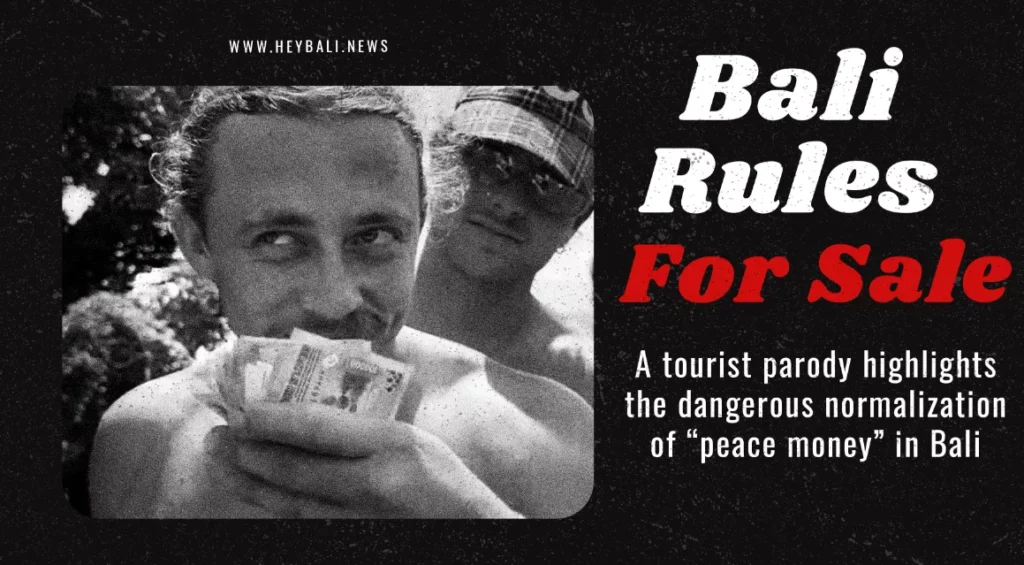
DENPASAR — In a short parody video created by foreign tourists, a traffic police officer in Bali stops two violators. Three people on one motorbike, no helmets, no shirts. The officer says, “You are all under arrest… or,” while his fingers deftly perform the universal gesture for money. The tourist hands over a banknote. The officer breaks into a wide smile, waves them off, and they leave. The scene concludes in 30 seconds.
This video went viral, viewed hundreds of thousands of times, commented on, and accepted as a “truth” that is both humorous and tragic. This is no longer coffee-shop gossip or anonymous complaints on dark forums. It is a digital mirror held up by the guests themselves, reflecting a reality so entrenched it has become a de facto legal culture: in Bali, justice has a negotiable price.
The Dual Damage: Image and Legal System
The impact of this video is seismic and layered. It not only wounds the image but also picks at a deep, systemic sore.
First, the damage to the global image (A Hard-Hit to Branding). For decades, Bali has built itself as the “Island of the Gods”—a destination of spirituality, sublime culture, and mesmerizing nature. The government and local communities have painstakingly promoted sustainable, quality tourism. Yet, this one short video effectively dismantles that narrative, replacing it with a shameful stereotype: Bali is a marketplace, not a destination. Here, rules are suggestions, and law is a commodity.
The effect is clear: quality tourists who value order and justice will question their choice. Meanwhile, unruly tourists looking for a place where they can “buy” their freedom to violate will be drawn in. This is a tragic irony: marketing efforts to attract “good tourists” are defeated by a reputation that coddles “bad tourists.”
Second, and more dangerously, is the damage to the legal system and social justice. The “peace money” phenomenon creates two distinct legal tracks: a cash lane for the affluent, and a procedural lane for the rest.
A wealthy foreign tourist can make a serious violation—like riding three-abreast without helmets—vanish with just Rp 100,000. Meanwhile, a local ojeg driver committing a similar offense must face a lengthy ticketing process, official fines, and possibly license confiscation. This is no longer petty corruption; it is the institutionalization of injustice. The parody serves as evidence of how the authority of law enforcement—meant to be a pillar of order—has been degraded into a subject of roadside jokes and vulgar transactions.
From Parody to Paradox: Why Does This Persist?
This practice endures because it is a short-term, mutually beneficial ecosystem of transgression. For certain law enforcers, it is easy, informal supplementary income. For violators—especially tourists wanting a hassle-free holiday—it is a quick, cheap, and paper-trail-free solution. The system is sustained by collective silence and normalization: “It’s always been like this,” or, “It’s better than the hassle.”
However, the long-term cost is far greater. The price is paid in eroded public trust, weakened legal sovereignty, and a culture of tolerated impunity. When an officer smiles more readily at cash than at the rulebook, what crumbles is not just one incident, but the very foundation of his authority.
The Way Out: From Cash Transactions to Digital Transparency
The momentum for change is ripe. This viral video must be seen not as a disgrace to be buried, but as a blaring wake-up call. The solution must be systemic, bold, and transparent.
- Consistent and Public Zero-Tolerance Policy. The Bali Regional Police Chief must issue a firm directive and launch undercover operations (sting operations) against illegal levies. More crucially, the results must be publicized—not to shame the institution, but to demonstrate commitment. Sanctions for proven offenders must be severe and exemplary.
- Two-Way Enforcement: Receiver and Giver. The law must be applied equally. Foreign tourists caught red-handed offering bribes must be prosecuted, heavily fined, and even deported. This would send a powerful global message: Breaking the law in Bali is a serious matter, and bribery is a grave offense, not a shortcut. This message would be more effective than a hundred “Wonderful Indonesia” campaigns.
- Digitalization and Depersonalization of Law Enforcement. Technology must become a shield against corruption. The existing e-ticketing system must be maximized. Every violation should be recorded digitally, fines paid through official banks or apps, and all cash interaction between violators and officers at the scene eliminated. This transparency would break the chain of temptation.
- Proactive Education and Socialization for Tourists. Upon entry via airport or check-in at hotels, tourists must receive clear information—in their language—about traffic rules and laws in Bali, and the firm consequences of violation, including the attempt to bribe. Make them informed parties, leaving no room for the excuse of “not understanding.”
Choosing Between a Marketplace and a Destination
The “peace money” parody video is ultimately not about police or unruly tourists. It is about Bali’s choice of identity on the global stage.
Will Bali remain a “marketplace” where everything—including traffic safety and legal integrity—can be traded for cash on the roadside? Or will Bali rise and decide to become a true “destination,” a society that respects rules, upholds equal justice, and protects the dignity of its own law?
The answer will not be found in the virality of a video, but in firm political will, leadership with integrity, and the courage to declare that Bali’s future is too valuable to be sold for the price of “peace money.” It is time to turn that shameful parody into a past chapter and write a new narrative where smiles in Bali are born from genuine hospitality, not from a banknote under the table.
Written by Giostanovlatto, Founder of Hey Bali and Observer of Tourism & Sustainability