

































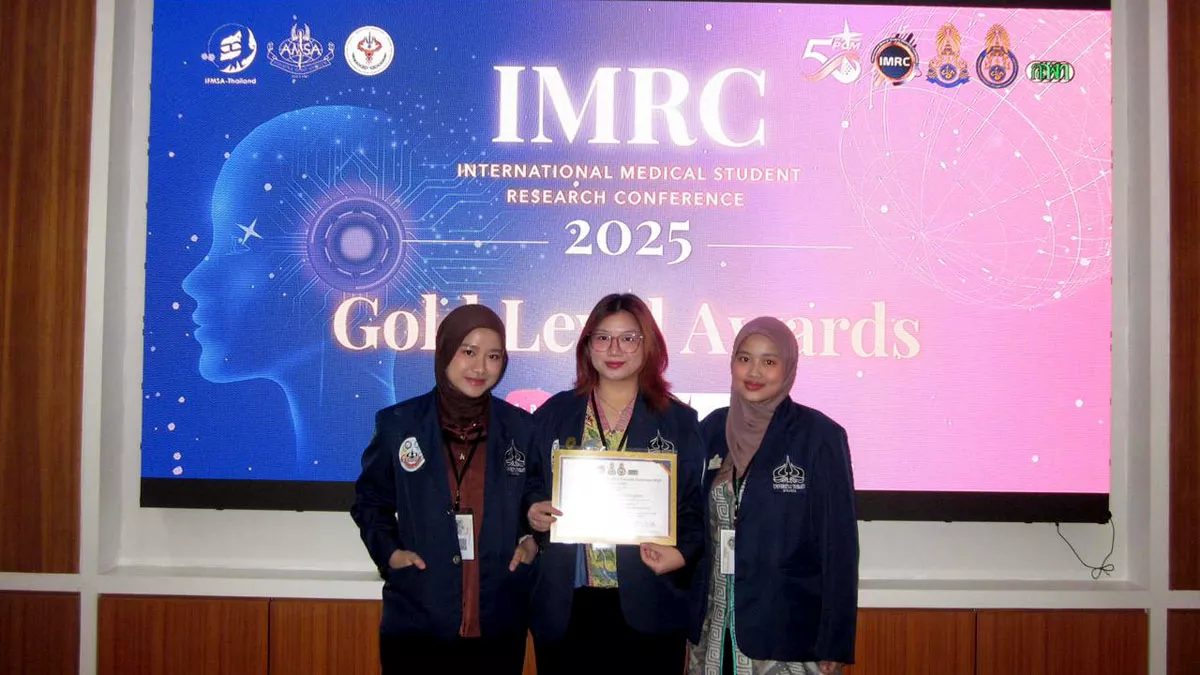
JAKARTA — In a significant validation of Indonesia’s burgeoning medical talent pool, a team of students from Trisakti University’s Faculty of Medicine secured the Gold Medal at the International Medical Student Research Conference (IMRC) 2025, held December 13-14 in Bangkok.
The achievement, in a forum dedicated to “Sustainable Healthcare: Integrating Medical Innovations for Sustainable Development Goals,” signals the rising global caliber of the nation’s future physicians—a development with promising implications for Bali’s evolving landscape as a destination for world-class healthcare.
The winning team, comprising Michelle Valerie Taniwijaya, Ikrimah Diyan Lestari, and Ainurrahmi Wulandari, triumphed in a competitive field of medical students from across the globe. Their success underscores a critical, often overlooked, component of Bali’s appeal to long-term residents and investors: the quality of its human capital.
“For all competition activities participated in by students, the funding is entirely provided by the Faculty,” stated Dr. Yenny, Dean of Trisakti University’s Faculty of Medicine, emphasizing the institutional commitment to fostering excellence. “The University cares deeply about student competitions and creativity, and the Rector’s policy strongly supports this.”
This investment in nurturing talent is pivotal. For expatriates residing in or considering a move to Bali, and for investors eyeing the island’s growing health and wellness sector, the quality of local medical professionals is a paramount concern. The triumph in Bangkok serves as a tangible benchmark, demonstrating that Indonesia’s next generation of doctors is being trained to engage with and excel on an international scientific stage.
The team’s faculty advisor, Dr. Mustika Anggiane Putri, highlighted the rigor behind the victory, noting it proves that “amidst the density of their academic load, FK Usakti students are still capable of achieving in international competitions.”
A Strategic Asset for Bali’s Future

While the award was won far from Bali’s shores, its resonance for the island is direct. As Bali aggressively positions itself not just as a leisure destination but as a holistic hub for premium living, high-quality healthcare infrastructure is non-negotiable.
This achievement is a powerful indicator that the “software”—the highly skilled doctors and specialists—required to support a robust medical tourism and expatriate healthcare ecosystem is actively being developed.
The narrative for Bali is expanding beyond scenic villas and yoga retreats to include a proposition of comprehensive, sustainable living. The success of these medical students aligns perfectly with this vision, offering a credible assurance that the island’s future medical services can be anchored by professionals of internationally competitive caliber. For investors in hospitals, specialized clinics, and wellness centers, this represents a mitigating factor against the perceived risk of a talent gap.
Ultimately, the gold medal from Bangkok is more than an academic accolade; it is a promising data point in the story of Indonesia’s, and by extension Bali’s, ascending profile in global healthcare. It suggests that the island’s ambition to become a center for world-class medical innovation and care is being built on a foundation of emerging, homegrown expertise.