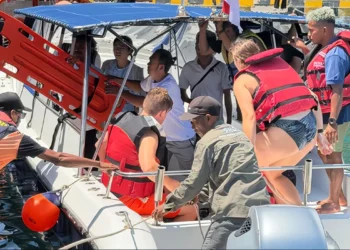


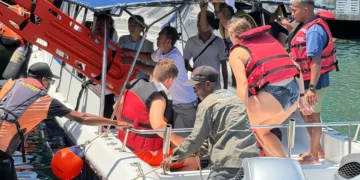




























The sinking of the KM Putri Sakinah, which left three dead and a child missing, has ignited fury in the gateway to Komodo National Park, with protesters calling for the overhaul of the local port authority.
LABUAN BAJO, Indonesia — In the shadow of the office that oversees one of Indonesia’s most famous maritime tourism hubs, a crowd’s anger is palpable.
The recent sinking of the passenger vessel KM Putri Sakinah, resulting in three fatalities and one young boy still missing, has become a catalyst for deeper grievances. A local community forum is now demanding not just answers, but the complete removal of the head of the local Port Authority and Administrative Office (KSOP) and his entire staff, alleging systemic failure and negligence.
The protest, held on January 8, 2026 directly in front of the KSOP Labuan Bajo offices, underscores a crisis of confidence in the institutions tasked with ensuring safety in the waters around Flores Island.
Demonstrators are urging police to immediately name the ship’s owner, the KSOP chief, the captain, and the on-duty crew as suspects in the tragedy.
A Pattern of Neglect and a Search Questioned
The community’s frustration is compounded by what they see as the inadequate official response to the disaster. Speakers at the rally pointedly highlighted that the three recovered victims were found not by the national search and rescue agency, Basarnas, which deployed significant personnel and technology, but by local fishermen in small boats.
“The victims weren’t found by Basarnas, but by fishermen,” a protester stated, a sentiment that echoed through the crowd, questioning the efficacy of substantial state expenditure on emergency response.
This perceived failure has transformed grief into public outrage, framing the incident as a symptom of a broken system.
Calls for Dismissal and Overhaul
The demand from the forum is unequivocal: a full purge of the KSOP leadership. “Withdraw all the incompetent staff!” one speaker demanded, calling for a transparent legal process. “So the national community can see how this case unfolds and what the final result will be.”

References were made to the KSOP chief’s leadership, with one speaker asserting it was clear he “could not demonstrate that he is a good leader at KSOP.”
The protesters framed their action as a defense of their home, with one emphasizing, “We are not racists. We are anti-racist. We are against leaders who have damaged tourism here.”
The tragedy is not viewed in isolation. Protesters cited a history of maritime accidents—claiming 17 incidents—that have resulted in loss of life in the region, accusing authorities of letting patterns of negligence repeat “every year.”
Broader Implications for a Tourism Epicenter
The outcry strikes at the heart of Labuan Bajo’s identity. As the primary launch point for tours to Komodo National Park, the town’s economy and international reputation are inextricably linked to perceived maritime safety and professional oversight.
The community’s anger is laced with a sense of betrayal, that the prosperity generated by tourism has not been matched by investment in competent regulation and safety.
“You already profit from Labuan Bajo,” a speaker addressed authorities, urging them to finally “respect” the local community and its warnings.
The protest concludes with a stark warning to the KSOP: if their demands for accountability are ignored, they promise to escalate their actions.
The message from the streets of Labuan Bajo is clear—the community will no longer silently bear the cost of what they view as institutional incompetence.
The sinking of the KM Putri Sakinah has become a rallying point, a demand that the safety of lives at sea be prioritized over bureaucracy, with the world watching.