
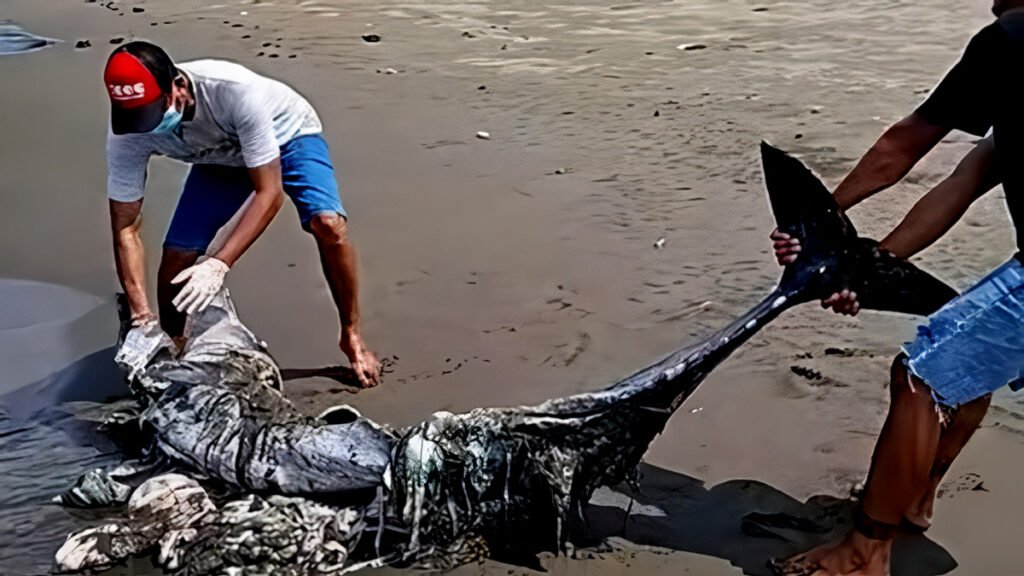
JEMBRANA, Bali — A protected dolphin was found lifeless in shallow waters off Bali’s west coast this week, its body already too decomposed to reveal how it died—turning what could have been a data point into a mystery.
“I received the information last night, but because it was dark and the dolphin was stuck in coral, we couldn’t bring it to shore,” said I Wayan Anom Astika Jaya, coordinator of the Kurma Asih Turtle Conservation Group in Perancak Village, as quoted by detikBali.
By the time volunteers reached the animal on Thursday morning, the opportunity to understand what had happened was already slipping away.
A Discovery Delayed by Hours—and Defined by Them
The dolphin, identified as a long-beaked common dolphin, was found entangled among coral formations near Perancak Beach late Wednesday night. The terrain was difficult, the light gone. Recovery had to wait.
By morning, the body had begun to break down.
In marine conservation, timing is everything. The difference between evidence and uncertainty can be measured not in days, but in hours.
When the animal was finally brought ashore, its condition ruled out a necropsy—the standard procedure used to determine cause of death in stranded marine wildlife.
What remained was a body, a measurement—340 centimeters—and a list of possibilities that could no longer be tested.
Buried Without Answers
Faced with a rapidly deteriorating carcass and worsening conditions, volunteers made a practical decision: bury it.
“We decided to bury it immediately because the carcass was already destroyed and giving off a strong odor,” Anom said.
There would be no lab results. No confirmation of disease, plastic ingestion, fishing gear entanglement, or vessel strike. No definitive cause.
Only absence.
What Gets Lost When Time Runs Out
Strandings like this are not rare in Indonesia. But not all of them become part of the scientific record.
Without rapid response, trained personnel, and proper equipment, critical evidence disappears quickly—especially in tropical climates, where decomposition accelerates.
In many coastal regions, including parts of Bali, the first responders are not marine biologists or forensic teams, but local volunteers.
They retrieve. They measure. They bury.
And often, they are left with questions no one can answer.
A Signal From the Water
Dolphins are more than passing wildlife. As top predators, they are widely regarded as indicators of ocean health.
When one washes ashore, it can point to larger forces at work—pollution, overfishing, vessel traffic, or shifting marine ecosystems.
But when the cause of death cannot be determined, the signal weakens.
In Bali, where marine ecosystems underpin tourism, fisheries, and coastal livelihoods, that loss of clarity matters. The ocean is not only a backdrop to the island’s economy—it is part of its foundation.
The Limits of a System Under Pressure
The incident in Jembrana reveals a structural challenge: response capacity.
Bali’s coastline is long, its waters busy, and its conservation efforts often fragmented. Coordination between local groups, authorities, and scientific institutions can depend on timing, access, and resources that are not always available.
What happened in Perancak was not a failure of effort. It was a limitation of conditions.
Darkness. Terrain. Delay.
And the narrow window in which knowledge can still be recovered.
What Remains
The dolphin has been buried in the sand. The volunteers have returned to their routine work—protecting sea turtles, monitoring nests, tending to a different kind of vulnerability.
Out at sea, the ecosystem that sustained the animal continues, largely unseen.
Its death leaves no confirmed cause. No conclusion. Only a reminder:
In places where nature is both abundant and under pressure, not every loss can be explained.
And sometimes, the most important questions are the ones that arrive too late to answer.
Why This Matters for Bali—and Beyond
For travelers, the image of Bali is often defined by beauty: clear water, marine life, vibrant ecosystems. But beneath that surface lies a more complex reality—one where conservation depends not only on awareness, but on infrastructure.
Rapid response. Scientific capacity. Coordination.
Without them, even protected species can disappear without leaving behind the evidence needed to protect what remains.
The Bottom Line
A dolphin died off Bali’s coast. That, in itself, is not unprecedented.
What is more telling is what could not be learned.
Because in marine conservation, the greatest loss is not only the animal—but the knowledge that dies with it.