
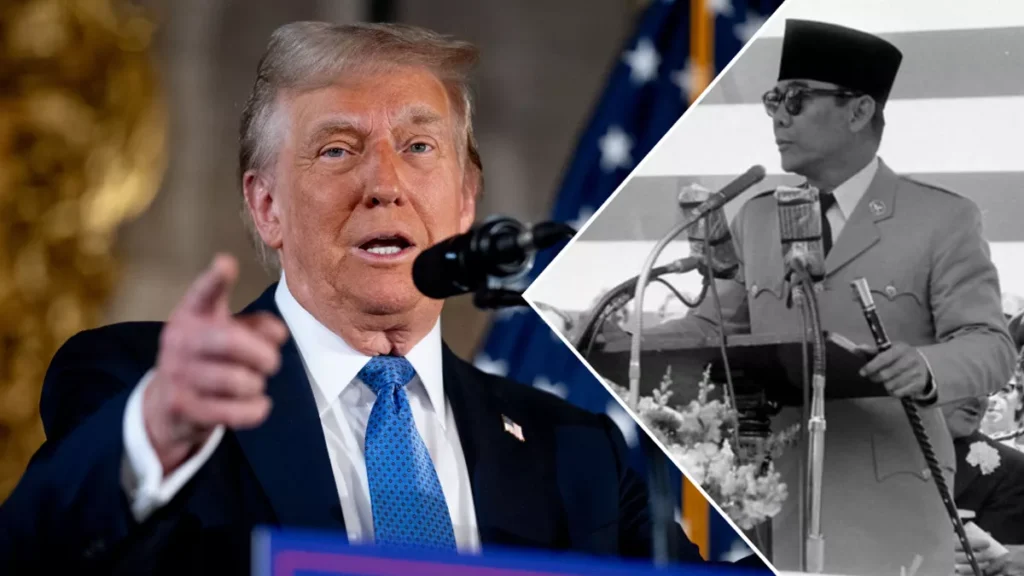
The U.S. initiative to form a new Gaza Peace Council recalls Indonesia’s short-lived but bold 1960s effort to create a rival global body for emerging nations.
WASHINGTON / JAKARTA — A recent diplomatic maneuver by the United States has drawn an unexpected historical parallel from Southeast Asia. The formation of a U.S.-led Gaza Peace Council, announced by President Donald Trump and viewed by many analysts as a step toward a “new UN,” mirrors a strategy Indonesia pursued nearly six decades ago during the Cold War.
Frustrated with what it saw as a Western-dominated and neocolonial United Nations, Indonesia under President Sukarno took the radical step of withdrawing from the world body and establishing a rival organization—the Conference of the New Emerging Forces (CONEFO).
A Shared Disillusionment with the UN
The current U.S. administration’s growing distance from the United Nations, marked by withdrawals from several UN agencies, finds a historical echo in Sukarno’s Indonesia. By the early 1960s, Sukarno argued that the UN had become an instrument of old colonial powers (dubbed Old Established Forces, or OLDEFO). His response was to champion the New Emerging Forces (NEFO)—newly independent nations in Asia and Africa—and create CONEFO as their platform on January 7, 1965.
The final trigger for Indonesia was the UN Security Council’s acceptance of Malaysia as a non-permanent member. Sukarno viewed the formation of Malaysia as a neocolonial British project threatening Indonesian sovereignty. The UN’s embrace of Malaysia confirmed, in his view, the body’s inherent bias.
The Brief Life of a Diplomatic Rival
CONEFO was conceived as a direct counterbalance to the UN and a third pole outside the U.S. and Soviet blocs. Initial members included China, North Korea, and North Vietnam. Indonesia’s voluntary exit from the UN to lead this new body sent shockwaves through global diplomacy; it was an unprecedented act of defiance against the post-war international order.
However, CONEFO’s existence was brief. Following Sukarno’s fall from power, Indonesia’s foreign policy shifted dramatically under President Suharto. Seeking reintegration into the global system and the resumption of vital foreign aid, Indonesia rejoined the UN on September 28, 1966. CONEFO faded into history, leaving Indonesia with the unique distinction of being the only nation to have voluntarily left the UN to establish an alternative.
A Historical Footnote with Modern Resonance
While the geopolitical contexts of the 1960s and today are vastly different, the core impulse—creating a new multilateral forum outside an existing structure perceived as unfair or unresponsive—shows a striking symmetry. The U.S.-led Gaza Council, while focused on a specific conflict, represents a similar willingness to operate outside traditional UN frameworks in pursuit of a recalibrated diplomatic order.
For the international community, and particularly for global observers in hubs like Bali, this historical parallel serves as a reminder of how nations have periodically sought to reshape the architecture of global governance when they feel their voices are marginalized within the established system.
Hey Bali News provides analysis on international affairs with relevance to our globally-connected audience.