
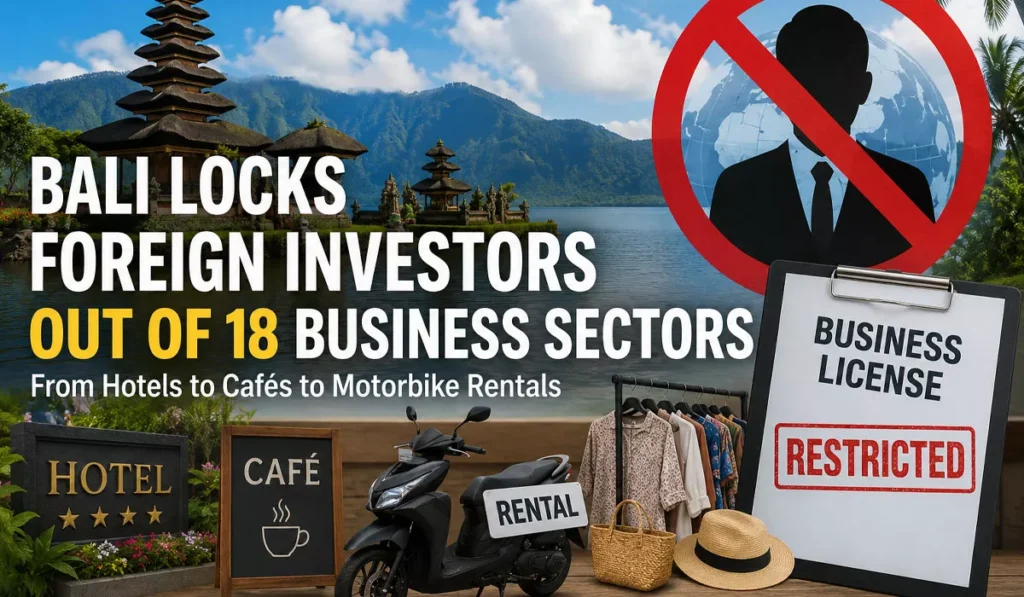
Bali’s provincial government has shut off foreign investment access to 18 categories of small and medium-sized businesses, ranging from budget hotels and cafés to motorbike rentals and clothing retail, in one of the most sweeping regulatory moves yet to protect the island’s local business owners from foreign competition.
The restriction blocks foreign investors from submitting new business licenses through Indonesia’s Online Single Submission (OSS) system for the affected categories, following an investigation that found foreign-owned companies had been exploiting loopholes in the country’s risk-based licensing framework to operate in sectors long dominated by Indonesian micro, small, and medium enterprises (UMKM).
How Foreign Investors Were Getting In
Bali Governor Wayan Koster said the province’s licensing evaluation team found that a number of foreign investment companies (PMA) had been taking advantage of gaps in Indonesia’s risk-based licensing system by registering under low-risk and medium-low-risk business classifications.
“The Bali Provincial Government’s licensing evaluation team sought to identify indications of abuse of the risk-based business licensing system by investors seeking to enter business sectors closely tied to micro, small, and medium enterprises,” Koster said in Denpasar on Thursday, July 23, 2026.
The loophole centered on Indonesia’s KBLI (Indonesian Standard Business Classification) system. Businesses registered under low-risk categories only need a Business Identification Number (NIB) to receive automatic approval, without the substantial investment commitments, standard certifications, or additional permits typically required of foreign-owned companies. That gap, Koster said, made it easy for foreign investors to enter UMKM-dominated sectors, in some cases using nothing more than a virtual office address.
“This condition has the potential to create unhealthy business competition and place significant pressure on the survival of local business operators, particularly UMKM, in sectors that should instead be encouraging partnerships with cooperatives and small businesses,” Koster said.
Approved at the National Level, Already in Effect Since May
The decision to close OSS access for these categories was approved by Indonesia’s Minister of Investment and Downstream Industry, who also serves as Head of the Investment Coordinating Board (BKPM). Once approval was granted, Bali’s provincial government moved immediately to restrict OSS access for the affected low-risk and medium-low-risk business fields.
“The closure of OSS access has been in effect across the entire province of Bali since the third week of May 2026,” Koster said.
The 18 Restricted Business Categories

| # | Business Sector (KBLI Category) |
|---|---|
| 1 | Star-rated hotels with building area under 6,000 square meters |
| 2 | Budget hotels (Melati-class) |
| 3 | Self-owned or rented real estate |
| 4 | Other management consulting activities |
| 5 | Car, bus, and truck rental |
| 6 | Clothing retail trade |
| 7 | Textile retail trade |
| 8 | Motorcycle rental (without purchase option) |
| 9 | Other food retail trade |
| 10 | Mobile retail trade of agricultural food products |
| 11 | Other accommodation services |
| 12 | Cafés and coffee shops |
| 13 | Traditional medicine shops/stalls |
| 14 | Custom tailoring and garment-making |
| 15 | Stadium facilities |
| 16 | Fitness center facilities |
| 17 | Sports event promotion |
| 18 | Industrial management consulting |
What This Means for Existing Foreign-Owned Businesses


The restriction blocks new business license applications from foreign investors through OSS for these 18 categories, and will remain in place until further policy guidance is issued in accordance with Indonesian law.
Foreign-owned companies that were already operating in these sectors before the restriction took effect are not required to shut down, but they remain obligated to submit periodic Investment Activity Reports (LKPM) until the relevant KBLI classifications are formally deactivated or removed from the licensing system.
Koster said Bali’s provincial government, together with regency and municipal governments across the island, will take action against any licensing violations identified going forward.
Foreign Investment Isn’t Banned, Just Redirected
Koster was careful to frame the policy as a targeted correction rather than a broader retreat from foreign investment. Bali, he said, remains open to investment that genuinely benefits the region.
“Investment coming into Bali is expected to align with the island’s development vision, respect local wisdom, and support the strengthening of a people’s economy built on small and medium enterprises,” Koster said.
Why This Matters for Foreign Entrepreneurs and Investors in Bali
For the island’s substantial community of foreign business owners, cafés, guesthouses, boutique retail shops, and rental operations have long been common ventures for expats and international investors, often registered through exactly the kind of simplified low-risk KBLI pathway this policy now closes. This restriction effectively ends that route for new applicants, while leaving unresolved questions about long-term treatment of businesses that entered through the same pathway before May 2026.
For prospective investors, the message is unambiguous: routes into Bali’s hospitality, retail, and consulting sectors that relied on low-risk registration shortcuts are no longer available, and legal consultation with a licensed Indonesian business attorney is now essential before attempting to register a new business in any of the 18 restricted categories.


Frequently Asked Questions
Which specific business categories are now restricted from foreign investment in Bali?
The restriction covers 18 KBLI categories, including budget and star-rated hotels under 6,000 square meters, cafés, motorcycle and vehicle rentals, clothing and textile retail, custom tailoring, fitness centers, traditional medicine shops, and various consulting services closely tied to small business activity.
When did this restriction take effect?
The OSS access closure has been in effect across all of Bali since the third week of May 2026, according to Governor Koster.
Can foreign investors still open new hotels or cafés in Bali?
Not through the standard low-risk OSS registration pathway for the 18 restricted categories. New foreign business license applications for these sectors can no longer be submitted through OSS until further government policy is issued.
What happens to foreign-owned businesses that already exist in these sectors?
Existing foreign-owned businesses are not required to close, but must continue submitting periodic Investment Activity Reports (LKPM) until the relevant business classifications are formally removed from the licensing system.
Is Bali banning all foreign investment?
No. The restriction targets specific low-risk business categories closely tied to small and medium enterprises. Bali’s government has stated it remains open to foreign investment that aligns with the island’s development goals and supports partnerships with local cooperatives and small businesses.
What should foreign investors do if they’re considering a business in Bali?
Given the scope of this restriction, consulting a licensed Indonesian business or immigration attorney before registering any new venture is strongly recommended, particularly for anyone considering hospitality, retail, rental, or consulting businesses that may fall under one of the 18 restricted KBLI classifications.