
BULELENG, Bali — Under the cover of darkness on Bali’s northern coast, a shipment of endangered sea turtles was quietly making its way toward the illegal wildlife market.
The journey had begun hundreds of kilometers away in the waters off Madura, East Java. Its destination was Bali, where authorities believe the protected animals were destined to be traded through an illicit network that continues to operate despite decades of conservation efforts.
The operation came to an abrupt end on the night of June 10 when officers from the Bali Police Water and Air Directorate raided Pegametan Beach in Gerokgak, Buleleng.
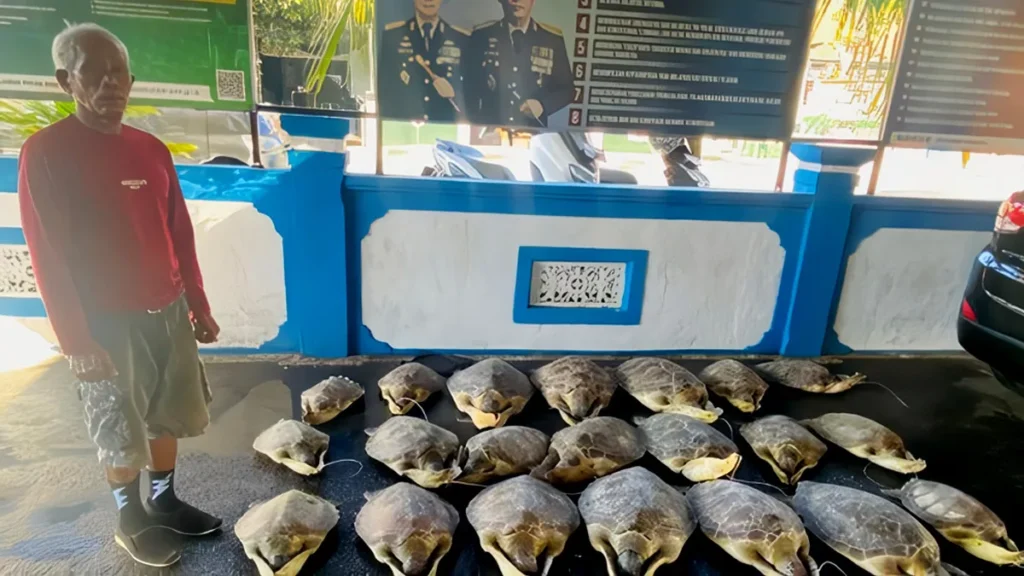
Inside a temporary holding area, police discovered 21 live green sea turtles (Chelonia mydas), one of the world’s most vulnerable marine species and a protected animal under Indonesian law.
A 67-year-old man identified only by the initials KS was arrested at the scene. Two other suspects, known as Iwan (30) and KMG (35), remain at large and have been placed on Indonesia’s wanted list.
According to AKBP Nanang Pri Hasmoko, Head of the Law Enforcement Sub-Directorate of Bali Police Water and Air Directorate, the case began after local residents reported suspicious activity along the coastline of Pegametan Beach in Sumberkima Village.
The information prompted investigators to launch surveillance operations in the area before carrying out the late-night raid.
“From the initial interrogation, the suspect admitted that the 21 green turtles had been sent by an individual named Iwan from the waters of Madura, East Java,” Nanang said in a statement on Friday.
Police allege that KS was responsible for receiving and storing the turtles upon their arrival in Bali before they were collected and distributed by another suspect, KMG.
Authorities believe the case may be part of a broader wildlife trafficking network operating between East Java and Bali.
Investigators are now working to determine how the turtles were transported across provincial waters and whether additional individuals were involved in the operation.
The seizure highlights an uncomfortable reality behind Bali’s image as a tropical paradise and conservation destination.
While the island has spent years promoting wildlife protection and sustainable tourism, illegal trafficking of protected species remains a persistent threat.
Green turtles are classified as endangered and face growing pressure from habitat destruction, pollution, accidental capture, and illegal hunting. Their slow reproductive cycle makes every rescued adult particularly valuable to the survival of future populations.
For decades, Bali has played a significant role in Indonesia’s sea turtle conservation movement, transforming public attitudes toward a species that was once widely exploited.
Conservation groups warn that the illegal trade continues to target turtles for meat, ceremonial use, shells, and other commercial purposes despite strict legal protections.
The suspect has been charged under Indonesia’s revised conservation laws, including provisions contained in Law No. 32 of 2024 concerning the Conservation of Biological Natural Resources and Ecosystems.
If convicted, he faces up to 15 years in prison, along with substantial financial penalties for possessing, transporting, storing, and trading protected wildlife.
Police also seized a gray Nokia mobile phone believed to have been used to coordinate the operation.
Meanwhile, officers continue searching for the two remaining suspects and are expanding the investigation to identify other members of the network.
For the 21 rescued turtles, the outcome is far more hopeful.
Authorities say the animals have been secured and will undergo assessment before any future release into their natural habitat.
But investigators believe the larger story may not end with a single arrest.
Somewhere between the waters of Madura and the beaches of northern Bali, the network that moved them may still be operating.
And police say the hunt is far from over.