









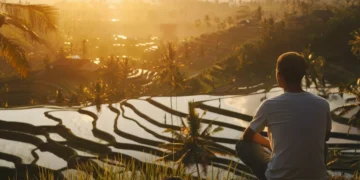








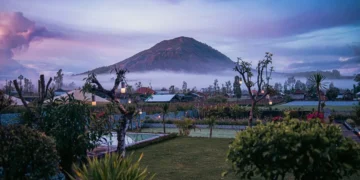



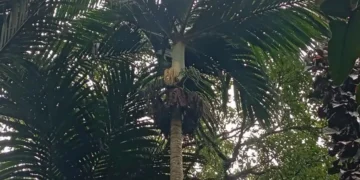

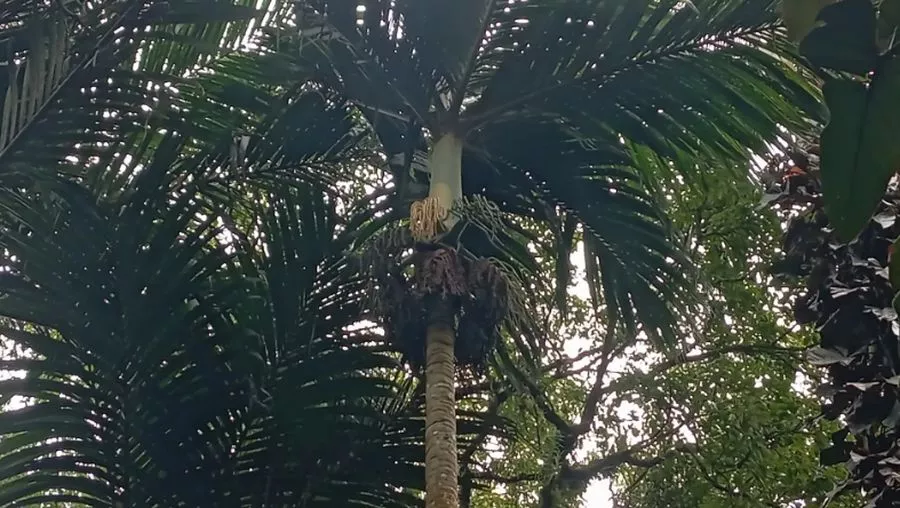
The nyabah palm grows only in the misty highlands of Bedugul and Jatiluwih. Now, with its habitat under pressure, researchers have mapped its DNA—creating a safeguard should it disappear from the wild.
BEDUGUL, Bali — In the cool, cloud-covered highlands above Bali, a palm species grows that exists nowhere else on earth. Its leaves are woven into Hindu offerings. Its young shoots are eaten. Its fruit substitutes for betel nut in traditional practices.
But the nyabah palm (Pinanga arinasae) is losing ground.
Confined to scattered forest pockets in Bedugul and Jatiluwih, the plant is now considered endangered as habitat pressures steadily narrow the conditions it depends on.
“The leaves are used in Hindu ceremonies across Bali,” said Arief Priyadi, a researcher at Indonesia’s National Research and Innovation Agency (BRIN). “It is not only a plant in the forest — it is part of daily cultural life.”
If the palm disappears, he added, a botanical species would vanish alongside a material woven into ritual tradition.
A Genetic Safeguard
To prevent that outcome, researchers have turned to a tool unavailable to earlier generations: genome sequencing.
Scientists from BRIN’s Center for Applied Botany Research have decoded the complete DNA of the nyabah palm, creating a permanent biological record of the species.
“For this palm, genome sequencing is not merely academic,” Priyadi said. “It is an effort to preserve knowledge of the species itself.”
Using fresh leaf samples collected in the highlands, researchers mapped its genetic structure and deposited the data in international scientific databases accessible worldwide.
The result is a safeguard. Even if the plant were lost in the wild, its biological blueprint would remain available for future restoration or cultivation efforts.
More Than a Forest Plant
To most visitors, the nyabah palm blends into Bali’s dense mountain vegetation. To Balinese Hindus, however, it appears regularly in ritual offerings placed at homes and temples across the island.
Its value lies not in rarity but familiarity. It is a material quietly present in daily religious practice.
Ni Putu Sri Asih, a researcher at BRIN’s Center for Biosystematics and Evolution Research, said sequencing the chloroplast genome also helps scientists understand how the species evolved and how best to conserve it.
“The genetic data allows further study and supports long-term sustainability planning,” she said.
A Narrow Ecological Window
Unlike widespread tropical palms, Pinanga arinasae evolved within a very specific environment: cool temperatures, volcanic soil, and persistent mountain moisture.
A 2022 study in the journal Diversity proposed classifying the species as Endangered under IUCN criteria, identifying elevation and forest floor conditions as critical to its survival.
As agriculture, settlement, and tourism infrastructure expand into upland areas, those conditions become increasingly fragmented.
What Can Still Be Saved
Sequencing the genome does not protect the plant in the wild. Conservation still depends on safeguarding habitat and possibly cultivating the species outside its natural range.
What the research ensures is simpler but profound: disappearance would no longer mean total erasure.
The nyabah palm still grows in Bali’s highland mist today.
Whether future generations encounter it as a living tree or only as stored data will depend not on science alone, but on the landscapes that remain around it.