
For more than a century, one piece of parental advice has survived nearly unchanged: wait 30 minutes after eating before getting back in the water, or risk cramps severe enough to drown. It’s the kind of warning repeated so often, by parents, camp counselors, and lifeguards alike, that most people never think to question it.
But according to major medical institutions and drowning researchers who have studied the claim directly, the “30-minute rule” isn’t based on science. It’s based on a century-old misunderstanding that somehow never went away.
Where the Myth Actually Came From
The eating-then-swimming warning can be traced back with unusual precision. According to Britannica and multiple medical sources, the claim first appeared in the original 1911 Boy Scouts of America handbook, which cautioned that “many boy swimmers make the mistake of going into the water too soon after eating,” warning that digestion would stop, “congestion is apt to follow, and then paralyzing cramps.”
That single passage remained in Boy Scout handbooks in some form for more than 50 years, until 1967, embedding itself deeply enough into American culture that it’s still repeated by parents today, more than a century after it was first written, and long after the medical basis for it was debunked.
“The myth has been circulating in American parenting culture for over a century,” according to water safety organization WaterWiseKids, which notes an earlier version of the same warning appeared as far back as a 1908 Boy Scouts handbook.
What Doctors and Researchers Actually Say
The core claim behind the myth sounds plausible on the surface: after eating, blood flow is redirected to the digestive system, leaving less blood available for the muscles used in swimming, theoretically causing debilitating cramps.
But according to Dr. Charles Smith of the Family and Preventative Medicine Department at the University of Arkansas for Medical Sciences (UAMS), “there is no medical evidence to support the myth.” He explains that while blood flow to the stomach and intestines does increase after eating, “you have more than enough oxygen to supply your stomach and muscles” simultaneously.
The Mayo Clinic reaches the same conclusion. “We know now that really there is no scientific basis for that recommendation,” said Dr. Boniface, a Mayo Clinic physician, in a Mayo Clinic Minute segment addressing the myth directly. “You may end up with some stomach cramping or a muscle cramp, but this is not a dangerous activity to routinely enjoy.”
Duke Health offers a similar assessment. According to Dr. Messick at Duke, the body does supply extra blood to aid digestion, “but not enough blood to keep your arm and leg muscles from properly functioning.” The most likely consequence of swimming on a full stomach, according to Duke Health, is a minor cramp, not a life-threatening event.
The American Red Cross Has Reviewed the Evidence, and Found Nothing
Perhaps the most authoritative rebuttal comes from the American Red Cross Scientific Advisory Council, which has directly addressed the myth in published guidance. “There is no documented case in any medical literature connecting swimming after eating with drowning or significant health risks,” the council states.
The Red Cross guidance goes further: “Eating before swimming had no effect on swimming performance and minimal side effects at several different time intervals after a meal.” Crucially, the organization notes that “no major medical or safety organizations make any current recommendations to wait before swimming after eating.”
A Drowning Researcher’s Blunt Assessment
Few people have studied drowning risk more directly than Dr. Linda Quan, an emergency physician at Seattle Children’s Hospital who has spent much of her career researching drowning prevention. Speaking to Inverse, Quan didn’t mince words about the eating myth.
“The bottom line is: there is no science, no basis to this issue,” Quan said. She added, with some exasperation, that the persistence of the myth despite a complete lack of supporting evidence remains one of the more frustrating misconceptions she encounters each summer.
So What Actually Happens If You Swim on a Full Stomach?

The honest answer, according to every medical source examined, is: very little. Britannica notes that digestion takes roughly four hours from the moment food is eaten until it clears the stomach, and during that window, the body does divert some oxygen and energy toward digestion. But the human cardiovascular system isn’t a fixed pipeline with a limited supply to allocate, it compensates dynamically, delivering adequate blood flow to both the digestive system and working muscles at the same time.
The worst-case scenario, according to Britannica, Duke Health, and the Mayo Clinic alike, is mild discomfort: a side stitch, minor stomach cramping, or a sense of sluggishness, not the dramatic, drowning-inducing cramp the myth describes. Even competitive swim coaches back this up. “I have never seen a swimmer get a muscle cramp from eating right before, not even once, and this is my 18th year [coaching],” Calgary swim coach Tammy Andersen told CBC.
One Small Caveat Worth Knowing
While the drowning risk is essentially nonexistent, doctors do offer one practical caveat: eating a very large, heavy meal immediately before vigorous physical activity, like a full pizza before jumping into a pool, can cause genuine nausea or discomfort simply from the physical jostling involved, not from any dangerous cramping mechanism. As Andersen put it, “I wouldn’t recommend eating a huge meal… just because you might get sick, because you’re jumping around.”
For competitive or endurance swimmers, meal timing still matters for performance reasons. Nutrition experts at Duke’s Diet & Fitness Center recommend eating a combination of carbohydrates and protein two to three hours before intense exercise for sustained energy, not because of any cramp-related danger, but simply for optimal athletic performance.
What This Means for Your Next Beach Day

After more than a century of repetition, the “wait 30 minutes before swimming” rule has been directly and repeatedly examined by the Mayo Clinic, Duke Health, the American Red Cross Scientific Advisory Council, UAMS, and drowning researchers, and none have found evidence to support it. The advice appears to trace back to a single, unverified claim in a 1911 Boy Scouts handbook that simply never got corrected in the public imagination.
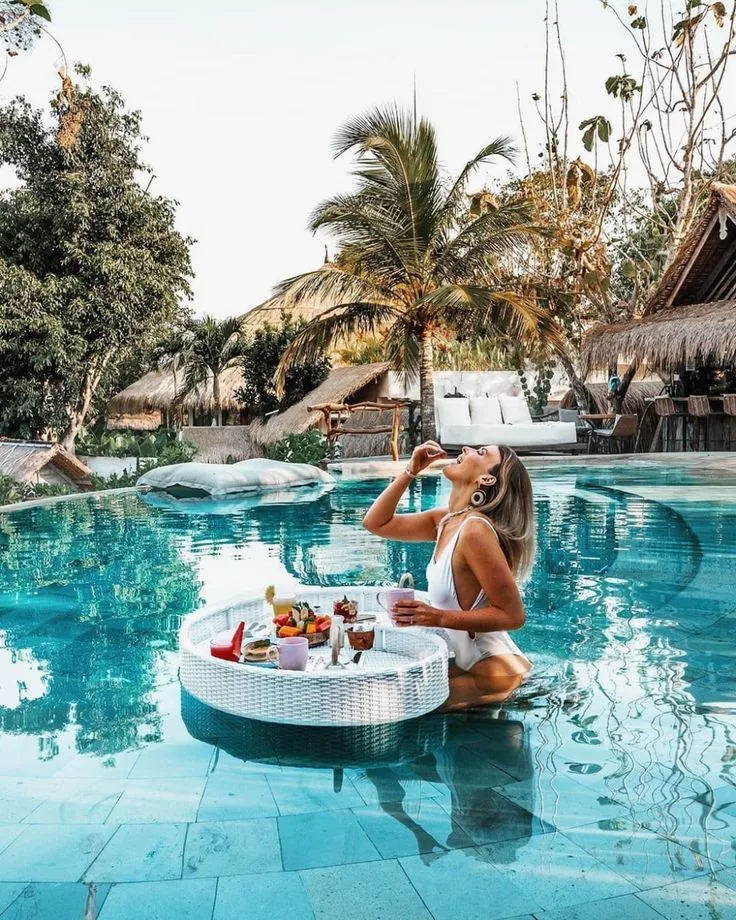
For travelers and expats in Bali, this is genuinely useful to know. Between beach clubs serving lunch a few steps from the sand in Canggu and Seminyak, pool-side dining at Uluwatu resorts, and family days spent moving between a warung meal and the villa pool, the old “wait 30 minutes” instinct often gets in the way of simply enjoying the water. The science says that instinct isn’t necessary.
That said, Bali’s real water safety risks are worth taking seriously, and they have nothing to do with meal timing. Strong currents and rip tides are common along many of Bali’s most popular beaches, ocean conditions can shift quickly, and alcohol consumption, common at beach clubs and sunset gatherings, remains one of the most significant factors in drowning incidents worldwide. Swimming ability, supervision of children near pools and open water, and awareness of flag warnings at Bali’s beaches matter far more than whether you’ve just finished lunch.
So the next time a plate of nasi goreng and a pool or ocean both present themselves on the same afternoon, the science suggests there’s no need to wait, just be mindful of the current, skip the extra Bintang before swimming, and don’t dive in straight after finishing an entire pizza.