


























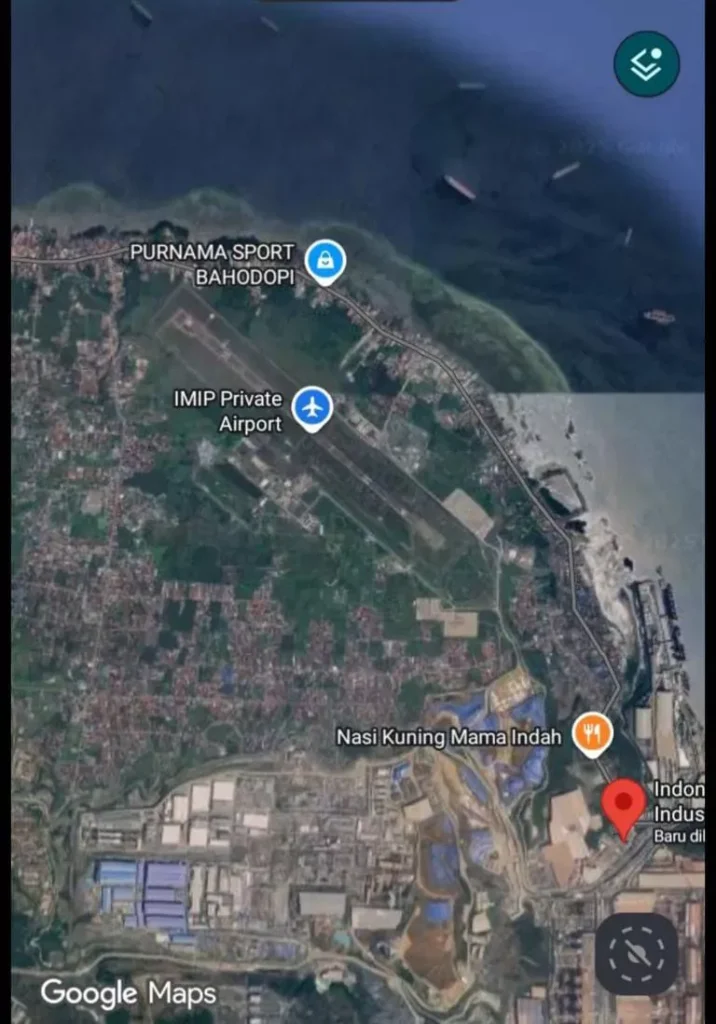
JAKARTA — The discovery of a privately operated airport functioning without state oversight inside the PT Indonesia Morowali Industrial Park (IMIP) complex has ignited national security concerns, with defense officials warning against what they describe as “a republic within a republic.”
The revelation comes as Defense Minister Sjafrie Sjamsoeddin publicly condemned the absence of immigration, customs, or any state apparatus at the facility following integrated military exercises in Central Sulawesi last week.
“This is an anomaly—an airport without state presence creates vulnerabilities in our economic sovereignty,” Minister Sjafrie stated, vowing regulatory enforcement while stopping short of naming the specific facility.
Long-Standing Warnings
The situation echoes familiar patterns seen in Bali’s ongoing struggles with unauthorized developments, though on a dramatically larger scale. According to IWO Chairman Teuku Yudhistira, the signs have been visible for years.
“President Prabowo himself highlighted revenue leaks from the mining sector during the 2019 presidential campaign,” Yudhistira noted. “The illegal airport confirms these warnings were based on valid intelligence.”
Yudhistira urged immediate presidential action to shut down the operation and investigate high-ranking executive branch officials allegedly holding shares in IMIP.
Security Breach and Criminal Concerns
Beyond sovereignty issues, investigators warn the unmonitored airstrip creates ideal conditions for transnational crime.
“Drug smuggling and human trafficking likely occur on a massive scale here,” Yudhistira added, citing evidence of increased narcotics circulation in Morowali since the airport began operations.
The facility, reportedly inaugurated by former President Joko Widodo in 2019, has operated for six years without customs, immigration, or aviation authority presence—raising questions about how such a breach could persist undetected.
Beyond sovereignty issues, investigators warn the unmonitored airstrip creates ideal conditions for transnational crime. “Drug smuggling and human trafficking likely occur on a massive scale here,” Yudhistira added, citing evidence of increased narcotics circulation in Morowali since the airport began operations.
The facility, reportedly inaugurated by former President Joko Widodo in 2019, has operated for six years without customs, immigration, or aviation authority presence—raising questions about how such a breach could persist undetected.
Bali Parallels: Sovereignty Versus Development
The Morowali case mirrors Bali’s ongoing tension between economic development and regulatory control. Where Bali faces illegal cliffside lifts and beachfront constructions, Morowali represents an industrial-scale sovereignty challenge.
Indonesia Strategic and Defense Studies researcher Edna Caroline confirmed the airport has prevented even security personnel from entering. “They have their own airport with no Indonesian authority—meaning people and goods move unchecked through closed territory.”
Defense Minister Sjafrie’s “no state within a state” declaration carries particular weight given Bali’s recent crackdown on zoning violations. As Bali’s Special Committee on Spatial Planning demolishes illegal structures in coastal areas, Morowali presents a national-scale test of the same principle.
Investment Implications
For Bali-based investors and developers, the Morowali case signals tightening enforcement nationwide. The government’s demonstrated willingness to confront powerful interests—whether in tourism or mining—suggests:
- Reduced tolerance for regulatory exceptions, even in strategic industries
- Increased military involvement in economic zone oversight
- Potential review of other private facilities operating with limited state supervision
As President Prabowo evaluates the defense minister’s findings, the outcome will likely influence how Bali balances its tourism economy with environmental and sovereignty concerns—proving that whether in mining or hospitality, the era of unchecked development may be ending across Indonesia.