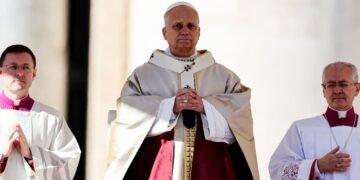




















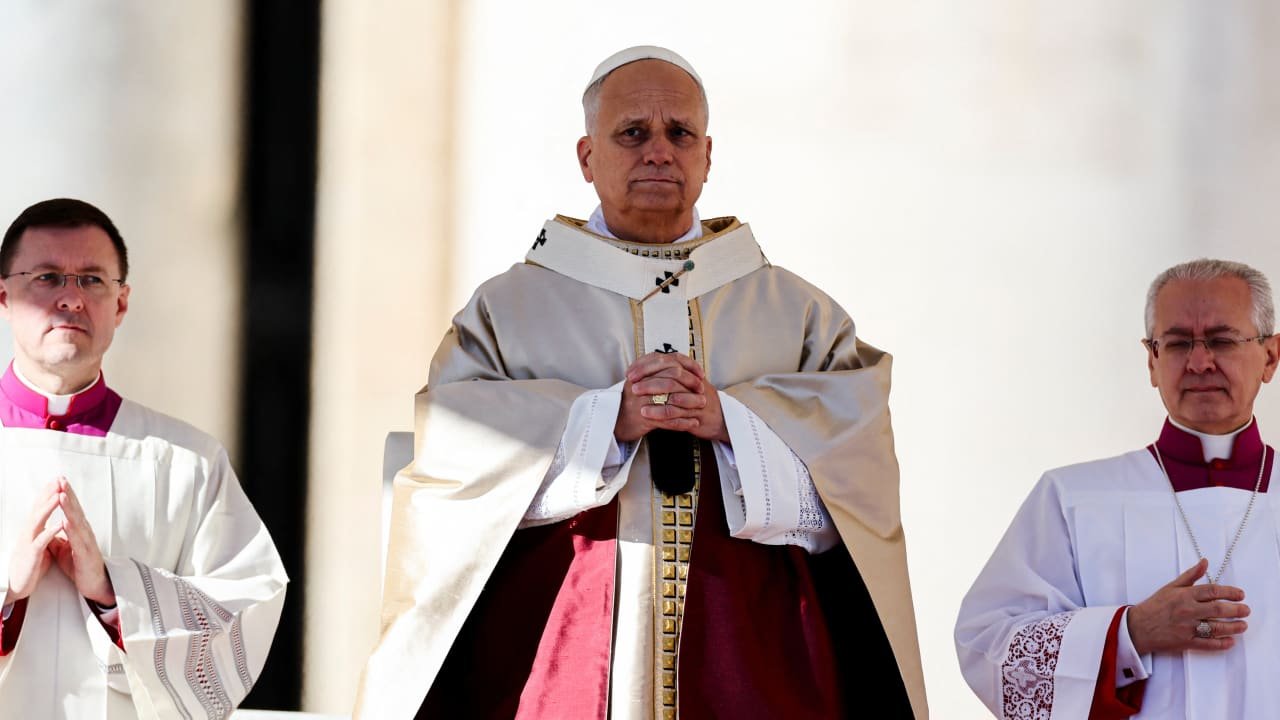
VATICAN CITY — In a moment that cut through both theology and geopolitics, Pope Leo XIV delivered one of his most direct warnings to date: faith cannot be used to justify war.
Speaking before tens of thousands gathered in St. Peter’s Square on Palm Sunday, the Pope framed his message with unusual clarity. As global tensions continue to rise—particularly amid the ongoing U.S.-Israel military campaign against Iran—his words carried both spiritual weight and unmistakable political resonance.
“This is our God: Jesus, King of Peace, who rejects war, whom no one can use to justify war,” Leo said.
Then came the line that would echo far beyond the Vatican:
“Even though you make many prayers, I will not listen: your hands are full of blood.”
The quotation, drawn from scripture, was not new. But in the current context, it landed differently.
A Moral Line in a Political Moment
The Pope did not name specific leaders. He did not need to.
His remarks came as the conflict involving the United States, Israel, and Iran entered its second month—a confrontation already marked by airstrikes, rising casualties, and a growing sense of global unease.
For weeks, Leo has called for an immediate ceasefire. More recently, he described certain military strikes as indiscriminate and argued they should be prohibited altogether.
Sunday’s message went further.
It was not only a call for peace—it was a rejection of the idea that war can be morally framed through religion.
When Faith Meets Power
The timing of the statement is critical.
In Washington, some officials have openly invoked religious language in connection with the military campaign. U.S. Defense Secretary Pete Hegseth, who now leads Christian prayer services at the Pentagon, recently prayed for what he described as “overwhelming violence of action against those who deserve no mercy.”
For the Vatican, this merging of faith and force appears to have crossed a line.
Leo responded not with political language, but with a theological counterpoint—returning to the image of Jesus not as a warrior, but as a figure who refused violence even in the face of arrest and death.
“He did not arm himself, or defend himself, or fight any war,” the Pope said. “He revealed the gentle face of God, who always rejects violence.”
A Diplomatic Shockwave
Though framed in religious terms, the implications of the Pope’s remarks are unmistakably global.
In diplomatic circles, such statements are rarely neutral. When a pontiff—particularly the first American Pope—draws a moral boundary this clearly, it resonates not only within the Church’s 1.4 billion followers, but also among governments navigating the politics of war and legitimacy.
Observers have described the statement as a quiet but powerful rebuke of policies associated with figures like Donald Trump and Benjamin Netanyahu, whose approaches to the conflict have been closely watched and widely debated.
The Vatican, long known for measured language, appears to be signaling a shift: less ambiguity, more clarity.
Why It Matters Beyond Europe
For audiences far from Rome—including in places like Bali, where global events often feel distant but are never disconnected—the message carries a broader relevance.
War is no longer a localized event. Its consequences travel—through energy markets, through tourism flows, through economic uncertainty.
But beyond those material effects lies something less tangible: the narrative.
When religion is used to justify violence, it reshapes not only policy, but perception—of nations, of cultures, of moral authority itself.
Leo’s intervention challenges that narrative.
The Question at the Center
At its core, the Pope’s message returns to a question as old as conflict itself:
Can faith be used to justify war?
His answer was unambiguous.
No.
And in saying so, he did more than deliver a sermon.
He drew a line—between belief and power, between prayer and violence—and made clear that, in his view, the two cannot stand together.