































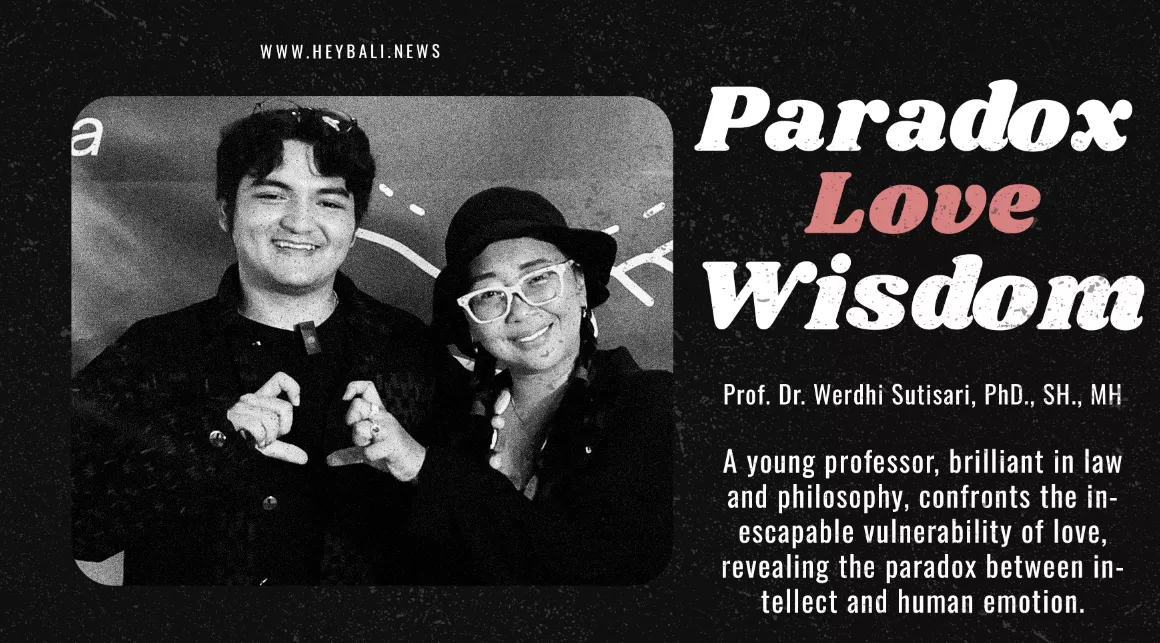
There is an irony rarely discussed honestly within academic circles. A professor, lawyer, and thinker trained to impose order through logic, law, and philosophy can find herself powerless before the most human force of all: love. This is the core of a radical philosophy: Love as Failure.
Prof. Dr. Werdhi Sutisari, PhD, SH, MH, embodies that paradox of love. In courtrooms and lecture halls, she is known for precision. She writes about artificial intelligence, social security systems, and public ethics. She teaches philosophy with a firm belief that human beings must think freely. Yet in her personal life, she confronts a reality that refuses to obey statutes, theories, or syllogisms.
Love as Failure in her story is not a place of victory. It arrives instead as a series of failures that force an intellectual to question the very foundation of her knowledge. The higher one’s rational authority, the more exposed one becomes when facing emotions that cannot be judged or resolved.
As a lawyer, Prof. Tissa has long witnessed marriages collapse across legal tables. She has seen love translated into lawsuits, demands, and divorce certificates. When failure entered her own life, the law offered no refuge. Love, she realized, cannot be settled through procedural justice. This is the first lesson in accepting love as failure.
From Personal Experience to Public Philosophy
From this personal wreckage emerged a conclusion uncommon among legal scholars. Love is not about success, but about failure that must be acknowledged. Not a humiliating failure, but one that liberates.
“The book was born from many of my failures in love,” she states. “It’s about the failure to understand love’s meaning.”
Love as Failure becomes dangerous when treated as an achievement. In that moment, people begin to dominate one another and lose the very wisdom love should impart. What is meant to free instead becomes a new form of control, subtle yet destructive.
Responsibility: The Counterpart to Failed Love
Another paradox appears in how Prof. Tissa understands responsibility. In many modern discussions, marriage is framed as the phase where love fades and obligation begins. She rejects that separation entirely.
Responsibility, in her view, is not the remainder of love, but its most concrete expression. It exists because of love, not merely because of contracts. This perspective, born from navigating love as failure, often places her outside the mainstream, both in her academic field and in public discourse.
When Philosophy of Love Demands a Melody

Her search for meaning did not stop at the academic text of Philosophy of Love. It moved into the realm of art. A similar reflection appears in Bayangan Cinta (Shadow of Love), a song she wrote from the heart of her personal failure. The track was realized in collaboration with musician Shayan, whose sensitive artistry gave the emotion its voice.
“Shayan saved me through our emotional closeness,” Prof. Tissa says, reflecting on the creative process. “He’s mature, polite, and responsible, and he could perform the song with deep feeling.” Together, they shaped a piece that does not attempt to define love, but allows it to exist as a shadow—beautiful, tangible, yet defined by its transience. “Like a beautiful twilight that must end, it urges us to be aware and wise,” she adds, sharing this reflection during an intimate interview with the Hey Bali team at STEAK BARA Cafe & Resto in Bogor, on December 14, 2025.
Art, like the experience of love as failure, lives in a gray area that theory can never fully tame or explain. It is here, in the space between philosophy and melody, that her most intimate lessons on love find their purest resonance.
The Human Behind the Title
At this point, Prof. Tissa is no longer simply a professor or a lawyer. She becomes a portrait of modern humanity living within this paradox. Educated yet fragile. Rational yet wounded. Holding authority in public, yet intimately familiar with powerlessness.
That paradox is precisely what makes her story—and her thesis of Love as Failure—profoundly relevant. In a culture obsessed with achievement, it suggests that personal failure is not a flaw to hide, but a wellspring of deeper understanding. From the failure of love emerges a more honest blueprint for human freedom, connection, and responsibility.
No amount of knowledge can conquer the territory of the heart. The journey through love as failure teaches that before love, even a professor remains, simply and irrevocably, human. This is the ultimate, liberating lesson from a mind that tried to litigate the heart and found a greater truth in surrender.