
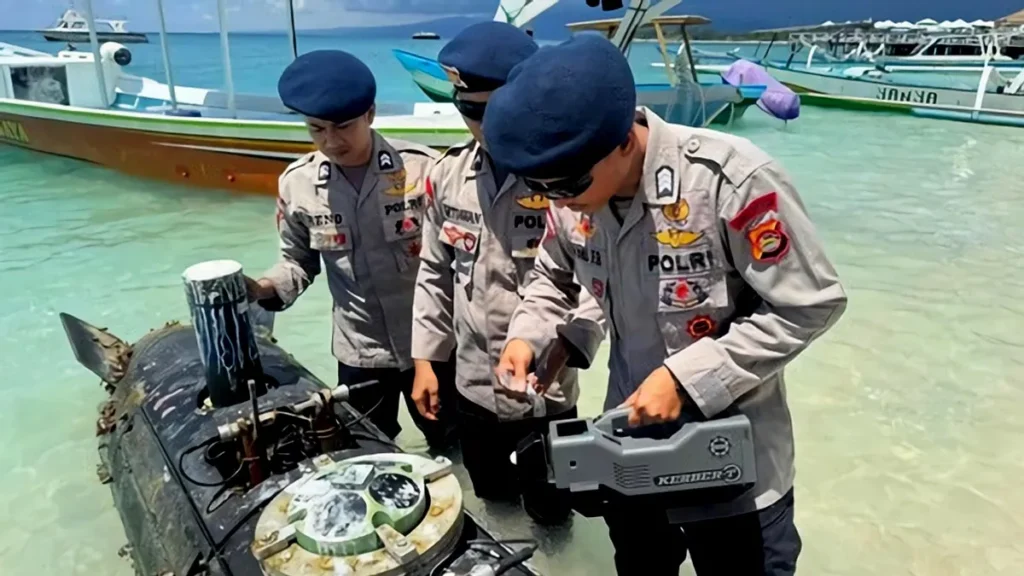
GILI TRAWANGAN, Indonesia — A large, torpedo-shaped object drifting off the coast of Gili Trawangan triggered a familiar reaction in Indonesian waters: suspicion.
Within hours of its discovery, images of the object spread across social media. Its cylindrical shape, metallic body, and visible Chinese characters fueled speculation—ranging from unexploded ordnance to foreign surveillance equipment operating in Indonesian territory.
By Tuesday, authorities moved to contain the narrative.
Police confirmed that the object posed no threat. It was neither an explosive device nor radioactive material, but a scientific instrument designed to measure ocean currents.
“The examination shows that the object is not a bomb, explosive material, or radioactive. It is a device used to measure sea water currents at certain depths,” said Kombes Mohammad Kholid, spokesperson for West Nusa Tenggara Police.
A Discovery at Sea—and a Rapid Escalation Online
The object, measuring approximately 3.7 meters in length and 70 centimeters in diameter, was first spotted by a local fisherman, Arianto, on Monday.
He was fishing roughly 16 kilometers north of Gili Trawangan when he noticed the unusual structure floating in open water.
Uncertain of what he had found—and wary of the potential danger—he brought the object ashore and reported it to authorities.
What followed was a rapid escalation—not in the water, but online.
Photos of the device circulated widely, with particular attention drawn to the Mandarin text printed on its surface. In a region where maritime boundaries, foreign vessels, and underwater activity often intersect with geopolitical sensitivities, the speculation was immediate.
What the Device Actually Is
According to police, the object is an oceanographic instrument used to measure underwater currents and environmental conditions.
Devices like this are typically deployed for marine research, climate monitoring, or navigation studies. They are often attached to buoys or anchored to the seabed, collecting long-term data on water movement, temperature, and pressure.
“It is usually installed on buoys or on the seafloor,” Kholid said.
How the device became detached—and how long it had been drifting—remains unclear.
Authorities have handed it over to the Mataram Naval Base (Lanal Mataram) for further examination. No official statement has been made regarding its ownership, origin, or the institution responsible for its deployment.
Why the Reaction Matters
The object itself may be benign. The reaction it triggered is more revealing.
Southeast Asia’s waters are among the most contested and closely monitored in the world. Scientific instruments, commercial vessels, and military assets often share overlapping space—sometimes indistinguishably to the public eye.
In that context, the presence of unidentified equipment—particularly with foreign markings—can quickly shift from curiosity to concern.
The speed of that shift has only accelerated in the age of social media.
What might once have been a localized incident—a fisherman reporting an unusual object—became a regional conversation within hours, shaped as much by speculation as by fact.
Authorities, in this case, responded quickly to clarify. But the episode underscores a broader dynamic: information now travels faster than verification.
What This Means for Travelers in Bali and the Gilis
For tourists visiting Bali and the nearby Gili Islands—known for diving, snorkeling, and open-water activities—the incident does not pose any safety risk.
The waters remain open. No restrictions have been issued.
But the event offers a subtle reminder of the environment travelers are entering.
These are not isolated resort zones. They are active maritime spaces—used for fishing, research, and international transit.
Occasionally, those worlds intersect in unexpected ways.