


































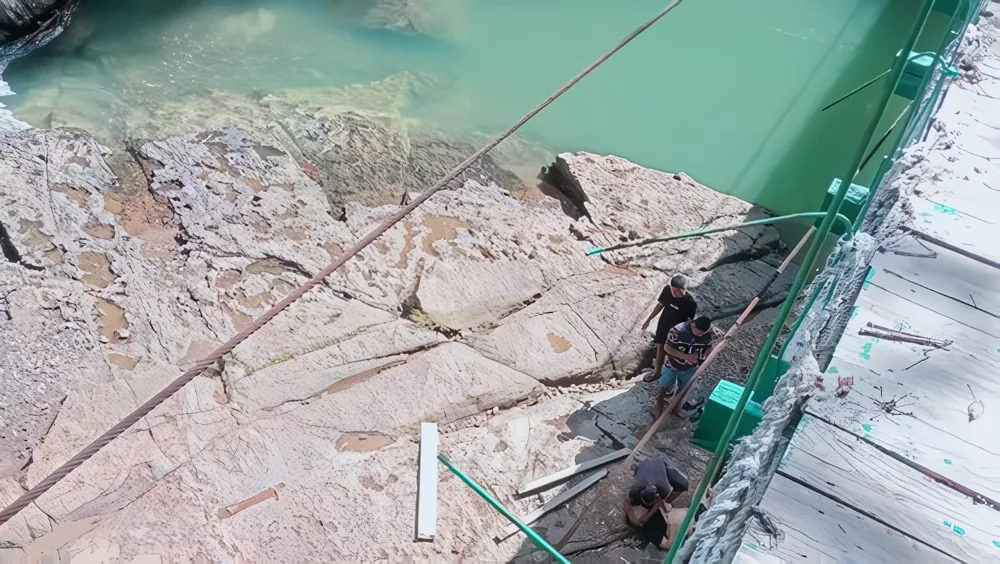
Two Austrian tourists died Sunday after falling through a suspension bridge at a popular waterfall site near Labuan Bajo, raising new concerns about safety standards at remote tourism destinations across Indonesia.
The victims, identified as Jurgen Perjul (55) and Astrid Perjul (57), fell approximately 20 meters onto rocks below the bridge at Cunca Wulang Waterfall on May 24, 2026.
Authorities have not yet officially confirmed the relationship between the two victims, though local officials said they are believed to have been traveling together.
The suspension bridge, constructed with wooden planks and stretching roughly 50 meters across a steep valley, serves as the primary access route to the waterfall, one of the region’s better-known inland nature attractions.
Photographs from the scene show a visible hole in part of the bridge’s flooring, suggesting the victims may have fallen through a damaged section while crossing.
Both tourists were discovered on rocks beneath the bridge and later evacuated to Komodo Regional Hospital in Labuan Bajo.
Peter A. Rasyid, head of West Manggarai’s Tourism, Creative Economy, and Culture Agency, confirmed the deaths on Sunday but said authorities are still gathering complete details surrounding the incident.
“The tourists are from Austria,” Peter said by phone. “We are still collecting complete information regarding the incident.”
He added that further details would be released as the investigation continues.
Questions Over Safety Standards
The deaths have renewed attention on infrastructure safety at remote tourism sites across eastern Indonesia, where suspension bridges, trekking routes, and viewing platforms are often exposed to heavy tropical weather conditions but may receive inconsistent maintenance.
Unlike the heavily promoted marine tourism sector surrounding Komodo National Park, inland attractions such as waterfalls and forest trekking routes typically operate with far less international scrutiny despite receiving growing visitor numbers.
For many foreign travelers, structures built from wood and local materials can appear scenic or rustic without clearly signaling potential structural risk.
At destinations like Cunca Wulang, where visitors cross narrow suspension bridges above rocky valleys and fast-moving water, even minor structural failures can become fatal.
The incident may also increase pressure on local authorities to inspect similar tourism infrastructure across the region, particularly as Labuan Bajo continues positioning itself as one of Indonesia’s priority international tourism destinations.
A Tourism Destination Under Global Attention
Labuan Bajo has become internationally recognized as the main gateway to Komodo National Park and the habitat of the world’s last Komodo dragons.
In recent years, Indonesia has invested heavily in promoting the region as a premium tourism destination aimed at attracting higher-spending international visitors through nature, adventure, and marine tourism.
But the deaths of two foreign tourists at one of the area’s inland attractions now place attention on a different issue: whether tourism infrastructure outside the main tourism corridors is keeping pace with the region’s rapid growth in international arrivals.
For now, Cunca Wulang remains open to visitors while authorities continue investigating the incident.
But on a suspension bridge above a remote valley in eastern Indonesia, a damaged section of flooring has turned one of Labuan Bajo’s scenic nature routes into the site of an international tragedy — and left two families in Austria waiting for answers from thousands of miles away.


















Comments 1