


































Angered by a proliferation of hotel-owned jetties marring the seascape, legislators in West Manggarai demand accountability. The controversy echoes a familiar tension for Bali, where coastal aesthetics and public access are increasingly contested.
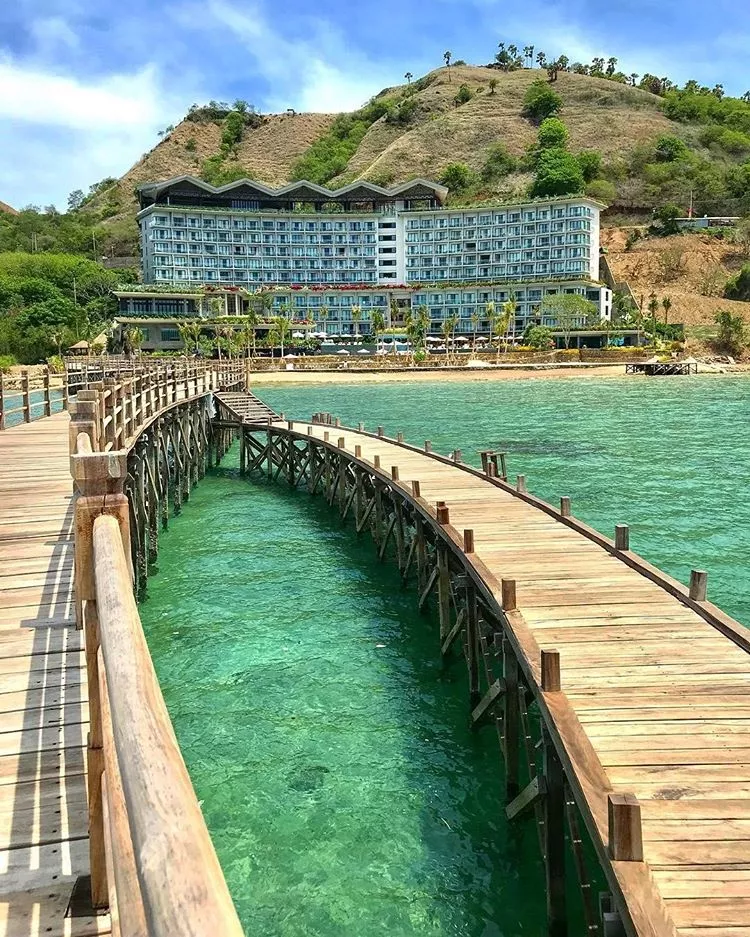
LABUAN BAJO, West Manggarai — There is a pink dock somewhere in the waters of Labuan Bajo. There is a blue one, too. They extend from five-star resorts like private fingers reaching into the Flores Sea, designed for the exclusive embarkation of guests bound for Komodo’s dragons.
But to Silverius Sukur, a member of the West Manggarai Regional Legislative Council, they represent something else entirely: an eyesore, and a regulatory failure.
“These piers are ruining the aesthetic order of our sea views,” Sukur declared during a public hearing with the Port Authority (KSOP) Class III Labuan Bajo on Tuesday, February 10, 2026. His frustration was palpable. “Pink docks, blue docks—nearly every hotel on the shoreline has one. We don’t know if these piers emerged through KSOP’s collaboration or authority. But what is clear is that they are everywhere.”
A Question of Jurisdiction
Sukur’s interrogation cuts to the heart of a broader governance question now echoing across eastern Indonesia: Who authorized the steady privatization of the archipelago’s most scenic waterways?
KSOP Head Stephanus Risdiyanto offered a procedural defense. He explained that such structures require a suite of permits: a Coastal Waters and Marine Space Utilization Permit (PPKPRL) from the Ministry of Maritime Affairs and Fisheries, environmental approvals from the Ministry of Environment, and appropriate business licenses
Yet the gap between regulation and reality has proven cavernous. Investigative reporting and advocacy groups have documented that for years, many of Labuan Bajo’s hotel-owned jetties operated in a legal twilight—some without Terminal for Self-Interest (TUKS) permits, others without environmental impact assessments . As recently as August 2024, KSOP confirmed that only two resorts in the region—Ayana Komodo Resort and Ta’aktana Luxury Collection Resort—had properly registered their private terminals.
From Manggarai to Bali: A Shared Predicament
For readers in Bali, this controversy carries an unsettling familiarity. The island has spent much of the past decade grappling with its own version of the same dilemma: the quiet enclosure of the commons.
In Badung, spatial planning authorities have demolished structures violating coastal setback regulations. In Karangasem, an excavator recently razed a beachfront building whose owner ignored three warning letters and could not produce land certificates. In Denpasar, the provincial government is drafting a land conversion regulation that Governor I Wayan Koster has vowed to enforce with “cleaning” actions.
The through-line is unmistakable. From the Bukit cliffs to the bays of Labuan Bajo, Indonesia’s premier marine tourism destinations are experiencing a regulatory reckoning. The question is no longer whether development will occur, but under what terms—and for whose benefit.
The Deeper Grievance: Aesthetics as Proxy
The complaint about “ruined aesthetics” is, upon closer reading, a proxy for deeper anxieties. Sukur’s interrogation of KSOP’s authority reflects a suspicion that has crystallized among local stakeholders: that the proliferation of private infrastructure has outpaced the public’s ability to audit it.
This suspicion is not unfounded. In 2025, the Corruption Eradication Commission (KPK) conducted a surprise inspection of 69 Resort & Beach Club on a small island near Labuan Bajo, revealing that the four-star property lacked both an environmental impact assessment (Amdal) and a tax registration with the local government . It was, in effect, operating in a parallel legal universe.
Earlier that same year, residents of Labuan Bajo reported being denied access to Binongko Beach by hotel security—a flashpoint that prompted DPRD member Hasanudin to declare that “there is no such thing as a private beach” .
For Investors: A Warning Disguised as Dialogue
For the international investors, expatriates, and hospitality developers who form part of Hey Bali News’ readership, the Labuan Bajo hearing offers a case study in shifting regulatory tides.
What is being contested in Manggarai Barat is not investment itself. Sukur and his colleagues have not called for the demolition of hotels or the expulsion of capital. What they are demanding is legibility: the ability to see, understand, and verify whether private infrastructure has passed through the proper gates of authorization.
The dock that appears overnight without public notice; the jetty that extends without a registered permit; the beachfront restaurant that operates without confirmed PPKPRL—each represents a small erosion of the social contract between tourism capital and the communities that host it.
An Advisory for Bali’s Coastal Developers
As Bali enters what appears to be a sustained cycle of regulatory enforcement—from coastal setback demolitions in Karangasem to the Governor’s pending land conversion regulation—developers would be prudent to internalize the Labuan Bajo precedent.
Here, distilled, is the emerging doctrine of Indonesia’s marine tourism governance:
- Permits are not optional. PPKPRL, TUKS, Amdal—these acronyms are not bureaucratic theater but binding prerequisites. Operating without them invites not only retrospective sanction but reputational exposure.
- The horizon is public. The view of the sea, like the sea itself, remains a collective asset. Infrastructure that degrades that asset without demonstrable public benefit will increasingly attract scrutiny.
- Community access is non-negotiable. Whether in Binongko or Bingin, the presumption is that coastlines belong to the citizenry. Private use is a privilege conditioned on continued public access.
- Enforcement cycles intensify. What was tolerated during the investment acceleration phase may be prosecuted during the consolidation phase. Past forbearance is not future guarantee.
The View from the Shore
There is, perhaps, a more elemental way to frame this. The pink dock that so offended Silverius Sukur’s sensibilities is not inherently objectionable. It is a structure, nothing more. What makes it controversial is its cumulative effect: dozens of such structures, each claiming a small piece of the horizon, gradually transforming a shared seascape into a collage of private claims.
For Bali, which has watched its own coastlines undergo a similar transformation over two decades, the Labuan Bajo controversy is a mirror. The question being asked in Manggarai Barat—who authorized this, and on whose behalf?—is the same question increasingly being asked in Badung, Gianyar, and Tabanan.
The answer, in both places, will determine not only the aesthetic character of Indonesia’s marine tourism destinations but the very terms of their social sustainability.