
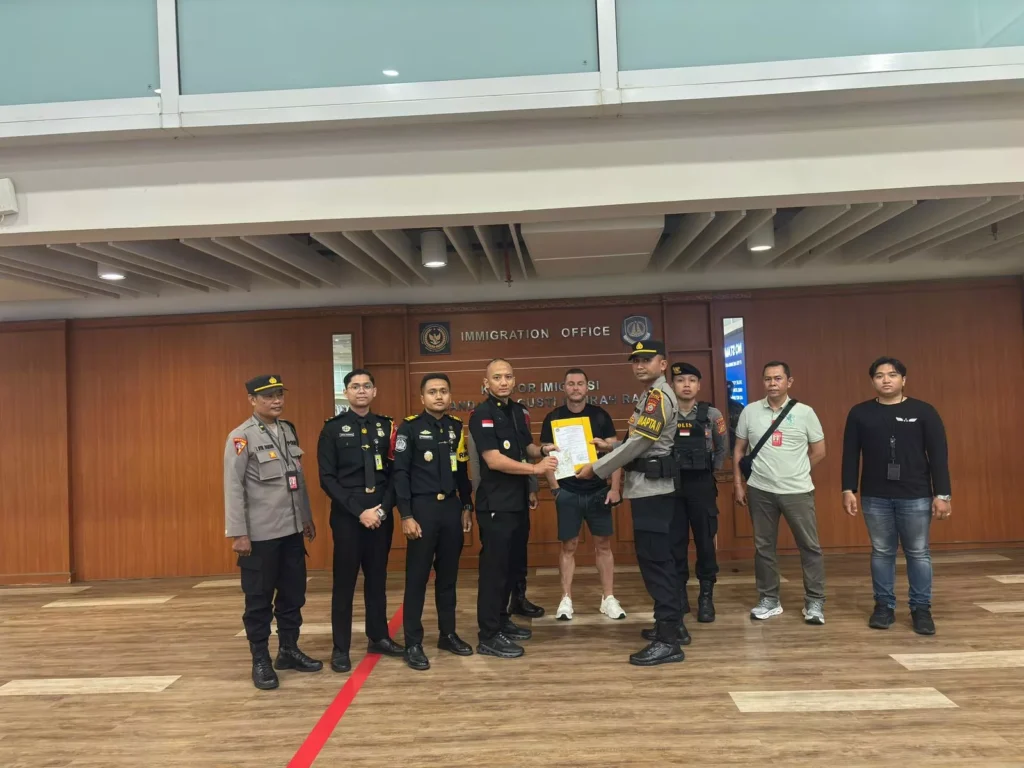
DENPASAR, Bali — When a 45-year-old man stepped off a flight from Singapore at Bali’s international airport, he appeared, at first glance, like any other traveler arriving on the island. He wore casual clothes, carried a backpack, and passed through immigration—until the system flagged his name.
Within moments, Indonesian authorities detained him.
The man was Steven Lyons, a Scottish national long associated with organized crime networks in Europe. His arrest in Bali was not incidental. It was the result of an international alert—an Interpol Red Notice—that had followed him across borders.
Now, his capture is drawing attention not only for who he is, but for what his presence in Bali reveals about the movement of global crime.
A Quiet Arrival, A Coordinated Arrest
Lyons was detained on March 28 at I Gusti Ngurah Rai International Airport after arriving from Singapore. Immigration officers identified him through an integrated system that connects Indonesian border control with international law enforcement databases.
He was immediately handed over to local police and is expected to be transferred to Jakarta, where Indonesia’s National Central Bureau (NCB) of Interpol will take over the case.
Officials say the arrest sends a clear signal.
“Bali will not be a safe haven for international fugitives,” said immigration authorities, emphasizing the effectiveness of coordinated monitoring systems.
Who Is Steven Lyons?


Steven Lyons is widely reported to be a senior figure within the Lyons crime clan, a group historically based in Scotland and linked to long-running conflicts with rival criminal organizations.
For more than two decades, the Lyons group has been associated with violent rivalries, particularly with the Daniel crime group in Glasgow. The feud has included shootings, targeted killings, and retaliatory attacks that have extended beyond the United Kingdom.
Lyons himself survived a shooting in Glasgow in 2006—an attack that killed his cousin. In the years that followed, he relocated across borders, spending time in Spain and later in Dubai.
Authorities believe that his operations evolved alongside these moves.
A Network That Crossed Borders
Investigators suspect Lyons was not merely a participant, but a coordinator within a broader international network. Indonesian immigration officials have described him as a figure linked to the management of shell companies and money laundering operations.
His connections reportedly extended to transnational crime networks, including links to groups operating out of Dubai and southern Europe.
At one point, he was believed to be in Bahrain. Before that, he had reportedly been detained in Dubai. In the weeks leading up to his arrest in Bali, his whereabouts were unclear.
Then he resurfaced—unexpectedly—on a commercial flight into Indonesia.
Violence, Alliances, and a Long-Running Feud
The broader context of Lyons’ network is shaped by sustained conflict.
In May last year, his brother, Eddie Lyons Jr., was shot dead alongside another associate in Spain. The killing took place in a beachside bar in Fuengirola, underscoring how the violence linked to these networks has spread beyond the UK.
Spanish authorities later linked the attack to rival criminal elements, while investigators across Europe continued to track connections between individuals, financial flows, and coordinated operations.
A Wider Investigation Already Underway
Law enforcement agencies across multiple countries—including Scotland, Spain, and partners in Europe—have been conducting coordinated operations targeting organized crime networks tied to the Lyons group.
These investigations have resulted in dozens of arrests and asset seizures across several jurisdictions.
Authorities say the work has involved years of intelligence gathering, cross-border cooperation, and coordination through agencies such as Europol.
The arrest in Bali is now part of that broader effort.

Why Bali Matters in This Case
For Bali, the arrest carries symbolic weight.
The island is globally known as a tourism destination, not a node in international criminal networks. Yet its accessibility—open borders, high mobility, and global connectivity—also makes it a potential transit point.
This case illustrates a broader reality: global crime moves through the same channels as global travel.
What distinguishes this incident is not that a fugitive arrived—but that he was identified before he could disappear again.
What Happens Next
Lyons is expected to be transferred to Jakarta before further coordination with international authorities determines the next legal steps, which may include extradition.
Authorities in Europe, particularly Spain, are believed to have an interest in the case.
For now, the process remains procedural.
But the implications are larger.
This was not just an arrest at an airport. It was the interception of a figure tied to a network that operates across continents—captured at the moment when global mobility intersected with global enforcement.
And in that intersection, Bali became, briefly, part of a much larger story.