
JAKARTA — It began, as many digital crises do, with something small and easily overlooked.
A photo. A sentence. A platform built for speed.
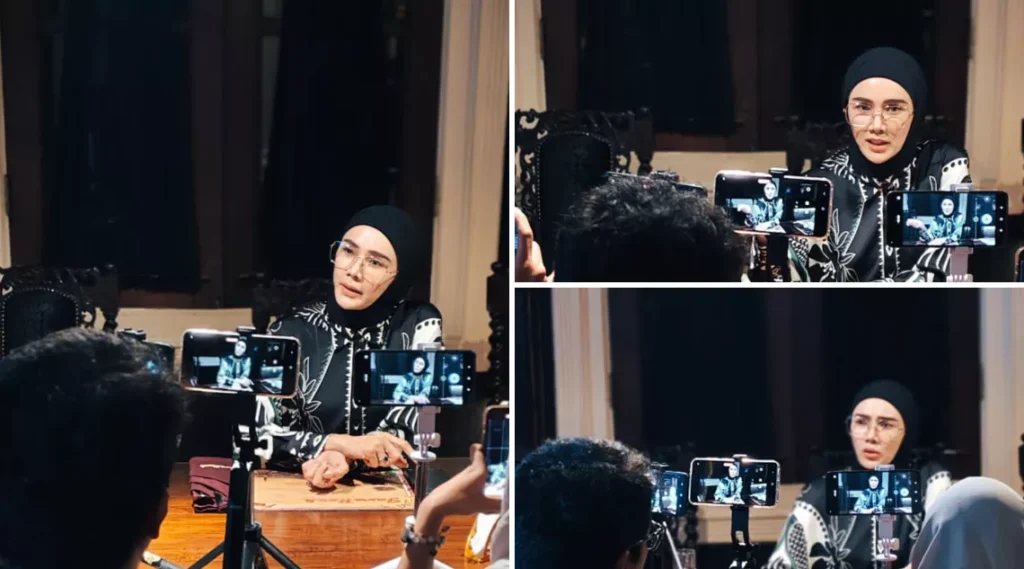
On March 26, at Dewa 19’s Javarock venue in Kemang, South Jakarta, Mulan Jameela spoke calmly about a controversy she never intended to be part of. Days earlier, after attending a quiet iftar gathering, she had noticed something unusual.
Her social media had changed.
The comments were sharper. More personal. Strangers were confronting her about a statement she did not remember making.
“I was confused,” she said. “Why were people saying I had spoken about teachers?”
The quote was everywhere: Teachers must improve their quality, don’t just demand higher salaries.
There was only one problem.
She had never said it.
How a Hoax Is Made—and Moved
The false quote did not emerge from a speech, an interview, or a recording. It appeared instead in a TikTok post—her image paired with text designed to look like a statement.
On its own, the post was unremarkable. It drew modest engagement.
But misinformation rarely depends on virality at the source. It depends on migration.
Screenshots traveled. The post was lifted, reframed, and redistributed across platforms—particularly Instagram, where context is often thinner and reactions faster.
By the time the quote reached a wider audience, it no longer needed proof.
It had already found belief.
The Speed of Accusation
Within hours, the narrative hardened.
Teachers, one of the most respected professional groups in Indonesia, became the unintended audience of a message that was never delivered. Colleagues in parliament began asking questions. Organizations sought clarification.
Jameela posted denials—twice.
But in the architecture of social media, correction rarely travels at the same speed as accusation.
“Even after I clarified, there were still people who didn’t believe it,” she said.
This is not unusual. In digital ecosystems, the first version of a story often becomes the most durable—regardless of whether it is true.
Why False Quotes Work
Fabricated quotes occupy a particular niche in the misinformation landscape.
They are simple. Shareable. Emotionally charged.
And, crucially, they attach themselves to recognizable figures—people whose public visibility makes the claim feel plausible, even in the absence of evidence.
In Indonesia, where public discourse is deeply shaped by social media and where respect for professions like teaching runs high, the impact is amplified.
A single sentence can create friction between a public figure and an entire community.
And once that friction exists, it is difficult to reverse.
A System Built for Spread, Not Verification
The trajectory of the hoax reflects a broader pattern.
Misinformation no longer stays within a single platform. It moves—adapted to each environment it enters.
TikTok generates the seed. Instagram amplifies the reaction. Messaging apps carry it further, often stripped of origin.
By the time it reaches its widest audience, the question is no longer whether it is true—but whether it feels true.
And feeling, in digital spaces, often outruns fact.
The Cost of a Sentence That Was Never Spoken
For Jameela, the damage was not only reputational. It was relational.
“I don’t want my relationship with teachers to be affected,” she said. “My children have teachers. I respect them.”
Her response was measured: clarification without confrontation.
Her husband, musician Ahmad Dhani, reportedly suggested a more aggressive approach. She declined.
“I don’t want conflict,” she said. “I just want the truth to be clear.”
But clarity, in these cases, is rarely immediate—and never guaranteed.
A Broader Pattern in the Digital Age
Jameela’s experience is not unique. It is part of a wider shift in how information circulates.
In the past, public statements were mediated—filtered through interviews, press conferences, or recorded appearances.
Today, attribution is fluid.
Anyone can generate a quote. Anyone can assign it. And once it enters circulation, the burden of proof shifts—from the accuser to the accused.
This inversion changes the dynamics of public discourse.
Silence can be interpreted as confirmation. Denial can be dismissed as damage control.
And truth becomes something that must compete—not only with falsehood, but with speed.
What the Incident Reveals
The episode highlights several structural realities:
Misinformation does not need to originate at scale—it only needs to be transferable.
False attribution is effective precisely because it bypasses verification.
Corrections are slower, less visible, and often less emotionally compelling than the original claim.
And once a narrative forms, it tends to persist—even when disproven.
In such an environment, credibility is not only built—it must be defended, repeatedly.
The Real Lesson
For Jameela, the takeaway is simple.
“Don’t be easily influenced by hoaxes,” she said.
But the lesson extends beyond individuals.
In a digital ecosystem where information is abundant but verification is optional, responsibility does not rest solely with those who create content—but also with those who share it.
Because sharing is not neutral.
It is a form of participation.
The Bottom Line
Mulan Jameela never told teachers to stop demanding higher salaries. She never made the statement that sparked the backlash.
But in the time it took to clarify that fact, the narrative had already spread—reshaping perception, provoking reaction, and creating a conversation she never intended to start.
That is the nature of modern misinformation.
It does not ask permission.
It does not wait for evidence.
And once it moves, it is already ahead.