



































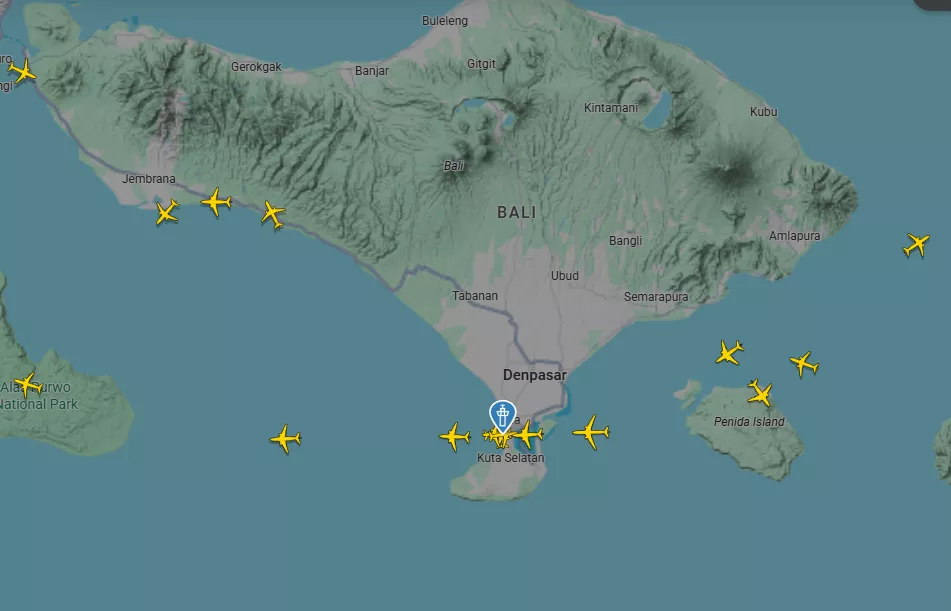
DENPASAR, Bali — Severe weather sweeping across Bali on Saturday, December 27, 2025, caused significant disruption to air travel at I Gusti Ngurah Rai International Airport, with six inbound flights forced into holding patterns and five others diverted to alternate airports.
Communication & Legal Division Head of the airport, Gede Eka Sandi Asmadi, confirmed the operational impacts in a written statement. The six aircraft placed in airborne holding patterns included flights originating from Melbourne (2), Perth, Labuan Bajo, Abu Dhabi, and Bengaluru.
“Additionally, five airlines decided to divert their landings to Lombok (2) and Surabaya (3),” Eka Sandi stated, as reported by Detik Bali.
The disruption began in the morning as intense rainfall, accompanied by lightning and strong winds, enveloped the airport area. The adverse conditions necessitated extended separation between aircraft for landing, creating a backlog. Airport and airline authorities emphasized that the delays and diversions were proactive safety decisions.
“Landing arrangements are made by the airlines to maintain the safety of flights and passengers,” Eka Sandi explained. “Currently, some of these flights have already landed. In general, flight operations and passenger services are running normally, smoothly, and under control.”
The incident underscores the direct impact of the extreme weather warnings issued for Bali by the Meteorology, Climatology, and Geophysics Agency (BMKG). The agency had forecast moderate to heavy rain with lightning and strong winds across multiple regencies, including Badung—where the airport is located—from late morning through early afternoon.
For the thousands of international travelers and expatriates transiting through Bali, this event serves as a real-time reminder of the challenges posed by the tropical wet season.
Practical Implications for Travelers:
- Expect Delays: During periods of severe weather in Bali, arriving and departing flights are highly susceptible to delays, cancellations, or diversions. Travelers should monitor their flight status closely through airline apps.
- Build in Buffer Time: When planning essential connections or events upon arrival in Bali, allowing for several hours of potential delay is prudent during the December-March rainy season.
- Understand Safety Protocols: While inconvenient, airborne holds and diversions are standard international safety procedures to avoid hazardous landing conditions like poor visibility, wind shear, and hydroplaning on wet runways.
Airport operator PT Angkasa Pura I stated that intensive coordination with air traffic control (AirNav Denpasar), airlines, and the BMKG is ongoing to manage operations safely. While the immediate disruption is being resolved, the situation highlights the vulnerability of global travel networks to localized extreme weather, even at a major international hub like Bali.















Comments 1