

Denpasar, Bali – For the first time in recent memory, a major Asian nation has issued a formal security alert explicitly warning its citizens about crime risks in Bali — a destination long marketed as safe, spiritual, and serene.
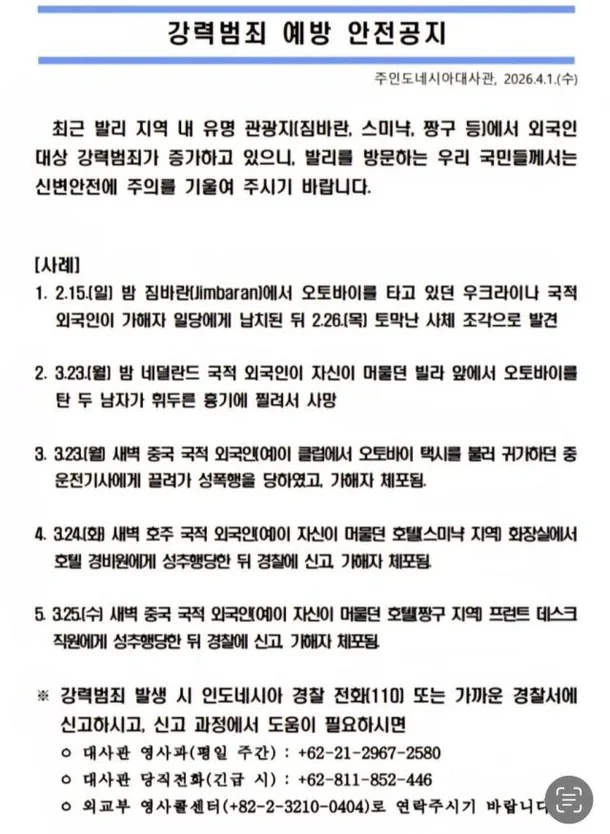
On April 1, 2026, the South Korean Embassy in Indonesia published an official notice titled “Security Warning on the Prevention of Serious Crime.” The message was unambiguous: Korean citizens visiting Bali should pay close attention to their personal safety.
The reason was equally direct. According to the embassy, serious crimes targeting foreign tourists have increased in key destinations — Jimbaran, Seminyak, and Canggu.
These are not peripheral zones. They are the core of Bali’s global tourism brand.
The warning was later reported by Chosun.com and picked up by Indonesian media, quietly turning what might have been a routine diplomatic notice into something more consequential: a signal that Bali’s international perception may be shifting.
The Governor’s Response: “Enough.”

When Bali Governor Wayan Koster was approached by journalists following a plenary session at the provincial parliament on April 6, there was an expectation of clarity.
A response. A reassurance. At minimum, an acknowledgment.
Instead, there was a single word.
“Cukup.”
Indonesian for “Enough.”
Pressed further — whether the warning risked damaging Bali’s global image, whether rising crime against foreign tourists was becoming a serious concern — the Governor repeated the same word and walked away.
“Cukup.”
No elaboration. No mitigation. No visible urgency.
For a leader known for assertive positions on environmental policy, cultural preservation, and tourism regulation, the brevity stood out. Not as restraint — but as refusal.
A Different Tone from Tourism Officials
If the Governor chose silence, Bali’s tourism office chose normalization.
I Wayan Sumarajaya, head of the Bali Tourism Agency, described the warning as a routine precaution.
“This is normal,” he said. “It is the responsibility of a country to remind its citizens to remain cautious.”
He added that coordination with security authorities would be strengthened to ensure a safer environment for visitors.
It was a measured response. But also a revealing one.
Because what is “routine” in diplomatic language does not always feel routine on the ground — especially when a warning singles out specific locations within one of the world’s most visited islands.
What the Warning Actually Signals
The South Korean Embassy did not provide statistics. It did not list cases. It did not assign blame.
But it did something more powerful: it named places.
Jimbaran. Seminyak. Canggu.
These are not abstract zones. They are Bali’s economic engine — where beachfront dining, luxury villas, and global lifestyle culture intersect.
When those names appear in an official foreign security warning, the message is not just about crime. It is about confidence.
And confidence, in tourism, is currency.

Not an Isolated Signal
On its own, a travel warning can be dismissed as precaution.
But placed alongside a growing stream of viral incidents, theft reports, and rising unease among expatriate communities, it begins to resemble something else: a pattern.
Not yet a crisis — but no longer noise.
For global readers, tourists, and long-term residents, the question is no longer whether Bali is “safe” in absolute terms. No major destination is.
The question is whether the risks are increasing — and whether they are being acknowledged with the seriousness they require.
What This Means for Travelers and Expats
For those planning to visit Bali, the warning does not suggest cancellation. It suggests awareness.
High-traffic tourist zones remain active and functional. But the embassy’s notice indicates a perceived rise in serious crime — a category that typically includes robbery, assault, and other high-impact incidents.
Without detailed local data, perception becomes the reality travelers respond to.
And perception, once shifted, is difficult to reverse.
A Leadership Test
Bali has faced crises before — from terrorism to natural disasters to a global pandemic. Each time, recovery was driven not only by resilience, but by communication.
Clear, visible, and often immediate.
This moment is different.
Because the challenge is not a single event, but a question of trajectory.
When a foreign government issues a formal warning about crime, the response is not simply about defending image. It is about demonstrating control, transparency, and accountability.
Silence, in that context, is not neutral.
It creates space — for speculation, for doubt, for narrative drift.
The Path Forward
The tourism office has promised coordination. Law enforcement presence may increase. Systems may adapt.
But for international audiences, what matters is not internal action alone — it is visible assurance.
Tourists do not expect zero risk.
But they do expect acknowledgment when risk is formally raised by another government.
They expect leadership to speak.
And when the world is watching, what is not said can carry as much weight as what is.
Bali has built its reputation on trust — not only in its beauty, but in its sense of safety.
When that trust is publicly questioned, the response cannot be a single word.
Because in a global tourism economy, silence is not just absence.
It is a signal.