
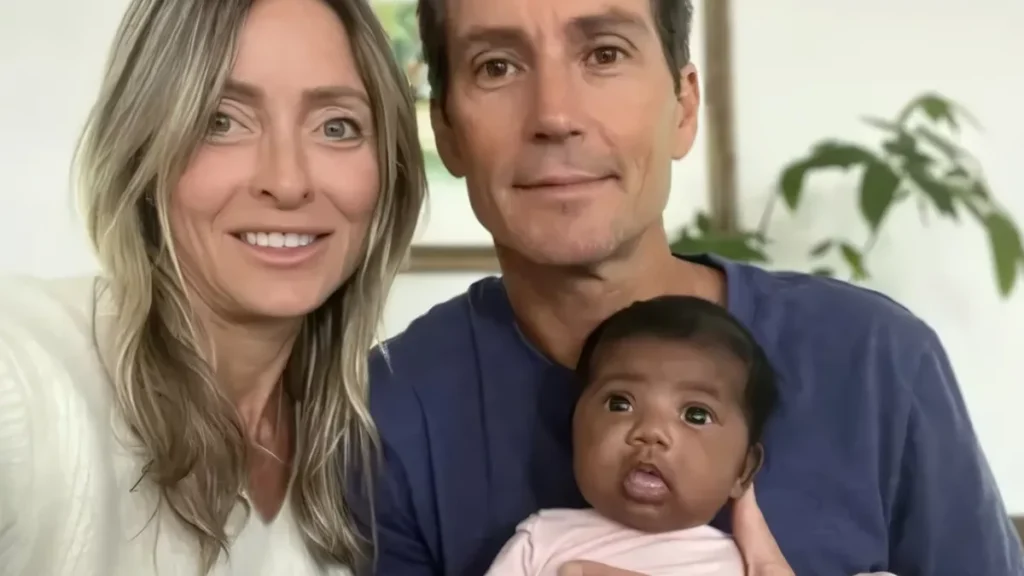
ORLANDO, Florida — When Tiffany Score gave birth to a baby girl in December 2025, she knew something was wrong almost immediately.
The child she had carried for nine months did not resemble either her or her husband, Steven Mills.
At first, the Florida couple tried to dismiss their concerns. But as questions mounted, DNA testing revealed a devastating truth: the baby they had welcomed into the world through in vitro fertilization (IVF) was not biologically theirs.
What followed was a legal and emotional battle that has captivated families, fertility experts, and parents around the world—and raised troubling questions about how one of modern medicine’s most celebrated technologies can sometimes go catastrophically wrong.
Now, months later, the couple has finally received the answer they had desperately hoped for.
A court has ruled that the little girl they call Shea will remain with them permanently.
A Birth That Sparked Unthinkable Questions
For Tiffany and Steven, the journey toward parenthood had already been difficult.
Like millions of couples worldwide struggling with infertility, they turned to IVF, placing their trust in a fertility clinic and the sophisticated systems designed to ensure embryos are handled with precision and care.
Tiffany underwent treatment at the Fertility Clinic of Orlando in April 2025.
Months later, on December 11, she delivered a healthy baby girl.
But almost immediately, the couple noticed physical characteristics that seemed impossible to explain. Both Tiffany and Steven are white. Their daughter appeared to have entirely different ethnic origins.
The questions were painful.
The answers were even more shocking.
Genetic testing confirmed that Shea shared no biological connection with either parent.
Instead, investigators later determined that the embryo implanted during the IVF process belonged to another family entirely.
When Biology and Parenthood Collide
Cases involving IVF mix-ups are exceedingly rare, but when they occur they create some of the most complex legal and ethical dilemmas in modern medicine.
Who is the child’s real parent?
The people whose DNA created the embryo?
Or the people who carried, delivered, nurtured, and loved the child from birth?
For Tiffany and Steven, the answer had never been complicated.
“One thing remains true today just as it was the day our daughter was born,” the couple previously said in a public statement. “We will always love her and always be her parents.”
The biological parents were eventually identified in April 2026.
What could have become a bitter custody battle instead took an unexpected turn.
After discussions between both families, the biological parents agreed that Shea should remain with the couple who had raised her since birth.
The court later formalized the arrangement, granting Tiffany and Steven permanent legal custody.
A Case That Raises Bigger Questions
While the custody dispute has now been resolved, the broader controversy is far from over.
The couple has filed legal action against IVF Life Inc. and fertility specialist Dr. Milton McNichol, alleging negligence and seeking answers about how the embryo transfer error occurred.
Perhaps even more troubling, they say they still do not know what happened to their own biological embryo.
That unanswered question continues to haunt the family.
For fertility specialists, the case highlights the immense responsibility carried by clinics entrusted with creating families.
IVF has helped bring millions of children into the world and transformed countless lives. Yet incidents like this demonstrate that even highly regulated medical systems remain vulnerable to human error.
Defining Family in the Modern Age
Beyond the courtroom and the medical investigations, the story of Tiffany, Steven, and Shea has resonated because it touches something deeply human.
It challenges conventional definitions of parenthood.
The couple did not share DNA with the child they fought to keep.
Yet they were the ones who attended doctor’s appointments, prepared the nursery, endured sleepless nights, and celebrated every milestone.
In the end, the court’s decision reflected a reality many parents already understand: family is not defined solely by genetics.
Sometimes, it is defined by love, sacrifice, and the people who choose to stay.
For Tiffany and Steven, the legal battle may finally be over.
But the questions raised by their extraordinary story—about technology, trust, and what truly makes a parent—are likely to endure far longer.