
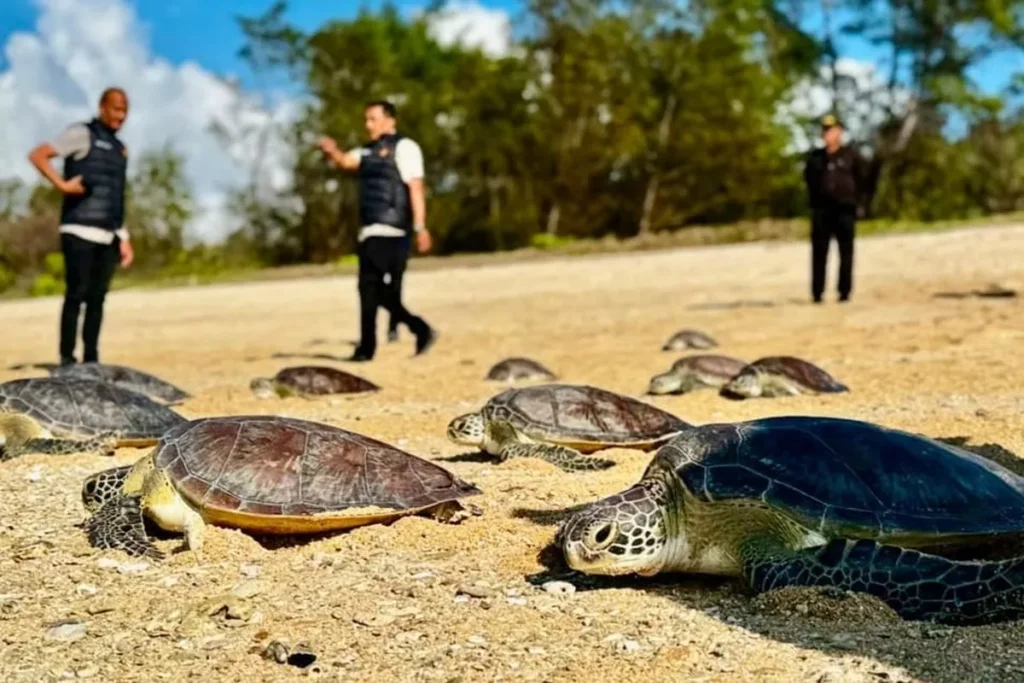
The rescued turtles spent a month recovering from injuries before being released into the protected waters of Serangan, highlighting Bali’s ongoing fight against wildlife trafficking.
DENPASAR, Bali – Twenty-one endangered green sea turtles have been returned to the ocean after surviving an illegal wildlife trafficking operation, offering a rare conservation success in Bali’s continuing battle against the black market trade in protected marine animals.
The turtles, all Green Sea Turtles (Chelonia mydas), were released Tuesday at Serangan Beach within Bali’s Kura Kura Special Economic Zone (KEK) after completing nearly a month of rehabilitation following their rescue by Bali Police’s Marine and Air Unit.
For conservationists, the release represented more than the return of rescued animals to the sea.
It was another reminder that despite Bali’s international reputation as a tropical paradise, illegal wildlife trafficking remains an ongoing threat to some of Indonesia’s most iconic marine species.
“The location was carefully selected with animal welfare in mind,” said Getreda Melsina Hehanussa, Head of the Denpasar Marine Management Office under Indonesia’s Ministry of Marine Affairs and Fisheries.
“Transporting the turtles over long distances could have placed additional stress on their health, so we chose a release site close to the rehabilitation centre.”
The turtles had been rescued in the coastal waters of Gerokgak, in Bali’s northern Buleleng Regency, before being transferred to the Turtle Conservation and Education Center (TCEC) in Serangan on June 11.
According to I Wayan Indra Lesmana, Chairman of the Turtle Conservation and Education Center, turtles rescued from illegal trade often arrive with severe injuries caused by the methods used by traffickers.
Many have holes or deep wounds in their front flippers after being tied with ropes during capture and transport.
“We provide intensive treatment until their wounds heal completely,” Lesmana said.
“Only after our veterinarians confirm that they have recovered, are free from dehydration, and are physically fit do we release them back into the wild.”
Wildlife authorities say protecting rescued turtles does not end with rehabilitation.
Selecting a safe release location is equally important to reduce the risk of the animals being captured again.
According to AKBP Nanang Pri Hasmoko, Head of Law Enforcement at Bali Police’s Marine and Air Unit, Serangan Beach was chosen because of its protected coastal environment and regular security patrols.
“This area is one of Bali’s important turtle nesting habitats,” Nanang said.
“It is also well protected, reducing the risk of irresponsible individuals attempting to capture the turtles again after their release.”
Police say they continue to intensify operations against turtle smuggling networks operating around Bali’s coastline, where green sea turtles remain a target of illegal wildlife trade despite decades of conservation efforts.
Under Indonesian law, Green Sea Turtles are a protected species, and capturing, transporting or trading them is illegal.
For many visitors, spotting a sea turtle while diving or snorkelling is one of Bali’s most memorable wildlife experiences.
Conservationists say each successful rescue helps protect not only an endangered species but also the fragile marine ecosystems that support Bali’s biodiversity and sustainable tourism.
Tuesday’s release was therefore more than a symbolic moment.
It marked another small victory in the effort to ensure that Bali’s sea turtles remain where they belong — in the ocean, not in the illegal wildlife trade.