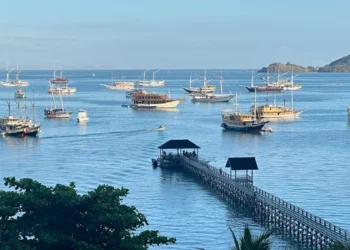








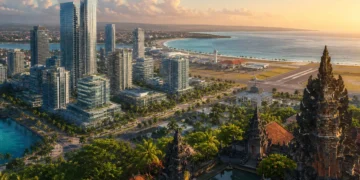























For decades, Bali’s skyline has remained unusually low.
Temples dominate horizons instead of towers. Palm trees often rise above rooftops. In many parts of the island, mountains remain visible from streets, villages, beaches, and rice fields.
That visual identity did not happen by accident.
For nearly half a century, a building height limit of around 15 meters has shaped development across much of Bali, helping preserve one of the world’s most recognizable tourism landscapes.
Now that limit is being challenged.
A proposal by a regional legislative committee to allow buildings up to 45 meters in selected tourism zones, including areas such as Nusa Dua and parts of Sanur, has triggered a growing debate over development, identity, and what kind of island Bali wants to become.
“This is not simply about investment and construction,” said I Nyoman Kenak, chairman of Bali’s Parisada Hindu Dharma Indonesia (PHDI).
“It concerns the purity and identity of Bali itself.”
More Than A Zoning Debate
Supporters of taller buildings argue the logic is straightforward.
Land in southern Bali has become increasingly scarce and expensive. Tourism demand continues to grow. Higher buildings, proponents argue, could reduce urban sprawl while allowing development to happen more efficiently.
The argument is economic.
Build upward rather than outward.
Critics argue the consequences may be larger than economics alone.
According to PHDI, Bali’s low skyline is not simply a planning decision but part of a broader cultural landscape shaped by Balinese Hindu philosophy.
Tri Hita Karana, the philosophy frequently referenced in discussions about Balinese spatial planning, emphasizes harmony between people, nature, and spiritual life.
From that perspective, taller buildings raise questions extending beyond architecture.
They raise questions about relationships between sacred spaces, landscapes, and the visual identity that has shaped Bali for generations.
“We are not rejecting development,” Kenak said.
“But Bali’s uniqueness is its primary attraction.”
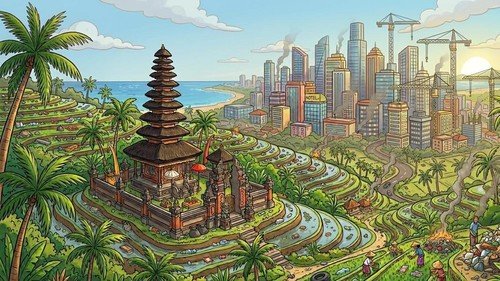
The Economic Argument Meets Cultural Limits
The proposal arrives at a time when investment pressure across Bali continues increasing.
Areas such as Canggu, Seminyak, and Uluwatu have experienced rapid growth during the past decade, with rising land values pushing development into increasingly dense areas.
Supporters of reform argue existing restrictions may unintentionally encourage horizontal expansion that consumes agricultural land and creates additional infrastructure pressures.
Opponents question whether vertical expansion solves those problems or simply creates different ones.
For cultural organizations and community leaders, concerns extend beyond what taller buildings look like.
They also concern what additional density may require.
Water.
Road capacity.
Waste systems.
Electricity.
Public infrastructure.
“We are discussing clean water, traffic congestion, and waste management,” Kenak said.
Why The Coconut Tree Matters
Bali’s height restrictions are frequently associated with a principle that buildings should not exceed the height of a coconut tree.
The policy itself emerged during the governorship of Ida Bagus Mantra between 1978 and 1988 and gradually became one of the island’s defining planning principles.
The result is a skyline that looks noticeably different from many tourism destinations competing for similar visitors.
That difference has also become part of Bali’s economic value.
Luxury resorts market open horizons.
Developers sell views.
Visitors photograph temples against mountains rather than towers against highways.
This helps explain why even relatively technical discussions about zoning rules often become emotionally charged.
Changing height restrictions may alter more than skylines.
It may alter expectations of what Bali is.
Is Compromise Possible?
Despite strong criticism, PHDI has not completely rejected the possibility of change.
Kenak said discussions could continue if supported by rigorous cultural and ecological studies and if protections for sacred spaces remain intact.
That leaves Bali facing a familiar tension.
How does an island dependent on tourism continue expanding without changing the characteristics that made it attractive in the first place?
No final decision has been made.
But the debate itself reflects how much pressure Bali now faces.
Because the question is no longer simply whether development should continue.
It is how much change an island can absorb before it begins changing what people came for.